Despite its somewhat foreboding title and subject matter, this Nanci Griffith song is upbeat and fun to play. “I Wish It Would Rain” was released by MCA in 1988 on Nanci’s 6th album titled “Little Love Affairs.” I hope you enjoy listening to the song as much as I enjoy playing it. I’m including a video of Nanci Performing in the late 1980’s. Just look at her beautiful smile. Here’s my cover.
Here’s another song, written by Paul Kennerly and made famous by Emmylou Harris, called “Heaven Only Knows.” The song was released on Emmylou’s 1989 album, “Bluebird.” The song reached #16 on the Hot Country Music Chart.
Since I’m a newcomer to the Country Music Scene, I’d never heard of Paul Kennerly before. He’s an Englishman who has written 30 published Country Music songs. (I guess there are stranger things that abound in our world). I don’t recall Kennerly’s name being mentioned in connection with any of the songs I’ve covered here. Be that as it may, he has written two powerful songs that Emmylou Harris has brought to my attention. I covered the other song, “Born to Run,” in my previous blog.
“Heaven Only Knows,” as performed by Emmylou and her band, features a driving beat, compelling lyrics, and the recording artist’s beautiful, singular voice.
While searching for a video of Bruce Springsteen playing his iconic hit “Born to Run,” I stumbled upon a video of Emmylou Harris singing “Born to Run.” Now, here’s the fascinating surprise: Emmylou is singing an entirely different song written by Paul Kennerly. And this song really rocks. Released in 1982 as the second single from Harris’ album Cimarron, “Born to Run” reached number 3 on the Billboard Hot Country Singles & Tracks chart.
Emmylou Harris sings like an Angel. She is a Country Music Hall of Fame inductee. I put Emmylou into my Hall of Fame alongside other Angels by the names of Eva Cassidy, Nanci Griffith, Linda Ronstadt, and Kate Wolf.
“Long May You Run” is written by Neil Young. The song came alive for me when I heard Emmylou Harris and her band perform it. Now in her seventies, Emmylou is still beautiful and sings like an angel, as attested to in the video I’ve included.
After hearing Miss Harris’ version of the song, I began listening to many of her other reels on YouTube. She is a consummate, unique performer, not to mention beautiful. Emmylou’s music has remained consistently excellent throughout her forty-year career. Willie Nelson is quoted as saying, “There are two types of people in this world…those who love Emmylou and those who have not met her.”
Harris has released more than twenty-five albums. She was inducted into the Country Music Hall of Fame in 2008 and earned a Lifetime Achievement Award in 2018.
The Beatles have produced a motherload of work in the thirteen* albums they released. Within their massive discography, there are bound to be songs that the band members liked or disliked in varying degrees. Lennon and McCartney wrote “It’s Only Love” in 1965. The song is about a difficult relationship that is ultimately worth it because, after all, “It’s Only Love,” and that’s the way it often goes.
I was surprised to learn that John Lennon thought the song was “pure rubbish,” meaning that it was only a filler song created to feed the hounds of commerce. Paul McCartney had a more optimistic view: “Sometimes we didn’t fight it if the lyric came out rather bland on some of those filler songs like ‘It’s Only Love.’ If a lyric was really bad, we’d edit it, but we weren’t that fussy about it because it’s only a rock ‘n’ roll song. I mean, this is not literature.”
Most fans, like myself, can relate to the song, finding the lyrics acceptable and the melody beautiful.
Here’s my cover.
*The number of Beatles Albums varies by country from twelve to seventeen. Thirteen Beatles Albums were released in the United States.
Jackson Browne has always been a brilliant lyricist, singer, guitarist, and songwriter. I have enjoyed playing many of his songs on this blog. All of them are my favorites, and “Enough of the Night” is no exception.
Written when he was turning forty, Browne originally thought he was writing about someone else, until he realized that “Enough of the Night” was about himself. He had grown tired of a destructive lifestyle that mostly involved drugs (Cocaine). He decided the time had come for a change, and Browne writes about it poignantly in his lyrics. Listen closely, and you’ll see what I mean. “Enough of the Night” is also reminiscent of Jackson’s sister, but that’s another story entirely.
The Jackson Browne song “You Love the Thunder” is about a musician and a lover who joins him on tour, a thread that underlies many of the songs on Browne’s album, Running on Empty. The album explores life on the road from performances, to backstage, hotel rooms, and relationships with band members and audiences. The lyrics of “You Love the Thunder” suggest that while Browne’s lover may not always enjoy the difficult aspects of a musician’s life on the road, they are irresistibly drawn to the excitement of the lifestyle and the passion that runs through it like a vein of valuable ore. The line, “To be a woman in love with a man in search of the flame,” exemplifies the central meaning of the song: the enduring, though sometimes challenging, love for someone driven by a passionate, and likely spiritual quest.
When the Eagles were a struggling group in Los Angeles, they noticed many beautiful women married to older, successful men. It posed the question: Were these women happy or unhappy? One night, while drinking in their favorite bar, they spotted a beautiful young woman. Alongside her, a fat, old, rich guy sat drinking. They were chatting, and apparently a couple. Glen Frey, the group’s leader, commented, “Look at her. She can’t hide those lying eyes.” The Eagles realized they had a great idea for a new song. They began to write the lyrics right then and there.
The song tells an in-depth story about women who have taken the easy way out by marrying for money alone. While the song is entirely fictional, it has an incontrovertible ring of truth. Maybe that’s why Lyin’ Eyes reached number 8 on the Country Chart. It is the only Eagles song to become a top 10 Country hit.
“Glenn Frey and Don Henley wrote this song together, and Frey sang lead. Along with “Desperado,” it was one of two songs they came up with in the first week that they started writing together. The songs formed the basis of the Eagles’ second album, with Frey and Henley comparing the life of a cowboy to that of a musician. “Tequila Sunrise” shows the transient nature of each lifestyle, as the singer falls for a woman who just wants to use him and move on. The theme didn’t immediately connect with the buying public, but the songs and the album stood the test of time.” *
Cat Stevens wrote “The First Cut Is The Deepest” when he was eighteen. At the time, he had no intention of becoming a worldwide star performer. He sold the song for thirty pounds to P.P. Arnold, a soul singer who lived near him in London. She released “The First Cut Is The Deepest” on her first album. It reached #18 on the U.K. charts in 1967. Eventually, Rod Stewart and Sheryl Crow covered the song, making it a major hit in America.
Stevens released his version of the song on his debut album, New Masters. Because he never released “The First Cut Is the Deepest” as a single, the album went largely unnoticed.
Despite his shyness, Stevens’ songwriting and singing burst through to make him an international star in the music industry. I’m using Stevens’ version in my cover.
In this song, (Yusuf) Cat Stevens is singing to a woman he yearns for in a Human form. On another level, he may be singing, aware or unaware, to the Divine Feminine. In either case, the object of Stevens’ love is unattainable in the present. Yet, I believe, that the admirer (Stevens) continues to yearn for his beloved in the hope that he will, one day, meet his perfect love, in either or both Human and Divine forms. There are many interpretations of “How Can I Tell You.” In my view, the song is hopeful rather than despairing.
However one interprets “How Can I Tell you,” I feel that the song is filled with incredible beauty that cannot help but shine through.
And thank you, Yusuf Islam (Cat Stevens), for your always beautiful, wise, and inspiring music.
An entertaining glimpse into the future of AI captured in a riveting story across space and time.
World Book Awards Gold Medalist—Science Fiction: Crime & Mystery
World Book Awards Gold Medalist—Science Fiction: Romance
The AndroBiotica Adventures chronicles the futuristic life and times of Derrick Faulk, an agent, investigator, and explorer surrounded by a rare breed of extraordinary friends and associates. Consider this your invitation to slip into enthralling, imaginary worlds and experience dangerous missions of the utmost importance. The novel combines the first two books in the series in an upgraded format to keep readers immersed from the beginning to the shattering climax. Start your journey today.
“Replete with engrossing subjects and considerations that make it highly recommended for sci-fi readers.”
Diane Donovan—Senior eBook Editor—Midwest Book Review
“David Gittlin’s ANDROBIOTICA 2: Journey in Time offers an intriguing and timely tale of artificial intelligence and corporate intrigue. The novella is a fun read with an interesting take on the mechanics of time travel—something very difficult to accomplish these days.”
Many of Yusuf/Cat Stevens’ songs convey underlying messages about childhood and the relationships between children and adults, such as ‘Father & Son’ and ‘Oh Very Young,’ to name a few. “Where Do the Children Play?” is no exception. It becomes increasingly timely with each passing day, given the environmental crisis we are facing.
The song refers to the destruction of natural spaces caused by overdevelopment and industrialization. It asks a fundamental question: What future awaits our children when the spaces where they play are increasingly paved over and polluted?
“Where Do The Children Play” prompts us to consider the inherent features of the ‘progress’ we are making, as well as Humanity’s impact on planet Earth. Essentially, this beautiful and simple song begs for a balanced relationship between Human Beings and nature.
Typical of a Cat Stevens song, the rhythm is quite unique. Here’s my cover.
“Father and Son” is a song about the age-old story where the father’s vision for his son does not align with his son’s dreams for the future. Cat Stevens refurbishes the story with his unique and beautiful phrasing in the lyrics and melody.
It has taken me some time to warm up to this song due to the violent rift I had with my father regarding my future. My Dad passed away in 2006, and now, in my older years, I can see and appreciate the opportunities he gave me. I am at peace with the relationship, and I am inspired by my father’s accomplishments.
You might think this song pertains to Cat Stevens’ struggles with his father, but that is not the case. His father owned a Greek restaurant, and like all fathers, wanted his son to join the business. Stevens, of course, had vastly different ideas. Wisely, his father never stood in the way of his son’s dreams.
Stevens wrote this song, imagining a Russian father and son differing about the son’s future. “Father and Son” was originally planned as part of a stage play. The project never saw the light of day. Stevens eventually released the song on his “Tea for the Tillerman” album.
Far from old age, Cat Stevens wrote “Oh Very Young” when he was twenty-five. The wisdom in the song surpasses Stevens’ chronology with lines like, “You’re only dancin’ on this Earth for a short while.” Stevens contracted tuberculosis when he was nineteen, and it almost killed him. After that experience, Stevens kept an eye on the Big Picture.
Always the explorer, Stevens sought the meaning and purpose of life, as illustrated in his songs like “On the Road to Find Out.” He eventually converted to Islam in 1977. Around the same time, he permanently left the world stage as a singer and songwriter. In his relatively short career, Cat Stevens left us with a body of music that is still relevant today and, to millions around the world, extremely enjoyable.
Originally, I played this song using a picking method, and then I switched to strumming. I watched a video of Stevens performing the song with a strumming method. I thought, I’ll never be able to play it that fast. To my amazement, I wound up playing the song as fast as Stevens when I strummed it. Interesting. Here’s my cover.
In case you’re interested, here’s the finger-picked version.
Well, here we go again–another Jackson Browne song. I tried not to do it, but when no songs came flying into my head, I went to Jerry’s Guitar Bar for inspiration. And there it was–a brand new Jackson Browne lesson. I just couldn’t resist.
“Somebody’s Baby” is reminiscent of a fifties Rock and Roll song. Only, it’s much better. Like they always said on American Bandstand, “It has a good beat.” For “Somebody’s Baby, the beat is better than just “good.” The song has a driving, get-up-and-dance beat. The lyrics are also clever, as is customary for any Jackson Browne song, and the melody is captivating.
Now, here’s the rub. “Somebody’s Baby” is atypical of a Jackson Browne song. The only reason he wrote it is because his friend, Cameron Crowe (Jerry Maguire), asked him to write it with Danny Kotchmar for Crowe’s film, Fast Times at Ridgemont High. Kotchmar wrote the framework for the song, and Browne finished and recorded it for the movie.
Jackson Browne tried to distance himself from the song because he felt it was “too commercial.” But too many people liked it, and Browne eventually recorded the hit song on one of his albums. Here’s the man himself playing the song.
An entertaining glimpse into the future of AI captured in a riveting story across space and time.
World Book Awards Gold Medalist—Science Fiction: Crime & Mystery
World Book Awards Gold Medalist—Science Fiction: Romance
The AndroBiotica Adventures chronicles the futuristic life and times of Derrick Faulk, an agent, investigator, and explorer surrounded by a rare breed of extraordinary friends and associates. Consider this your invitation to slip into enthralling, imaginary worlds and experience dangerous missions of the utmost importance. The novel combines the first two books in the series in an upgraded format to keep readers immersed from the beginning to the shattering climax. Start your journey today.
“Replete with engrossing subjects and considerations that make it highly recommended for sci-fi readers.”
Diane Donovan—Senior eBook Editor—Midwest Book Review
“David Gittlin’s ANDROBIOTICA 2: Journey in Time offers an intriguing and timely tale of artificial intelligence and corporate intrigue. The novella is a fun read with an interesting take on the mechanics of time travel—something very difficult to accomplish these days.”
Kara Dennison for IndieReader
“David Gittlin takes sci-fi to a new level!”
Courtnee Turner Hoyle—Readers’ Favorite
Available in eBook, Paperback, and AudioBook formats on or about August 25, 2025
Willie Nelson made “Always On My Mind” one of his signature songs. Upon hearing the song for the first time, Nelson knew that he wanted to add “Always On My Mind” to his repertoire. Several recording artists, including Elvis Presley, released the song unsuccessfully. When Nelson recorded it in 1982, the song became a smash hit. Nelson’s sensitive rendition made the song a top 5 hit and a Grammy nomination.
Wayne Carson wrote “Always” as an apology to his wife when he was working in a recording studio in Memphis and stayed ten days longer than he expected to. When Carson called his wife to tell her that he had to stay in Memphis longer, she let him have it. To make his wife feel better, Carson told her she was “always on his mind.”
“It just struck me like someone had hit me with a hammer,” Carson told the LA Times. “I told [my wife] real fast I had to hang up because I had to put that into a song. ‘Always’ is about one long apology. I guess there are a lot of people in the world who are looking for a way to say [what the lyrics express] in a song.”
“Always On My Mind” popped into my head from out of nowhere. Coincidentally, I’ve been hearing it at the gym where I work out, but after the fact. I’ve decided that it’s a reminder from the cosmos to appreciate my loyal wife of thirty-six years. Here’s my cover played in Nelson’s style.
This song is about a man who gives up his dreams to live a life of routine monotony due to the crushing necessity of earning a living.
In a 1997 interview with Mojo magazine, Browne said of this song: “I’m a big fan of ambiguity and its bountiful rewards, and ‘The Pretender’ is two things at once. It’s that person in all of us that has a higher ideal, and the part that has settled for compromise, like Truffaut says, there’s the movie you set out to make, and there’s the one you settle for. But in a more serious sense, ‘The Pretender’ is about 1960s idealism —the idea that life is about love, brotherhood, justice, social change, and enlightenment. These concepts were prevalent as our generation reached its stride, and later, we settled for something quite different. So when I say ‘Say a prayer for The Pretender,’ I’m talking about those people who are trying to convince themselves that there really was nothing to that idealism.” (excerpt from an article by SongFacts.com)
The boldface type is about a lyric in the song I could relate to most, since I lived through that period: “I want to know what became of the changes we waited for love to bring. Were they only the fitful dreams of some greater awakening?”
Jackson Browne wrote “For A Dancer” in memory of a modern dancer friend who died tragically in a fire. When Jackson’s wife, the model Phyllis Major, died suddenly in 1976, “For A Dancer” mysteriously took on a new meaning. “That’s how songs work,” Brown said in an interview. “They migrate into other parts of your life and other experiences.”
Browne eventually played the song at the funerals of two other celebrity friends. And if one listens to the lyrics closely, “For A Dancer” becomes a larger commentary on the intransience of life itself. We cling to it like a thread, and nothing is certain.
To me, the larger meaning of the song underscores the necessity of using every precious moment wisely. Here’s my cover.
Jackson Browne’s guitar techniques, lyrics, and melodies stand apart from the crowd. What he says through his music is sometimes searing, sad, and occasionally, happy. However, all of Browne’s songs have something in common: an incredible sensitivity and beauty.
Browne wrote “These Days” when he was only sixteen years old. Despite his youth, Browne demonstrated a keen sense of heartbreak. I’m not sure how a sixteen-year-old could feel the depth of emotion and remorse expressed in this song. If we assume Jackson experienced and gave voice to the words and tone of “These Days,” then he was wise beyond his years and deeply rooted in himself from early on.
The song had its first release when a protégé of Andy Warhol named Nico picked it up on her “Chelsea Girl” album. Brown played acoustic guitar in the background. “These Days” gained wider recognition when several artists subsequently covered it.
Brown eventually released his version of the song in 1973 on the album “For Everyman.” He rewrote “These Days” to make it more optimistic. In his own words, Jackson remembers, “Over the rest of my teenage years and into my 20s, I developed a kind of optimism, a kind of resoluteness, so I changed [one verse] to: ‘I’ll keep on moving, keep improving.’ That’s more to me what life is made of, the idea that I’ll get through this, I’ll continue looking.”
I’ve always wanted to play this song the way Jackson Browne does. Thanks to my friend Jerry Lambert, I can now do it. Here’s my cover.
Writer and adventurer Jacob Casell, his lovely Astronomer wife Amy, and their brilliant but moody AI friend, Arcon, are at it again. Joined by new crew members, the trio embarks on a training mission in preparation to chauffeur a group of world leaders around the solar system to impart perspective and promote peace. As is often the case, their intentions are honorable, but the results are disastrous.
While parked in orbit around the swirling clouds of Jupiter, four alien freighters appear to siphon off enough of the planet’s gaseous atmosphere to cause a gravity imbalance. The intrepid Aneleyan Starcruiser, which Amy and Jacob have named ‘the Dauntless,’ will be devoured and crushed by Jupiter’s gravity unless the crew can escape orbit.
Find out what happens next in this extraordinary adventure that will keep you on the edge of your seat and guessing until the very end.
AlthoughReturn to Aneleya is the fifth book in the Silver Sphere Series, there is enough background included in the story to orient new readers and allow them to enjoy the novella as a stand-alone offering, and arouse enough curiosity to pick up the earlier editions.
Return to Aneleya is available in eBook and AudioBook editions on Amazon.com and Quality Online Retailers Worldwide.
Reviewed by K.C. Finn for Readers’ Favorite
“Return to Aneleya by David Gittlin transports readers back into the Silver Sphere universe with a thrilling space adventure that’s equal parts danger and charm. When Jacob Casell, his wife Amy, and their AI companion Arcon embark on a routine mission, things go off the rails fast. Alien freighters are harvesting Jupiter’s atmosphere, the Dauntless is nearly destroyed, and diplomacy quickly turns into a fight for survival.
“Despite the stakes, this installment balances high-concept sci-fi with accessible storytelling, witty dialogue, and strong emotional beats. And while it’s technically book five, the story stands solidly on its own, introducing its stakes and characters in a way that welcomes new readers to the galaxy.
“Author David Gittlin blends smart sci-fi ideas with a warm, character-focused heart. I enjoyed how much fun this book was—it didn’t just throw me into danger, it gave me a crew I wanted to root for. Arcon, the AI, brings just the right touch of humor and logic to balance the very human tensions between Jacob and Amy. The pacing is fast but not rushed, and the imaginative settings that go from deep space to the swirling chaos near Jupiter really drew me in. Even the politics were interesting without bogging the plot down.
“Overall, Return to Aneleya is an exciting, thoughtful, and thoroughly entertaining space opera for anyone who loves adventure with a human (and artificial) touch. I wouldn’t hesitate to recommend it, and I can’t wait to see what else comes out of this fascinating story universe in the future.”
I first heard “Cornflower Blue” as the opening song on Kate Wolf’s 1983 double album “Give Yourself to Love.” As I listened to the album many times over, “Cornflower Blue” grew on me (no pun intended). I began to appreciate the exquisite beauty in the lyrics and in Kate’s lovely singing voice.
Oftentimes, songs like this one will find their way into my heart and I feel compelled to play them myself. With this song, I had my doubts. The chances were good that I might not pull it off. Learning how to play “Cornflower Blue” like Kate does was like learning how to walk again. The style is completely counterintuitive to what I’m used to, but I’m glad I made the effort. I hope my cover of the song conveys some of the mystery and beauty of the original.
“Pluck” is the word that comes to mind when I think of Nanci Griffith and her music. In terms of stature, Nanci can be described as diminutive, or perhaps petite is a better, if overused, description. Ironically, the essence of Nanci Griffith is anything but small. She imbued her songs with a crystal clear, powerful voice and confident stage presence. In her simple way, Griffith is remembered as a giant among country and folk singer/songwriters. With twenty-four albums released from 1978 to 2002, Griffith has left a lasting impression on an art form she once described as “folkabilly.” Nanci’s music merges the elegant folk of her early years with the folk-rock of her later years.
I’ve covered many of Nanci’s songs on this blog, including this latest, “Trouble In The Fields.” It’s a penetrating and beautiful song inspired by Griffith’s recollections of her great-grandparents’ struggles with drought and hard economic times during the 1930s. “Trouble In The Fields” is dedicated to Nanci’s great aunt and uncle, Nettie Mae and Tootie, farmers for eighty years near Lubbock, Texas.
In a 2009 interview, Cat Stevens (by then Yusuf Islam) is quoted as saying: “I was on holiday in Spain. I was a kid from the West End [of London]- bright lights, etc. I never got to see the moon on its own. In the dark, there were always streetlamps. So there I was on the edge of the water on a beautiful night with the moon glowing, and suddenly I looked down and saw my shadow. I thought that was so cool; I’d never seen it before.”
The song is about finding hope in any situation, of being present and joyful. With the simplicity and joy of a child, Stevens writes about seeing life as it is in the moment and not comparing it to others’ lives or other times in an individual’s life.
Moonshaw is a beautiful song expressing the idea that every moment in life is rich and unique. Whether we are aware of it or not, Stevens is saying, we are always “leaping and hopping on a Moonshadow” every second of our existence. He cautions against being too wrapped up in our worries and concerns about what could be or what has been, and consequently missing the richness of life as it is.
On a musical tour of the Western United States, Gordon Lightfoot discovered a highway sign that read, “Carefree Highway.” The words on the sign led Gordon to write a song about a carefree lifestyle and a lost love.
Lightfoot put the lyrics away in the glove compartment of his car. Eight months later, Gordon wrote the music for “Carefree Highway” after almost forgetting about the song. Wouldn’t you know that the song became one of Lightfoot’s biggest hits?
Tom Paxton released “The Last Thing On My Mind” in 1964 on his album, Ramblin’ Boy.” The inspiration for the song came from Dave Van Ronk and Bob Dylan’s versions of “He Was A Friend of Mine.” This lost love ballad became one of Paxton’s biggest hits. He is also known for his protest songs against the Vietnam War and other social injustices. (What Did You Learn In School Today?)
“The Last Thing On My Mind” was one of the first songs I learned some forty years ago when I started playing the guitar. This is the first time I’ve released my cover publicly. The themes of the song include friendship, loss, and the passage of time.
John Fogerty wrote “Have You Ever Seen The Rain” about his brother, Tom Fogerty, who left Creedence Clearwater Revival in 1971 at the apex of the band’s popularity. The departure of his brother was a sad time for John.
Eventually, the hurt healed, and the meaning of the song changed. In Fogerty’s own words, “This song was originally written about a very sad thing that was going on in my life. But I refuse to be sad now. These days, this song reminds me of my little girl, Kelsy, and every time I sing it, I think about Kelsy and rainbows.
“Have You Ever Seen the Rain” is another song that emerged unexpectedly from my subconscious. The song bounced around in my head until I played it. Here’s my cover.
Bob Dylan recorded the first version of “Tomorrow Is A Long Time” in 1962. He didn’t release it until 1971 on his “Greatest Hits Album.” Oddly, Ian and Sylvia were the first recording artists to release the song in 1963 on their album “Four Strong Winds.”
The song is about longing for a loved one, specifically Suze Rotolo, who Dylan dated from 1961 to 1964. It is widely believed that another Dylan song, “Girl From The North Country,” is also about Rotolo.
Relationships, and especially love relationships are difficult. Here’s my cover of “I Thought I Was A Child,” a song about the universal search for love and Browne’s admiration of the wisdom of an older woman.
In her brief lifetime, which was cut short by Leukemia, Kate Wolf became a major influence on the folk scene with songs like “Give Yourself to Love,” “Across the Great Divide,” “Green Eyes,” “September Song,” and many more. Kate’s audience has continued to grow since her unfortunate passing. As an example, I found her late in my life. Here’s my cover of “Green Eyes.”
“Girl From The North Country” is another one of those songs that popped into my head from out of nowhere. I can’t decide if it’s a message from the Beyond or just a little piece of my subconscious rising like a sunspot from the deep layers of my skin with aging. Whatever the case, “Girl From The North Country” is one of Dylan’s earliest recorded songs, written in England in 1961 and released in 1963. Listening to it now, I find the ballad enchanting.
As a young adult, I followed Dylan’s work tangentially only because it was prominent in the mainstream. Lately, I’ve developed a deep appreciation for Dylan’s music and the man himself. I’ve covered several Dylan songs in this blog, including “Mr. Tambourine Man,”“My Back Pages,” and now this one.
“Girl From The North Country” is a beautiful ballad recounting a lost love. Many believe the woman in the song is Suze Rotolo. At the time, Dylan had just dropped out of college to pursue his musical career in New York City. Rotolo had just graduated from high school and entered the Greenwich Village folk scene. Their first meeting took place at the First Riverside Church concert in New York City. Dylan described the meeting in his memoir: “Cupid’s arrow had whistled past my ears before, but this time it hit me in the heart, and the weight of it dragged me overboard.”
Eventually, the couple lived together in Greenwich Village and then grew apart when Dylan went to England, and Rotolo went to Italy to continue her education.
After some time passed, Dylan went to Italy to find Retolo. At the same time, Rotolo returned to New York City. The couple finally reunited and lived in Dylan’s apartment until their final breakup.
The album cover of Dylan’s second album, Freewheeling, features Dylan and Rotolo walking arm in arm down a Greenwich Village street.
Born to Jewish Hungarian parents in Brooklyn in 1941, Paul Simon grew up to be one of the foremost musicians of our time. He is best known for his albums with childhood friend Art Garfunkle, but I believe Simon’s solo work is where he really shines.
“American Tune” is a fine example. With its melody, guitar picking, lyrics, and overall artistry, the song comes together as a masterpiece. “American Tune” expresses the recording artist’s political disappointment in the early nineteen-seventies. The nineteen-sixties bloom of racial equality, love, and peace had already blossomed and faded.
While my favorite recording artists continued to produce heartfelt, meaningful, and exquisitely beautiful folk and folk rock music, America’s social and political evolution stalled. With the election of President Richard Nixon in 1972, the glowing hope and ideals of the prior decade receded into the background.
Paul Simon artfully captures the undercurrents of this period in this remarkable song. Despite its melancholy tone, I am deeply moved by the beauty of the words and music.
“American Tune” popped into my head unexpectedly and without warning. It literally came “from out of nowhere.” I think it did because we are about to take another evolutionary backward step under the Trump administration.
Please enjoy my cover of Paul Simon’s moving song.
Nanci Griffith introduced her third album with its title song, “Once in a Very Blue Moon,” on the Austin City Limits TV show in 1984. She sang to a live audience with her typically bold and beautiful voice, which continues to endear this singer/songwriter to millions of people around the world after her passing.
This poignant song could easily sound sad, but not the way Nanci performs it. With her crystal-clear voice, it actually sounds uplifting. A quality comes through Griffith’s songs. It sounds to me like “nothing will ever get me down.” I’m sure Ms. Griffith endured many hardships and obstacles in her life, but she always came out on top. I dedicate my cover to the memory of this inspiring woman.
The Incredible String Band burst onto the folk music scene in 1966 with the release of their first album, aptly named “The Incredible String Band.” As an avid lover and consumer of folk, I had never heard anything like their songs. The band started out as a trio composed of Clive Palmer, Robin Williamson, and Mike Heron. Williamson and Heron composed most of ISB’s music. Palmer eventually dropped out, replaced by other musicians and the girlfriends of Williamson and Heron.
Signed by Electra Records, the group produced seven albums for the label, most notably their first four, which included “The Five Hundred Spirits or the Layers of the Onion” and “The Hangman’s Beautiful Daughter.”
Through intermittent tours and appearances at prestigious venues like the Albert Hall, The Incredible String Band gained worldwide fans and international recognition from their humble beginnings in Edinburgh, Scotland.
Listen to Mike Heron’s lilting, whimsical “Painting Box” to get a sense of The Incredible String Band’s multifaceted musical range. Here’s my cover.
“Against the Wind” is regarded as one of Bob Seeger’s best songs. The lyrics are replete with the songwriter’s reflections on his youth, past relationships, and music career. The metaphor of running against the wind came from Seeger’s high school days, where he ran on the track team.
Seeger created his eleventh album, “Against the Wind,” intending to record hit songs. In other words, the artist wasn’t overly concerned with aesthetics. He wanted to make a commercially viable collection of songs, leaving it up to Capitol Records which ones to release as singles. Along with his Silver Bullet Band, Seeger certainly succeeded.
“Against the Wind” has been described as a bittersweet cross between country and rock music. The song holds an attraction for me as I look back on my life from the perspective of a 75-year-old. I’ve published eleven novels and recorded innumerable songs. Has any of it made a positive and significant impact on the world? Perhaps in a very small sense, the answer is “yes.” But the results have been far below my expectations.
I’m sure we are all, in one sense or another, running against the wind. There are things we turn away from that must be confronted. There are obstacles we must overcome if we are to move forward. Seeger ends this song with a determination to keep running against the wind no matter what it takes. I offer my cover in the same spirit.
Recorded with Audacity software–Absolutely the best free recording software out there.
John Fogerty wrote this song, in part, for his son, Josh. Josh was three years old at the time, and John could barely wait for his son to hear him sing the song on the radio, especially the part that goes: “Doot doot doo lookin’ out my back door.”
In the song’s chorus, a passing parade is mentioned. Fogerty says the lyric is inspired by a Dr. Seuss book he read as a child, “To Think I Saw It On Mulberry Street.”
Some people say the lyric “Won’t you take a ride on the flying spoon” is a reference to cocaine or heroin. Fogrety vehemently denies this. He discouraged drug use by any of his band members, saying drugs interfered with their music and their jobs.
Credence Clearwater Revival gained prominence in the late 1960’s. The band split up acrimoniously in 1972. John Fogerty is still performing as of this writing.
Cat Stevens ( Yusuf Islam) has never publicly said what this song is about, so we are left to offer our own interpretations.
When I read the lyrics, I get a picture of a farmer of indiscriminate age waking up at the crack of dawn and looking out through a window at his fields. At the very instant when the sun rises, there is barely sound. Our farmer reflects back on his youth and how it felt every day to awaken with a song in his heart and the dreams he envisioned to pursue.
The last refrain floated into my head from out of nowhere:
“There’ll be the evening,
In the end,
But ’till that time arrives,
You can rest your eyes,
And begin again.”
The lyrics are beautiful and express the child-like innocence found in many of Cat Stevens’ songs. I interpret this last refrain to mean: Take advantage of and be grateful for every moment you are alive.
Most of the lyrics in “Danny’s Song” were inspired by a letter Kenny Loggins’ brother, Dan, wrote to him in 1968 after Dan’s son, Colin, was born. In the letter, Dan said he planned to marry the boy’s mom, Sheila, and they planned to move to Berkley, California, even though they had no money.
Kenny Loggins wrote the song in 1970 and released it as a single. It went nowhere. Later that year, Kenny teamed up with Jim Messina and released the song on their first album, “Sittin’ In.” Again the song went nowhere. If nothing else, “Danny’s Song” showcased Loggins’ talent for capturing a feeling for a moment in time.
It was not until Anne Murray covered the song and released it as a single in 1973 that it became a hit, reaching #1 in Canada and #7 on the charts in America. The song’s success put Loggins and Messina on the map.
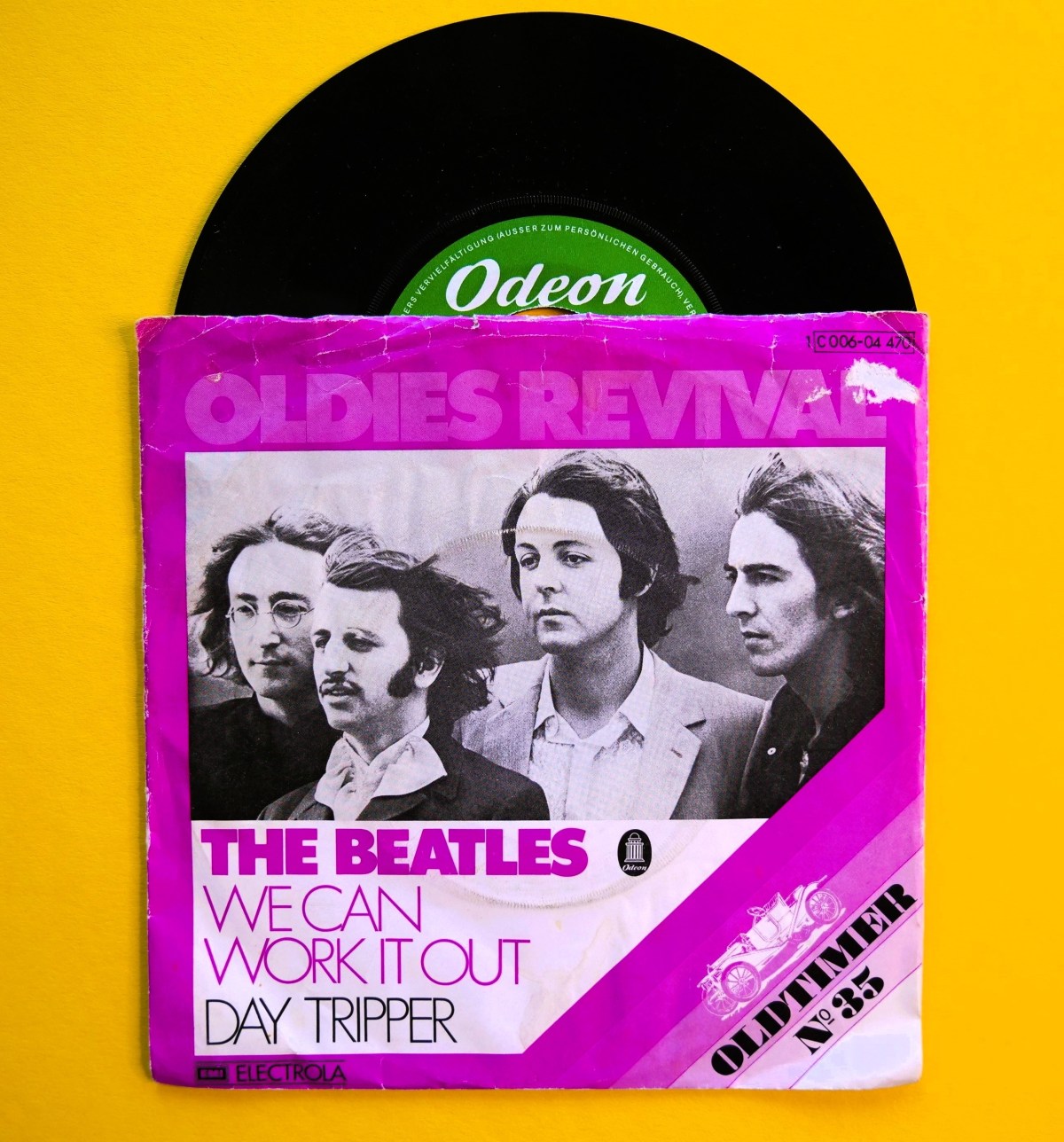
Back in the days when recording artists released singles, “We Can Work It Out” made its debut in 1965. The Beatle’s manager, Brian Epstein, felt that the other song on the record, “Day Tripper,” was more commercial and so, should be the lead song. Typically, the lead song of a single is recorded on the top side (A side) and the other song (B side) goes beneath it. Since both songs became hits, the record turned out to be the first double “A” single ever recorded.
John Lennon and Paul McCartney wrote the song with Paul writing the optimistic verses and John writing the more pessimistic chorus, in this case, the bridge.
The song sprang from a disagreement Paul had with his then-girlfriend, actress Jane Asher. Jane and her mother, Margaret, had a powerful impact on Paul’s life. The couple stayed together for five years from 1963 to 1968.
Cat Stevens’ song “The Boy With A Moon And Star On His Head” is a poetic and mystical tale that expresses themes of love, destiny, and the unknown and unexpected.
The song’s lyrics are replete with metaphors and symbolism, for example, the “holy magnolia” and “naked earth,” which elicit a sense of purity and connection to the universe. Cat Stevens, known for his introspective and spiritual songwriting, uses this narrative to convey a deeper message about the power of love and the unpredictable ways in which destiny unfolds. It is a beautiful story in song, rendered in Stevens’ unique style. Here’s my cover.
Take a Perilous Journey into the Unknown with the Fate of the World on Your Shoulders
GOLD MEDAL WINNER IN THE GLOBAL BOOK AWARDS FOR SCIENCE FICTION: ROMANCE12/28/24
SILVER MEDAL WINNER IN THE GLOBAL BOOK AWARDS FOR SCIENCE FICTION: CRIME AND MYSTERY 12/28/24
After unceremoniously losing his job, Special Investigator Derrick Faulk is summoned by his close friend, Adrien Mattias, a developer of best-in-class nearly human Androids, for a mission that holds the future of their world in the balance. “Time is of the Essence,” as Adrien likes to say, and the clock is ticking.
Go with Derrick and his brilliant associate, Kristina Flemming, AndroBiotica’s Director of Research, for a ride into the future that will keep you guessing until the very end.
AndroBiotica 2 can be read as a stand-alone novella. Take advantage of special introductory pricing at Amazon.com and major online retailers worldwide.Order Your Copy Today!
Kate Wolf’s music conveys Love, Beauty, and a full range of human emotions. “See Here She Says” is a remarkable song because it speaks to children and adults alike with a reminder that the dreams of the Heart are one of the most valuable commodities we own.
“The time that’s left is yours to keep” is a phrase at the end of the chorus of Kate’s song “See Here She Says.” The phrase impacts me powerfully because it is sweet advice to use our time wisely. This is especially true for children, but it is also important for people of all ages to keep in mind.
Each moment that is given to us is precious. Why waste it on foolish pursuits that bear no useful results? Yes, recreation, relaxation, and pleasure are important too, but they are best employed as a balance for the attainment of meaningful goals. And if the motivation to achieve these goals comes from the heart, then the process of manifesting them will surely, for the most part, be enjoyable.
In a truncated life of only forty-four years, Kate Wolf embodied the words of this song. She used her time to create over two hundred songs, performing mostly at venues in her native state of California. Kate’s work has warmed and gladdened the hearts of millions of people around the world. Here’s my cover of “See Here She Said.”
If you’ve been following this blog, then you know I’m a huge fan of Cat Stevens. He produced some of the most iconic and unique music of the 1960s and ’70s. Shortly thereafter, Stevens’ sincere spiritual search led to his conversion to Islam, a surprise to many, including myself. For several decades after his transformation, Stevens, now known as Jusuf Islam, remained musically inert.
During his most productive years, Stevens gave over his immense musical talent to the study and preaching of Islam. Although Stevens says, in his own words, “I’m only trying to help,” I can’t help thinking that the world lost out on a treasure trove of inspiring, educational, and entertaining music
To be fair, I guess I’m just expressing my sour grapes. Everyone has the right to do whatever he or she wants with their life. Stevens believes his conversion to Islam “was meant to be.” It may very well be because Stevens has done a lot for the Arabic world. And he has stayed with his persuasion for almost fifty years. Kudos to Cat…er…Yusuf.
“Hard Headed Woman” celebrates an empowering and life-affirming love. The artist envisions an enriching and fulfilling relationship in which each partner contributes to the other’s growth and happiness. The song reminds us of the importance of finding someone who complements and strengthens us rather than a companion who fits a pre-determined, superficial mold.
“Day Is Done” is a simple song about a clandestine relationship. Since very little has been written about the song, it is difficult to pinpoint its exact meaning. It could be about two married adults having an illicit affair. The lyrics and tone, however, indicate a relationship between two adolescents forbidden by parents or society.
The drawings on the album cover of “Lost Dogs and Mixed Blessings,” where the song is one of the tracks, tend to support the theory of a prohibited young love.
In “Day is Done,” Prine has written a charming little song with universal implications. Many of his songs deal with the intricacies of human relationships and are laced with Prine’s subtle sense of humor. Lost Dogs and Mixed Blessings was John’s fourteenth album. Released in 1995, it is another example of the artist’s exploration of the human condition.
From humble beginnings, John Prine came a long way in his fifty-year career. He won Grammy Awards and was posthumously inducted into the Country and Folk Music Hall of Fame. What struck me, however, is this early recollection of his career. It is taken directly from Prine’s official website:
“Prine still remembers the first three songs he performed on any stage: Sam Stone, Hello in There, and Paradise. With humility, he recalls, “I sang those three songs and people just sat there and looked at me. I thought, ‘Wow, those are really bad.’ They wouldn’t even applaud.”
Things changed dramatically when a young journalist named Roger Ebert dropped into a Chicago folk club for a beer while John was on stage. Ebert wrote a glowing review of Prine’s performance in the Chicago Sun-Times which essentially launched John’s career.
John Prine began his professional career as a mailman in Illinois. He went on to become one of America’s most beloved singers and songwriters. If you are a fan of Folk and Country Music, then you know John Prine. His music was a blend of humorous lyrics about love, life, current events, and songs recounting melancholy tales from his life. Prine was active as a composer, recording artist, live performer, and occasional actor from the early 1970s until his death in 2020 from complications of COVID-19.
“I Remember Everything” was the last song John wrote. Published posthumously, it’s a simple yet moving song looking back on a life well-lived.
Prine may have had a premonition that his life was coming to an end. If that is the case, then “I Remember Everything” is John’s epitaph, which he characteristically wrote himself. Here’s my cover.
Bob Dylan wrote and recorded the original version of “Mr. Tambourine Man,” but The Byrds’ electrified folk-rock version shot it to #1 on both the US and UK charts. The song hadn’t been released when The Byrds learned it from a demo Dylan gave to their manager, Jim Dickson.
Dylan released Tambourine Man in March 1965 on his Bringing It All Back Home album.
What is “Mr. Tambourine Man” about? On the surface, this tambourine man is a wandering musician whose music has captured Dylan under its spell. The song is considered by many to be about drug experiences, with lines like “Take me for a trip upon your magic swirling ship” and “Take me disappearin’ through the smoke rings of my mind.” Phrases like these suggest a marijuana or LSD trip. Dylan is famously close-lipped about explaining his songs, but in his 1985 Biograph compilation album, he revealed that “Mr. Tambourine Man” is not about drugs. Instead, he said the song was inspired by a backup folk musician named Bruce Langhorne, who played a large tambourine in one of Dylan’s recording sessions.
To me, the song’s poetic images are like impressionist paintings. The melody is haunting and mesmerizing. The song stands alone as a true work of art. Here’s my version.
“Ah, but I was so much older then, I’m younger than that now.”
These lyrics and the refrain popped into my head a few mornings ago. This sort of thing has been happening to me frequently these days: Long-forgotten songs resurfacing. It may be a function of the aging process, or it might be the universe talking to me. I kind of hope it’s the latter.
In the 1970s, a group called the Bryds covered a few Bob Dylan songs. They made songs like Mr. Tambourine Man and this one popular. The Bryds’ cover of Mr.Tambourine Man went to number one on the US charts, and their cover of My Back Pages went to thirty. I may have never listened to My Back Pages had it not been for The Byrds. By the way, Roger McGuinn and The Byrds are credited with starting the Folk Rock Revolution. And they inspired Bob Dylan to go electric.
In 1964, Dylan released his fourth album, “Another Side of Life.” Around this time, he began to distance himself from his earlier songs. He claimed his earlier work was not about politics. Instead, it was about universal themes and not individual political issues. In “My Back Pages,” Dylan lambasts himself for his authoritarianism and arrogance.
Moving forward, Dylan’s music focused more on individual consciousness and personal freedom. He is remembered more for his music from 1965-1970 than his earlier work.
To me, the lyrics at the top infer that we tend to think we know it all at a young age. I know that I did. As we age, we gain more wisdom and realize that we know less than we thought we did. This understanding opens us to learning more when we admit that we know little in comparison to what is out there. To be open to learning without imposing pre-existing ideas is to become more pliable and, therefore, young.



































 Heart Banter by David Gittlin