John Fogerty wrote this song, in part, for his son, Josh. Josh was three years old at the time, and John could barely wait for his son to hear him sing the song on the radio, especially the part that goes: “Doot doot doo lookin’ out my back door.”
In the song’s chorus, a passing parade is mentioned. Fogerty says the lyric is inspired by a Dr. Seuss book he read as a child, “To Think I Saw It On Mulberry Street.”
Some people say the lyric “Won’t you take a ride on the flying spoon” is a reference to cocaine or heroin. Fogrety vehemently denies this. He discouraged drug use by any of his band members, saying drugs interfered with their music and their jobs.
Credence Clearwater Revival gained prominence in the late 1960’s. The band split up acrimoniously in 1972. John Fogerty is still performing as of this writing.
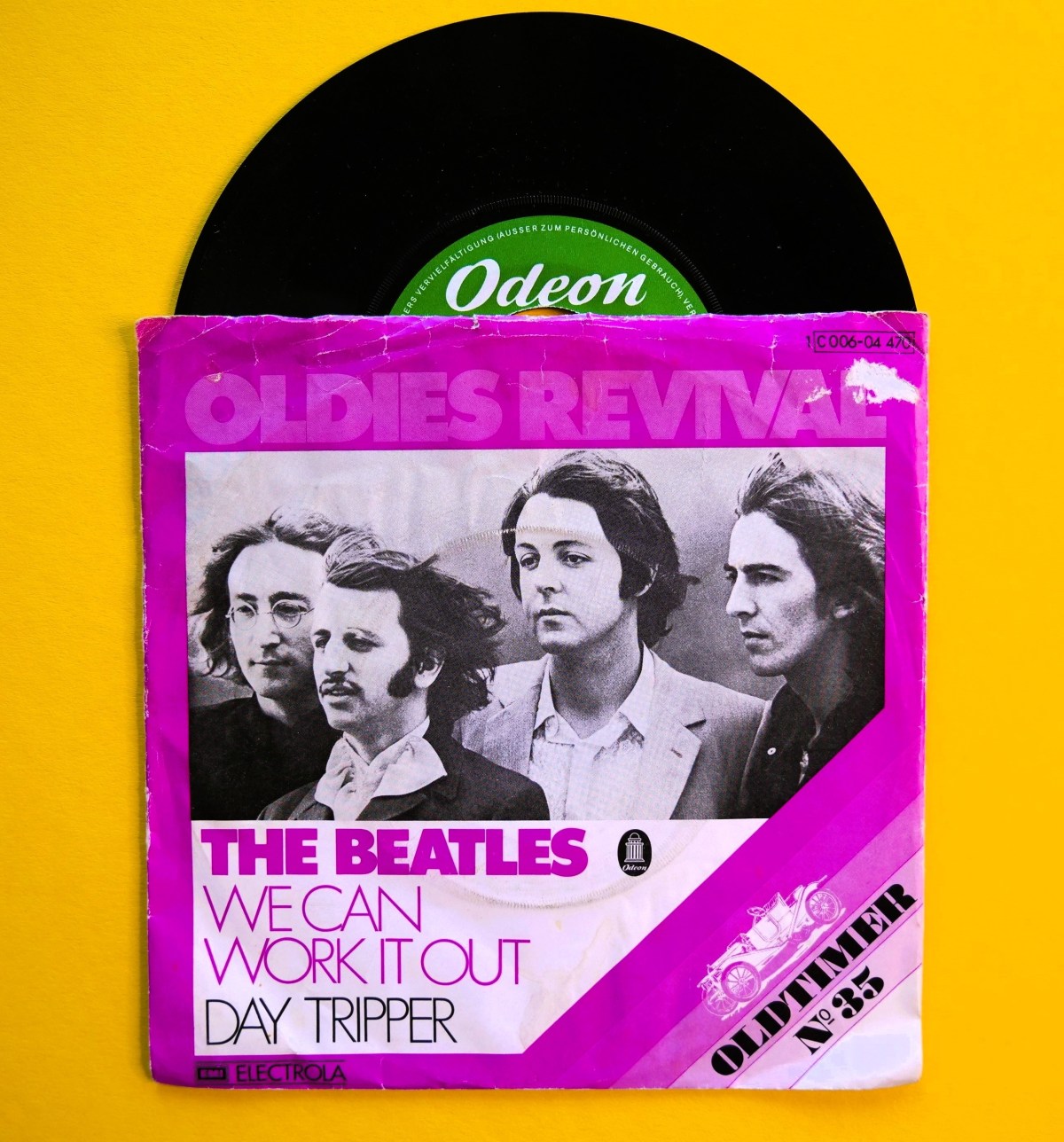
Back in the days when recording artists released singles, “We Can Work It Out” made its debut in 1965. The Beatle’s manager, Brian Epstein, felt that the other song on the record, “Day Tripper,” was more commercial and so, should be the lead song. Typically, the lead song of a single is recorded on the top side (A side) and the other song (B side) goes beneath it. Since both songs became hits, the record turned out to be the first double “A” single ever recorded.
John Lennon and Paul McCartney wrote the song with Paul writing the optimistic verses and John writing the more pessimistic chorus, in this case, the bridge.
The song sprang from a disagreement Paul had with his then-girlfriend, actress Jane Asher. Jane and her mother, Margaret, had a powerful impact on Paul’s life. The couple stayed together for five years from 1963 to 1968.
Kate Wolf’s music conveys Love, Beauty, and a full range of human emotions. “See Here She Says” is a remarkable song because it speaks to children and adults alike with a reminder that the dreams of the Heart are one of the most valuable commodities we own.
“The time that’s left is yours to keep” is a phrase at the end of the chorus of Kate’s song “See Here She Says.” The phrase impacts me powerfully because it is sweet advice to use our time wisely. This is especially true for children, but it is also important for people of all ages to keep in mind.
Each moment that is given to us is precious. Why waste it on foolish pursuits that bear no useful results? Yes, recreation, relaxation, and pleasure are important too, but they are best employed as a balance for the attainment of meaningful goals. And if the motivation to achieve these goals comes from the heart, then the process of manifesting them will surely, for the most part, be enjoyable.
In a truncated life of only forty-four years, Kate Wolf embodied the words of this song. She used her time to create over two hundred songs, performing mostly at venues in her native state of California. Kate’s work has warmed and gladdened the hearts of millions of people around the world. Here’s my cover of “See Here She Said.”
If you’ve been following this blog, then you know I’m a huge fan of Cat Stevens. He produced some of the most iconic and unique music of the 1960s and ’70s. Shortly thereafter, Stevens’ sincere spiritual search led to his conversion to Islam, a surprise to many, including myself. For several decades after his transformation, Stevens, now known as Jusuf Islam, remained musically inert.
During his most productive years, Stevens gave over his immense musical talent to the study and preaching of Islam. Although Stevens says, in his own words, “I’m only trying to help,” I can’t help thinking that the world lost out on a treasure trove of inspiring, educational, and entertaining music
To be fair, I guess I’m just expressing my sour grapes. Everyone has the right to do whatever he or she wants with their life. Stevens believes his conversion to Islam “was meant to be.” It may very well be because Stevens has done a lot for the Arabic world. And he has stayed with his persuasion for almost fifty years. Kudos to Cat…er…Yusuf.
“Hard Headed Woman” celebrates an empowering and life-affirming love. The artist envisions an enriching and fulfilling relationship in which each partner contributes to the other’s growth and happiness. The song reminds us of the importance of finding someone who complements and strengthens us rather than a companion who fits a pre-determined, superficial mold.
“Day Is Done” is a simple song about a clandestine relationship. Since very little has been written about the song, it is difficult to pinpoint its exact meaning. It could be about two married adults having an illicit affair. The lyrics and tone, however, indicate a relationship between two adolescents forbidden by parents or society.
The drawings on the album cover of “Lost Dogs and Mixed Blessings,” where the song is one of the tracks, tend to support the theory of a prohibited young love.
In “Day is Done,” Prine has written a charming little song with universal implications. Many of his songs deal with the intricacies of human relationships and are laced with Prine’s subtle sense of humor. Lost Dogs and Mixed Blessings was John’s fourteenth album. Released in 1995, it is another example of the artist’s exploration of the human condition.
From humble beginnings, John Prine came a long way in his fifty-year career. He won Grammy Awards and was posthumously inducted into the Country and Folk Music Hall of Fame. What struck me, however, is this early recollection of his career. It is taken directly from Prine’s official website:
“Prine still remembers the first three songs he performed on any stage: Sam Stone, Hello in There, and Paradise. With humility, he recalls, “I sang those three songs and people just sat there and looked at me. I thought, ‘Wow, those are really bad.’ They wouldn’t even applaud.”
Things changed dramatically when a young journalist named Roger Ebert dropped into a Chicago folk club for a beer while John was on stage. Ebert wrote a glowing review of Prine’s performance in the Chicago Sun-Times which essentially launched John’s career.
John Prine began his professional career as a mailman in Illinois. He went on to become one of America’s most beloved singers and songwriters. If you are a fan of Folk and Country Music, then you know John Prine. His music was a blend of humorous lyrics about love, life, current events, and songs recounting melancholy tales from his life. Prine was active as a composer, recording artist, live performer, and occasional actor from the early 1970s until his death in 2020 from complications of COVID-19.
“I Remember Everything” was the last song John wrote. Published posthumously, it’s a simple yet moving song looking back on a life well-lived.
Prine may have had a premonition that his life was coming to an end. If that is the case, then “I Remember Everything” is John’s epitaph, which he characteristically wrote himself. Here’s my cover.
“Ah, but I was so much older then, I’m younger than that now.”
These lyrics and the refrain popped into my head a few mornings ago. This sort of thing has been happening to me frequently these days: Long-forgotten songs resurfacing. It may be a function of the aging process, or it might be the universe talking to me. I kind of hope it’s the latter.
In the 1970s, a group called the Bryds covered a few Bob Dylan songs. They made songs like Mr. Tambourine Man and this one popular. The Bryds’ cover of Mr.Tambourine Man went to number one on the US charts, and their cover of My Back Pages went to thirty. I may have never listened to My Back Pages had it not been for The Byrds. By the way, Roger McGuinn and The Byrds are credited with starting the Folk Rock Revolution. And they inspired Bob Dylan to go electric.
In 1964, Dylan released his fourth album, “Another Side of Life.” Around this time, he began to distance himself from his earlier songs. He claimed his earlier work was not about politics. Instead, it was about universal themes and not individual political issues. In “My Back Pages,” Dylan lambasts himself for his authoritarianism and arrogance.
Moving forward, Dylan’s music focused more on individual consciousness and personal freedom. He is remembered more for his music from 1965-1970 than his earlier work.
To me, the lyrics at the top infer that we tend to think we know it all at a young age. I know that I did. As we age, we gain more wisdom and realize that we know less than we thought we did. This understanding opens us to learning more when we admit that we know little in comparison to what is out there. To be open to learning without imposing pre-existing ideas is to become more pliable and, therefore, young.
“Brown-eyed Girl” was originally called “Brown-Skinned Girl.” The song is about an interracial relationship. Morrison changed the name to make it more acceptable to radio stations at the time (1967). Some stations banned it anyway for the line, “Making love in the green grass.” Why some gatekeepers took issue with the line in the free-loving sixties is beyond me. I guess there is no accounting for taste.
From his roots in Northern Ireland, Van Morrison began his musical career at the age of thirteen. He played the saxophone, harmonica, and guitar in several bands until he formed his own group called “Them.”
“Brown-Eyed Girl” launched Morrison’s solo career due to the song’s overwhelming popularity. Ironically, Morrison never truly cared for the song. He considered it “too commercial.” And the psychedelic cover of Morrison’s first solo album appalled him. I think it’s safe to say Van Morrison never came anywhere near the mainstream of music and pop culture.
Most of Morrison’s work consists of rhythm and blues and occasional jazz pieces. The man may be unpredictable, but his songwriting has certainly been prolific. He has written over three hundred songs in his fifty-year career.
Commercial or not, this is a fun song to play. Here’s my cover.
Bob Dylan wrote “When the Ship Comes In” in 1963 and released it on his “The Times They Are A-Changin’ ” album in 1964. Dylan was in an angry mood when he wrote the song after a hotel clerk refused him a room, thinking the artist was a deadbeat. Dylan finally scored a room after Joan Baez verified his good character. The song is violent and vengeful, but it is also hopeful. The song’s lyrics hint at a vision of a better world built on the ideals of an enlightened generation.
Sixty years have passed since the song first appeared. Aside from a more inclusive social fabric and our ever-advancing technology, I wonder if the times have changed that much. Dylan’s words still ring true in a world where:
The cruel and inhuman war in Ukraine rages on.
The leading Republican candidate faces numerous indictments for fraud and other misdeeds.
The US President’s son faces charges of selling access to his father, and the President may be implicated.
Selfish Aramco raises oil prices despite the devastating effect it will have on the world economy.
Oil companies make token gestures toward clean energy while sitting on their hands and raking in hundreds of billions in profits from the sale of fossil fuels.
Billions of people continue to live under dictatorships and go to bed hungry every night.
The clock is running out on Global Warming.
We need the social conscience and action of a generation of young people like the one we had in the sixties. Instead, we have a malaise of complacency and ignorance today with too few bright spots in between. But it’s not too late. “When the Ship Comes In” came to me in a dream. It came, literally, from out of nowhere. It must have come to me for a reason. Maybe Dylan’s resounding words will spark something in us. Here’s my cover.