In his prime, Jean Shepherd hypnotized audiences for hours with stories about bumper stickers, TV commercials, Green Stamps, and the Good Housekeeping Seal of Approval. Like most great discoveries, I found Jean Shepherd purely by accident. Sunday nights presented a precarious dilemma until Jean came along. I didn’t want to close my eyes because the next thing you knew, the sun would be pinching my cheek. It would be Monday morning, the beginning of another week of Junior High School.
My primary goal, therefore, centered upon pushing Monday morning as far into Sunday night as my sleep-deprived brain permitted. My pre-Jean Shepherd solution to the Sunday night dilemma involved listening to Rock and Roll music on a radio underneath the covers. One night, while switching from one Rock and Roll station to another, I found “Shep.”
The experts at the time might have called it “experimental radio.” Whatever it was, I had never heard anything like the smooth jazz overlaid by that voice, the one that put an arm around my shoulder and whispered, “c’mon pal, I got some cool places to take you to.”
When I first tripped over the threshold of this new world, the silky voice in the night was talking about cigarette coupons. It told a story about two friends who “made the same dough,” yet one of them had a new TV, and a boat, and a Ford Mustang, and a vacation home in the country—all purchased with cigarette coupons. It soon became clear to the other sad sack that he was an idiot not to smoke “Wonkies,” the brand with the coupons, the kind his buddy smoked. Of course the poor slob who smoked the Wonkies was dying of cancer, but it didn’t matter, because he had been smart enough to get the boat, and the car and the vacation home for free. He had enjoyed a lifetime of smoking Wonkies, and now his family could use the boat and the other goodies after he died.
The music swelled a bit louder. Now the voice talked about life on other planets. Did the inhabitants have better bathrooms than ours? Did the people have jobs, or could they just go to the bank and ask the teller for as much money as they needed to feed and clothe their families, with enough left over to go to an amusement park or take a quick vacation on another planet. Everyone had to be on the honor system, or there wouldn’t be enough money to go around. But these were aliens, after all, not human beings, so there would probably be no problem.
The voice kept talking. It swept me away. I lay there listening to my radio. I felt like a five-year-old kid attending the circus for the first time with his Dad. The world outside was crazy as hell, but I had it made in the shade, hypnotized by another one of Jean Shepherd’s stories. Monday morning had disappeared over the horizon—miles, and miles, and miles down the road.
Open your mental windows. Let your attitude bathe in the sunshine of optimism. Don’t worry about the possibility of sunburn.
That’s a pretty corny metaphor. Just imagine, however, what would happen if every chronic pessimist on the planet took this advice.
The cost of healthcare would plummet. There would be fewer traffic accidents. The unemployment rate would nose dive. The average human life span would increase by five or ten years. These are just a few of the likely outcomes of a few billion upgraded attitudes.
My optimistic attitude is based on the belief that at the very center of the universe in which we live there dwells a loving kindness that cares about our happiness and well-being.
When I choose to believe and to feel this way, life becomes easier.
Through the eyes of optimism, I see the world as a place full of endless possibilities to express myself positively.
There is a voice in my head that tries to convince me otherwise. I suspect I am not the only person who hears this derisive, discouraging voice. The only difference between most of us in this regard, it seems to me, is how we deal with this voice.
I used to believe the discouraging voice in my head was a friendly voice. I believed it was there to warn me not to try things I couldn’t or shouldn’t do. It has taken a lot of growing through painful experience to learn the critical voice was not my friend most of the time.
On the surface, it would seem an easy task to learn the difference between healthy self-restraint and the paralyzing fear engendered by an over-abundance of self-criticism. Perhaps the messages a person hears as a child from parents and teachers makes a difference in the way he or she responds to their inner critic. A strong self-image provides a safe haven from the twin sirens of doubt and fear.
I have found it helps to express your fears to a friend or to a mental health professional to get an objective view of your thoughts as they relate to accomplishing goals. Most fears, when expressed out in the open, prove to be phantoms made of irrational thinking.
The dream in your heart needs to be nurtured with positive, reinforcing thoughts in order for it to manifest into a concrete reality. It takes a persistent, consistent effort to escape the prison of the jailing voice of discouragement.
Being optimistic is an act of loving yourself and your possibilities. It is an act of flying above the clouds of doubt.
Personal fulfillment and the joy of helping others flow from the fountainhead of optimism.
An attitude of optimism leads to an active life of freedom.
Opportunities for growth and prosperity surround us constantly. Smile. Open your heart and embrace these gifts as they come your way. The loving force at the center of life beckons you to become your highest, happiest, and best self.
Nature persistently taps me on the back with subtle hints on how to live a happier, more fulfilled life.
As my sixty-fourth birthday approaches, the hints are becoming less subtle.
Take my right knee, for example. It’s falling apart. The cartilage in the joint has moved out. Arthritis has moved in. The good news is that I’ve found a skilled surgeon who can repair my knee with an artificial joint. Still, I must not allow this newfound hope to obscure the lesson available to me from this latest brush with nature.
As I watch my body deteriorate, I must constantly remind myself that no matter how much I exercise, eat right, think positively, love my wife and daughter, and take care of my 90 year-old mother, I am not getting any younger.
The time to be happy is right now.
The thing is, I don’t want to settle for just a little happiness. I want to be really happy. I want to, believe it or not, live in joy. It’s something I’ve put off for long enough.
About twenty-five years ago, a friend introduced me to a teacher who helped me to find joy within myself.
To be perfectly honest, I haven’t taken full advantage of the opportunity. You might say I’ve been playing a game of hide and seek with my capacity to feel joy for most of my life.
In a sense, I’ve made of habit of putting my happiness on hold by making other things in my life more important—like my desire to write ten best-selling novels, or to sell my latest screenplay to Miramax Studios, or to make a quarter-of-a-million dollars in real estate commissions in a single year. It’s not that these pursuits are unworthy goals. The problem is, I made them the number one priority in my life, rather than making peace and joy the number one priority.
Don’t get me wrong. I’ve experienced more than my share of joy, peace, and love in my life, thanks especially to the unique inner experience my teacher revealed to me. It just could have been more consistent. My teacher has taught me that happiness is an art. I want to become an accomplished artist in the field of happiness.
I only hope this moment of clarity lasts. From now on, I’m determined to harvest every last droplet of joy that comes my way…before my left knee gives out.
I remember the day my father asked me to become a partner in the stable. He was sitting behind his desk in the temporary office space we rented then, dressed in a camel colored sport coat and checkered cotton sport shirt. He looked straight at me with his bright, keen eyes and proceeded to make an offer that took me back to my secret weekend excursions in high school with my best friend, Danny. We were seventeen, a year too young to pass through the gates of any gambling establishment. That didn’t stop us. Danny and I were tall enough to look the part. On Saturdays, we drove to the “flats” at Monmouth Park on the Jersey shore and the “trotters” at Roosevelt Field in Long Island at night. We would bet two dollars a race and have the time of our lives.
My father, B. Morton Gittlin, was an unpredictable genius. At sixty-one, after selling a wallpaper manufacturing and distribution business he had built from a small company into a national market leader, he began purchasing thoroughbred horses. Completely in character, he shocked me with his offer to become a partner in a racing partnership he intended to name “Three G Stable,” assuming I agreed to become the third “G.”
I never suspected my father had an interest in thoroughbred racing. We used to play a lot of golf together on the weekends when I was growing up. I cannot fathom how or when he found the time to sneak away to the track with my mother. He certainly would never have gone to the racetrack during the week. He was too disciplined and focused on building businesses into powerhouse companies to fritter away time during working hours. I imagine he didn’t share his secret passion for the horses with me when I was a minor because it involved gambling.
My own secret interest in the horses took a long break after high school. Danny, my dear friend and co-conspirator, attended a different college than I and we grew apart. I was eager to move on with my life and put childish interests behind me. Thirty years flew by filled with adult activities—marriage, a family, and a career in marketing next to my father in the family business.
I accepted Morton’s offer to join Three G Stable as a full partner. It was an entity created out of my father’s love for us as well as his love for the sport of kings. The stable gave us something to keep us together and have fun with after we sold the wallpaper business.
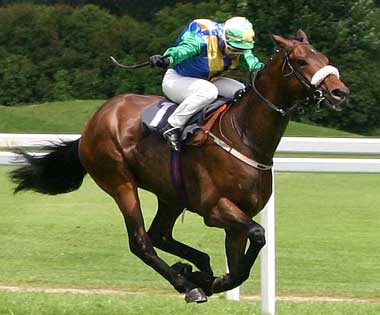
There is nothing more exciting than seeing a horse you own pounding down the stretch in the lead. My parents and I were fortunate to experience the exhilarating feeling of victory often in the twenty years the Three G Stable was in operation. We owned and enjoyed a number of remarkable, stakes-winning horses. One of them reminded me of my father. His name was “Storm Predictions.”
The Excitement of Horse Racing
We acquired Storm Predictions by claiming him out of a race as a two-year old. Many of the more experienced owners and trainers at Calder Race Course laughed behind my father’s back for claiming Storm Predictions. Although the young horse was winning races, it was common knowledge he had some problems. The breeder couldn’t sell “Stormy” at the two-year-old-in training auctions because he had what the veterinarians called “sawdust,” or bone particles in one knee. This is an ominous condition for most horses, indicating a tendency towards bone and joint injuries. My father didn’t care. He saw in Storm Predictions the rare courage and talent of a potential champion. The other owners and trainers saw a horse with a limited future.
As a three-year old, Storm Predictions won the Palm Beach Stakes on the grass at Gulfstream Park competing against the best horses on the East Coast. Then, our gutsy gelding won the Inaugural Stakes and the Tampa Bay Derby, a race for three-year olds on the Kentucky Derby trail. Ridden by an unheralded journeyman jockey, Storm Predictions won with a flourish of speed at the top of the stretch, upsetting the heavy favorite in the race.
As a four-year old, “Stormy” won the Americana Handicap on the turf at Calder, as well as a number of “overnight” stakes and allowance races. The gelding banked close to $400,000 in purse money during his racing career. The horse cracked bones in his shins and suffered from joint aches and muscle pains of all sorts. Nothing stopped him. We just gave him long rests when necessary. Storm Predictions always came back running hard and winning. We gave Storm Predictions away to a caring farm owner when his racing days were over. The gelding lived a long and useful life after his years at the track as a pleasure riding horse.
My father, like Storm Predictions, was no stranger to adversity. After clearing the inevitable hurdles of a successful business career, he endured many physical setbacks in retirement, including a hip replacement, throat cancer, and emphysema. Nothing stopped him. He just kept enthusiastically pursuing his interests and enjoying life to the fullest, until the effects of exposure to asbestos as a boy caught up with him at age eighty-three. Even then, he didn’t want to give up. On the last day of his life, lying in a hospital bed, his body whittled down to skin and bone by Mesothelioma, my father threw off his covers and announced he intended to walk to the bathroom unattended. We practically had to hold Morton down to spare him further pain and embarrassment.
I still dream of my father and the horses. We call him “Morton” now, instead of Dad, or Pop, or my husband, or my father-in-law. We call him by name because he was such a unique individual. Anyone who knew my father well knows what I’m talking about. Morton has been gone five years now, and I miss him terribly. We sold all of our horses and disbanded the stable shortly before my father’s death. The world of thoroughbred racing, like my father, has moved on. Hialeah Park, once a haven for fabulous Flamingos and the finest thoroughbred racing in the East during the winter, is now a relic that hosts a brief quarter horse meeting. Gulfstream Park, another south Florida track, was razed and rebuilt into an enormous shopping center and gambling parlor. Gone are the fan friendly grounds where patrons spent the day with family members in a country fair atmosphere.
I remember taking my five-year old daughter to the petting zoo and putting her on the backs of Shetland ponies for rides at the old park. The spacious, open-air grandstands and box seats where fans used to bet, eat, drink, and watch the races all day long, are now an unfriendly complex of cramped, concrete buildings.
Thankfully, I still have my memories. I remember Morton and the horses. I remember the chain of love known as Three G Stable that linked me together with my parents, wife, and young daughter, in those glorious, fun-filled days gone by.
I turn left on the two-lane road leading to the town of Sedona. The world outside transforms into something much different than the one I am accustomed to.
Towering red-rock Mountains appear unexpectedly. The striped hills are radically different from the ordinary-looking mesas overlooking the surrounding terrain. For the first time, the advertisements promoting this area ring true. I get the distinct impression there is something special here. There is suddenly hope the three thousand mile plane ride and the hotel suite awaiting my wife and I will prove to be a wise investment after all.
Sedona is a spiritual spa for die-hard vacationers as well as world-weary travelers searching for a way to resurrect their lives from an assortment of disappointments and failures. I am not here to seek advice from healers, psychic or life counselors. I am here to discover the heart and soul of this city out of time without the help of a tour guide.
Sedona is amazingly clean. There are no signs of litter in the streets or sidewalks, no unsightly garbage dumps to mar the town’s bright aura. The buildings, homes and streets all look brand new. Most of the architecture is a sort of southwest modern with earth tone colors alternating with pastels. It seems as though a beautiful, uniquely designed church abides on every street corner. No two homes look alike, yet no building seems out of place. There is an underlying unity of design but not at the expense of individuality.
The single-story adobe-style homes at street level and the larger mansions in the mountains have no bars on their yawning windows. They all look expensive, probably worth hundreds of thousand dollars each upwards into the millions. Incredibly, you don’t see gates in front of the winding driveways. There are no traffic lights clogging the two-lane road running throughout the town. Instead, they have what the locals call “round-a-bouts.” Here, the visitor finds an honor system where vehicles yield to the one reaching the four-way intersection first. Anyone who doesn’t obey the code is sure to be a tourist.
I spend most of my time here in art galleries and walking around slack jawed, agape at the rock formations, multi-colored mountains, and fiery sunsets. I feel “buzzed” every waking moment. Even shopping, which I normally hate, feels like an acid trip. The town itself, I think, is one huge energy vortex.
Young people flock here as if drawn to the area by the magnetic power of the town’s famous energy vortexes. Many of the transplants have fled small towns where they grew up throughout the west to taste big city life. After living in places like Houston, Phoenix, and Santa Fe, they search for something else. They find it in Sedona, where small city values couple with new vistas of financial and cultural opportunity.
Everyone you meet here seems to be from somewhere else. Heaven is likely to be quite similar, come to think of it.
The Adventure Project set an ambitious goal. Blog writers and their readers worldwide responded with enthusiasm, compassion and generosity.
The idea came to Becky Straw and Jody Landers, Co-Founders of the Adventure Project, from members of their organization, known affectionately as “The Tribe.” One week before World Water Day (March 22nd) blog writers proposed a challenge to raise $10,000 in one day by promoting The Adventure Project’s latest initiative: repairing broken water pump handles in northern India. The anticipated results of the initiative are twofold. By bringing wells that have fallen into disrepair back into use, 300 more people per month (3,600 per year) will have access to clean water. In addition, the initiative will provide training and jobs to enable unemployed people to lift themselves out of poverty.
A Pump Mechanic Rides to Her Next Job
Becky thought the tribe members might be able to recruit 50 bloggers to promote the fundraising effort. Jody, an eternal optimist, suggested 100 bloggers. One week later, 137 bloggers had signed up to participate. As the final seconds of World Water Day elapsed, the amount raised reached $11,390. Donations are still rolling in, by the way. All funds collected go to WaterAid, a charity that takes a unique approach to providing the poorest communities with potable water.
“It all came together like magic,” Becky reports. She asked her friend and colleague, Nicole Skibola, to find a company that might be willing to provide matching funds to the promotion. In her role as a “Social Innovation Strategist” with Apricot Consulting in New York City, Nicole works with corporations to create and execute effective programs for social change. A former attorney, Nicole also serves as a “Social Enterprise Advisor,” for the Adventure Project.
Nicole e-mailed a list of her friends and business contacts in an effort to locate a matching funds sponsor. Kathya Bustamante’s name happened to be on the list from a position she previously held with UBS. Kathya, among other interests, now volunteers for TPRF as Manager of the Fundraising Team. Kathya recognized a common thread between both organizations: “Clean Water” and “Dignity.” She forwarded Nicole’s request to decision makers at TPRF. Within twenty-four hours, TPRF committed to providing up to $10,000 in matching funds. “Awesome,” Nicole commented in an e-mail to Becky and Kathya, “the fastest foundation response in history.”
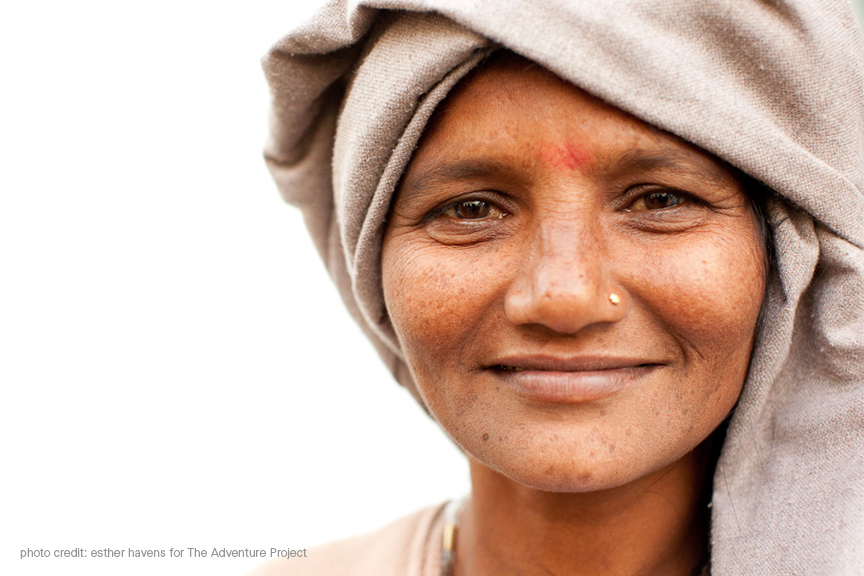
Northern Indian Woman
One final footnote—Although TPRF agreed to provide up to $10,000 in matching funds, we surprised the girls by cutting a check for the full amount of the funds raised on World Water Day: $11,390.
“Your response was so amazing and so responsible,” Becky said about TPRF’s participation.
*Photos courtesy of Esther Havens for The Adventure Project
I am trying to write my second novel. It is not easy, to say the least. I am confident, however, that this is a universal truth among authors attempting to write their first or seventy-first long piece of fiction or non-fiction. The reasons for this difficulty may vary from author to author. My main roadblock seems to be the increasing disenchantment of sitting in a room all by myself for long periods of time. Again, I suspect I am not alone in this predicament. The problem apparently extends far beyond the relatively small segment of the population on planet earth attempting to write novels. I know this because I have recently taken my laptop to a local Starbucks to resolve my isolation problem.
The Starbucks I now regularly inhabit is not your everyday Starbucks. Management recently retrofitted the place with long tables, benches actually, with stools and a strip of electrical outlets underneath to plug in battery cables. Droves of people come here, not just to chat and caffeinate, but to do WORK! This includes college-students doing real, actual homework, not wasting time on Facebook. Freelance, self- employed, and independent contractor types also hang out here. These people, like myself, are hard at work, despite the distractions of noisy conversation and often-times idiotic, piped-in music. I find this phenomenal and wonder,”Why do we come here?” Many, if not all of us, are surely not homeless.
I can only speak for myself. I come here to overcome loneliness—to make some sort of connection. And I’m happy to report that my new strategy is paying off. I’m writing my novel on a regular basis, slowly but surely.
Now that we may have some insight into the reason for the overwhelming success of the Starbucks chain, I would like to come to the point of this piece. Many years ago, I began listening to Prem Rawat speak about an inner experience of peace and contentment. At the time, I did not have to go to Starbucks to be around people. I had a full time, good-paying job, a girlfriend, my parents and cousins to surround me. Yet, something was missing.
Mr. Rawat’s message of peace captivated me in a way nothing had previously. I followed up on his promise to reveal a source of peace and contentment within myself. I practiced the techniques of what he calls Knowledge, and, to make a long story short, I have not been in the least bit disappointed. Well, perhaps that statement is not entirely true. I had the idea shortly after receiving the techniques of Knowledge that I would not need anything else, including people. To make another long story short, that idea turned out to be foolish and a bit funny, now that I look back on it.
But there is a point here, somewhere. Oh yes, here it is: I need outer connections—with colleagues in my chosen profession, with friends and family, even Facebook connections. Thanks to the experience of Knowledge, I’ve learned that I need something else. I need a connection with myself for my life to be complete. I’m not going to put a name to what I’ll call “myself,” because I’ve learned that names are insufficient to describe it. I will just say this: I was looking for a missing piece of the puzzle of my life. Prem Rawat helped me to find it. Now, I feel my life is complete. It is full, not stuffed with things on the outside, but from within. And my connections on the outside are more fulfilling, because I am a more full and complete person, with more to offer to others.
We sat on a flat rock overlooking the pond with the lines of our fishing poles dangling in the fresh water. Actually, the poles we used were not real fishing poles. They were made from tree branches strung with nylon lines and hooks my Zeda bought from a nearby bait and tackle shop. My Zeda could not afford to buy real fishing poles, so he made them instead. I didn’t mind. He said they would work just fine.
The early morning sun glinted off the pond and the side view mirror of my grandfather’s 1953 Plymouth sedan. The reflected light was so bright I had to squint to see. My stomach rumbled. I thought of the roll beef my mother had packed for lunch. The roll beef and Kaiser roll sandwiches wrapped in wax paper sat in a brown paper bag next to my grandfather. We had found one of the only shady places to sit in this tiny corner of the Essex County Reservation. We had the pond all to ourselves.
“You said we would have a better chance of catching fish if we got here early. I think you were right, Pop-Pop.” I always called my grandfather Pop-Pop when I wasn’t calling him Zeda.
“The water is cool near the surface in the early morning,” Pop-Pop said. “Fish like cool water. They go deeper in the pond as the sun rises and the water near the surface gets warmer.”
“I hope we catch a lot of fish,” I said.
“A good fisherman is always patient, tateleh. It is important to remain patient in any situation and twice as important when you are waiting for a fish to bite.”
I wasn’t used to sitting still for very long. It was almost magical, however, how calm I could be when spending time with my Zeda. I found everything that came out of his mouth interesting. I loved the way he played the role of different characters in the stories he told. He could do anything he put his mind to. Right at the moment, he was fishing with one hand, reading from a small book in the other, and talking to me.
Something big crashed into the mirror of the pond’s surface.
“Pop-Pop. I think a meteorite just fell. We learned about them in school yesterday. The big meteor comes into the atmosphere and breaks up. Then smaller pieces fall out of the sky.”
“It’s not a meteorite, bubaleh. The fish are happy. They freulich in the water and jump out when the spirit moves them.”
“Wow,” I said.
There was a second splash about a hundred yards away. “There goes another one. I’ll bet they all start jumping now.”
“They aren’t going to make it that easy for us to catch them,” Pop-Pop said. “Fish have more brains in their Kuphs than the average person gives them credit for.”
“If fish were stupid, it wouldn’t be fun to try and catch them, right Zeda?”
“Correct,” my boy.
“Could we go fishing every day before school and on the weekends too?”
“Well, we could go on any day during the week, but not on Saturday. Saturday is for the mitzvah of observing Shabbas—something your parents seem to have forgotten, ankeleh.”
And so it went, back and forth between us the rest of the morning, until it was time to eat our delicious roll beef sandwiches. We didn’t catch any fish that day. I can’t say I was disappointed.
The earth is one big ecosystem. Think of it as a human body. Every cell, every organ, every system of organs is interdependent. Think of the water in the earth’s rivers as blood in the body’s circulatory system. What happens to the body when infection invades the blood stream? What happens when the body cannot produce enough cells to maintain a sufficient, systemic blood level? The answer, of course, is illness.
Industrialization, urbanization, and global warming have adversely affected the rivers of the world. Pollution and insufficient water levels pose a serious health threat to all life in the surrounding regions. The problem is common to big cities as well as rural areas. The best way to illustrate this point is to cite specific examples.
From approximately 1947 to 1977, the General Electric Company poured an estimated 1.3 million pounds of polychlorinated biphenyls (PCBs) into the Hudson River from manufacturing plants at Hudson Falls and Fort Edward.
The health of area residents is at risk due to the accumulation of PCBs in the human body caused by eating the river’s contaminated fish. Since 1976, high levels of PCBs in fish have led New York State to close various recreational and commercial fisheries and to issue advisories restricting the consumption of fish caught in the Hudson River. PCBs contain carcinogenic substances known to stimulate the growth of cancer cells in humans. Additional adverse health effects include low birth weight, thyroid disease, nervous and immune system disorders. PCBs in the river sediment also affect fish and wildlife.
Runoff in urban and rural areas can easily affect a river’s health, putting local wildlife and human life at risk. Nitrates from fertilizers and pesticides collect in rainwater draining from surrounding land into rivers. These chemicals stimulate the growth of algae, throwing delicate, ecologic relationships out of whack. The result is a clogged, dysfunctional river system.
Runoff from acid rain and rain falling through polluted air is another source of contamination. A recent report states that pollution from urban runoff has become the Potomac River region’s fastest-growing water quality problem, threatening the quality of drinking water for 86 percent of local residents.
Several Abandoned mines located in England and Wales have caused significant pollution in nearby rivers. Dangerous metals such as iron, aluminum, tin, lead, mercury and cadmium from old mine workings contaminate drinking water extracted from regional rivers fed by polluted tributaries.
Phosphorous from detergents in sewage flushed into rivers is another dangerous pollutant. The chemical stays in the system for a long time, threatening plant life by taking up oxygen and poisoning the drinking water of animals and humans alike. The impact of a slow buildup of river pollution in a wide area can be devastating. In the 1950’s, the otter population in England was nearly wiped out by the accumulation of toxic wastes in major rivers throughout the country.
Rising weather temperatures caused by global warming have had a dramatic effect on fresh water levels in rivers around the world. Persistent drought conditions in Australia’s major farming region, the Murray-Darling river basin, threaten the nation’s food supply. The Murray-Darling crosses most of southeastern Australia and is one of the region’s most important river systems. It provides water for growing 40 percent of the nation’s vegetables, fruits, and grains.
Corey Watts, of the Australian Conservation Foundation in Melbourne, told reporters that drought conditions were becoming the norm in the area instead of occurring once every 20 to 25 years.
“We’ve had a string of official reports over the last fortnight painting a pretty grim picture for the climate and the future of our economy and our environment,” Watts said. “So now we’re looking at a future in the next few decades where drought will occur once every two years.”
The 2,000 year-old Yamuna is a river that “fell from heaven,” according to Hindu mythology. The residents of New Delhi worship the river and depend on it for life. Residents tossing coins and sweets into the river, or scattering the ashes of dead relatives from bridges jutting across the waters are a common sight. Unfortunately, the actions of the citizenry and the New Delhi governmental water board do not coincide with this feeling of reverence.
As the Yamuna enters the capital city, its waters are still relatively clean after a 246-mile descent from atop the Himalayas. New Delhi’s public water authority, the Jal Board, extracts 229 million gallons from the river daily for drinking water. As the river leaves the city, residents pour an average 950 gallons of sewage into the Yamuna every day.
As it winds through India’s capital city, the Yamuna transforms into a filthy band of black ink with clumps of raw sewage floating on the surface. Methane gas bubbles to the surface. The river is hardly safe for fish, let alone bathing or drinking water.
A recent government audit condemned the Jal Board for spending 200 million dollars on the construction of sewage treatment plants with minimal results. One of the city’s Pollution Control Board Directors said the situation “has not improved at all because the quantity of sewage is always increasing.” The regular occurrence of power failures adds to the problem.
The above examples are only a tiny representation of the problem. The health of the world’s rivers and their effects on plant, animal, and human life is a complex problem difficult to summarize in one short article. Governmental water management boards worldwide are struggling to deal with the problem now to avoid catastrophic water shortages in the next twenty years. Bold, new initiatives are under consideration along with traditional methods. One point is clear, however. Change in the way we treat the environment, collectively and individually, is essential.
The new movie, “The Day the Earth Stood Still,” explores this theme. The story posits the theory that painful and necessary change can occur when it becomes obvious that doing things the same old way will lead to certain destruction. Certainly, we have reached this point with respect to the environment. Two questions remain. Will we change? Can we change in time to prevent a complete breakdown of the earth’s life sustaining ecosystem?
Sources: Gertner, Jon, “The Future Is Drying Up,” Time Magazine, October 21, 2007; Government of Australia — Waters and Rivers Commission, “Water Facts,” July 1997; Sengupta, Somini, “In Teeming India, Water Crisis Means Dry Pipes and Foul Sludge,” The New York Times, September 26, 2006.







 Heart Banter by David Gittlin