Issac Templeton is a successful attorney with a thriving law practice in downtown Fort Lauderdale, Florida. Aside from a few recurring nightmares, Issac is happy where he is in life, although he knows there is always room for improvement. Issac’s relationship with his headstrong artist girlfriend is challenging, but he understands that all good things take time and must be earned.
Yes, Issac has built a successful career and a fulfilling personal life, one brick at a time. It is said, however, that a human life can change dramatically in an instant. Issac’s comfortable life is about to take a sharp turn into dark and unpredictable realms that are more horrifying than even his worst nightmares.
When Lindsey Buckingham and Stevie Nicks joined Fleetwood Mac, the band had been in a state of constant turnover. Originally a blues band, the group was as famous for its revolving door of guitarists and vocalists as it was for its handful of hits. Because of its changing lineup, the band had no signature sound. Fortunately, the addition of Buckingham and Nicks was just what Mick Fleetwood, John McVie, and his then-wife Christine McVie needed to achieve the group’s long-overdue success. The duo gave the band new energy, a unique and recognizable vocal sound, and material that would become part of Fleetwood Mac’s identity, like the song“Landslide.”
A song about the changes and challenges of life, Stevie Nicks wrote “Landslide” in 1974 in Aspen’s snow country when her then-boyfriend, Lindsey Buckingham, was on tour. Nicks has said in interviews that the song is about her romance with Buckingham and their career struggles, as well as her relationship with her business-executive father. Her months in the mountains helped to inspire the song’s title contained in the lines:
And I saw my reflection in the snow-covered hills/‘Til the landslide brought me down.
Another verse contains questions that most of us ask ourselves at one time or another:
Oh, mirror in the sky, what is love? Can the child within my heart rise above? Can I sail through the changing ocean tides? Can I handle the seasons of my life?
While they may sound simple, the introspection of these words resonated with millions of record buyers and helped to make the debut album by this Fleetwood Mac cast one of the best-selling albums of the 1970s.
How great musicians like Lindsey Buckingham create original compositions like this one is beyond my understanding. His guitar accompaniment on this song is a testament to his extraordinary talent.
You might expect there to be, like the Hallmark cards, an overabundance of love songs about valentines. Well, I’m here to tell you there ain’t. Jim Brickman sought to rectify the situation when he co-wrote the song “Valentine” with Jack Kugell.
“I thought it was odd that for a day or for a word that is such a euphemism for love that there wasn’t a song that celebrated it, considering that most songs are love songs,” Brickman said in an interview. “The word ‘valentine’ is a euphemism for love or a replacement word for love, so I wrote it like, you are my love, only the song says, you are my valentine.”
Jim selected Country and Western singer Martina McBride to sing “Valentine” on his album “Picture This” which he released in 1997. Brickman said he selected McBride because he thought she sang like an Angel when he heard her debut album. I would have to agree with him.
To paraphrase, Brickman has said he feels that his music can go with anyone’s music collection. “We have different songs for different occasions. My songs are for romantic occasions.”
I would agree with Brickman there too. Here’s my cover.
This phrase came to me when I woke up this morning. I have no idea what it means, but it sounds interesting. So…let’s go exploring.
It could be someone telling me to recall the wrong turns I’ve made in life. To be honest, I haven’t made that many, but I’ve made enough. I’ve come perilously close to crashing and burning more than once.
I believe each one of us is walking a tightrope across a broad and deep chasm. Somehow, most of us are making it across. We are doing so by the hand of grace. Because we are loved. You might even say cherished. It’s easy to forget this love, but it is always there, like a gentle hand, guiding us on our way. I may often feel alone, but truly, I am not.
I hope these words help you on your journey. Have a wonderful day!
Gordon Lightfoot is one of those rare individuals who resides in the top echelon of his profession. It takes a huge deposit of raw talent, hard work, intestinal fortitude, and luck to reach the level of success Lightfoot has achieved in the music business. Amidst all of this recognition, Gordon remains a simple and straightforward man. He is a survivor with no plans to retire. At 83 years young, Lightfoot once dodged death when his manager found him lying on the floor of his dressing room with a burst aorta. Lightfoot has navigated numerous romantic relationships, spawned six children and five grandchildren, remained close with his offspring, and outlasted most of his contemporaries, not without some regrets.
When he comes on stage these days, Lightfoot often uses a misquote inaccurately attributed to Mark Twain: “Reports of my death have been greatly exaggerated.” In November of 2021, Lightfoot had the honor of re-opening the newly renovated Massey Hall in Toronto in a live performance. He has played the historic concert venue more than 160 times.
Lightfoot released his fifteenth original album in 1982 on Warner Records. The songs on the album are slower and more contemplative than many of the songs he released in the prior decade. As is his custom, Lightfoot compiled the album’s songs from scraps of notes he collected in his briefcase and tapes he recorded at home.
Of the album’s title song, “Shadows,” Lightfoot has made a few somewhat vague comments. He says it was the best song he had at the time, and that it is about a particular problem he was going through in his life involving a man and a woman, and nature.
I feel the song is quite beautiful. I’ve learned it the way Lightfoot plays it. Here is my cover of “Shadows.”
“True Colors” is a song with legs. It started out as a song written for a mother in a traditional ballad format. Billy Steinberg and Tom Kelly wrote the song in 1986 and offered it to Anne Murray, a popular singer at the time. Murray passed on the song. Cyndi Lauper took it and creatively revamped the format into a stark and breathtaking version.
The song became a hit worldwide because of its universal appeal. The songwriters acknowledge that Lauper was the perfect artist to adapt the song partly because of her bold style. Released as the title song on Lauper’s 1986 album, “True Colors,” is the only original song on the album that the artist did not help to write.
In 1998, Phil Collins covered the song on his “Greatest Hits” album. Australian country music star Kasey Chambers covered the song as the theme for the 2003 Rugby World Cup. In 2007, Cindy Lauper launched “The True Colors Tour” to support gay rights and fight hate crimes. In 2016, Justin Timberlake and actress Anna Kendrick used the song in the soundtrack for the movie “Trolls.” Kodak also used the song to advertise their film stock.
Like I said: The song has legs. Here’s my version.
When someone shows you their true colors, don’t try to repaint them.
“Crossroads” is another great song by Don McLean. It first appeared on his hit album, “American Pie.” Although the song is not as well-known as the title song and some of the other songs on the album (“Vincent”“And I Love You So” and “Empty Chairs“) Crossroads is nonetheless moving and beautiful.
On the surface, the song is about a man remembering a long-lost love with a sense of regret and a desire to turn back time. I believe the subtext of the song has a larger and more universal meaning: hope and happiness can be found with anything that joins us on the inevitable journey of life. It doesn’t have to be a lover or anyone in particular. It can be an idea, a thought, an emotion, or even an absence of something or someone. An absence can be as strong a motivator as a presence.
On the album, McLean performs the song on Piano. Fortunately, my good friend and tutor, Jerry’s Guitar Bar, has transposed the song for guitar. Here’s my version.
BELIEVE IN YOURSELF. BELIEVE IN A POSITIVE OUTCOME. AND, IT WILL BE SO.
I’m reposting a blog previously titled “Vincent: A True Lover.” I’ve decided to re-learn the song closer to the original.
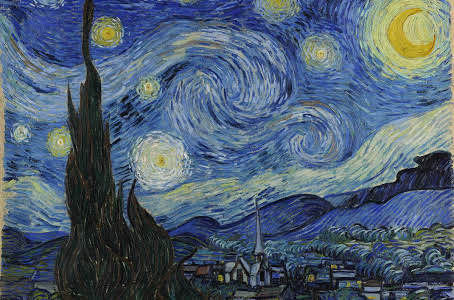
“Starry, starry night/ Paint your palette blue and grey/ Look upon a summer’s day/ With eyes that know the darkness in my soul.”
Those words came to Don McLean as he gazed at Vincent Van Gogh’s 1889 painting “The Starry Night.” Soon, he had a masterpiece of his own: “Vincent,” a 1972 hit that he released right on the heels of his defining epic “American Pie.”
Like Van Gogh’s painting, Mclean’s “Vincent” has touched a broad array of hearts and minds over the last 50 years. The song, the painting, and the book “Dear Theo,” written by Van Gogh’s brother, have certainly touched my heart again and again. I’ve always thought that Vincent’s style was at least in part inspired by his mental illness. To me, the brush strokes reflect an altered state of perception similar to the hallucinogenic patterns seen under the influence of Mescaline or LSD.
Van Gogh labored in obscurity until his self-inflicted death at the age of thirty-seven. He sold only a few of his paintings during his lifetime. Today, Van Gogh is a household word, and his paintings each sell for fifty million dollars or more. “The Starry Night” is one of Van Gogh’s most famous paintings.
Here’s the updated version of “Vincent” played closer to the original recording by Don Mclean.
Thought for the Day
When your world shrinks, your issues amplify. Keep your world and your perspective broad, for your own happiness, and the happiness of others.
Fifty years have flown by at supersonic speed. I can flash back on memories of my childhood and adolescence and remember them clearly as if they happened yesterday. I try to be present for each remaining moment. I forget. I get lost in my head. Again and again. A week slips by in a day. Does time go slower when we are young? I think it does.
How is time going by for you?
I thought Joni Mitchell wrote and popularized “Who knows Where The Time Goes.” It turns out a British folk rocker named Sandy Denny wrote the song and Judy Collins made it famous. A little research can go a long way. Here’s my version of the song based on the way the late great Eva Cassidy played it.
Science Fiction Writing Tip For Today:
“You have to be out of your mind while knowing what you’re doing most of the time.”
“I live for a sense of a feeling of purposefulness in this world, you know, that I could stop my life at any point and feel that my life has been worthwhile; that the people I’ve loved and my children have all reached a point where their lives are now going to come to fruition. And as far as something I live by, it’s to try to be as alive as possible and feel free to make my mistakes and try to be as honest as I can with myself.”
Kate Wolf–Singer Songwriter–1942-1986
Perhaps Kate Wolf had these thoughts in mind when she wrote the song “Unfinished Life.” It’s a haunting ballade filled with hard-won wisdom, exquisite beauty, grace, and focused determination. The song is also ironically prophetic. Kate Wolf died tragically of Leukemia at the age of forty-four. Despite her abbreviated lifespan, she wrote over two hundred songs and performed them at venues in her native state of California and around the world. Kate’s life was, indeed, unfinished, but she left behind a treasure trove of beautiful music.
I first recorded “Unfinished Life” using a free-form guitar strumming method. Recently, while driving in my car, I listened to the song with a different pair of ears. I noticed the unique and highly effective guitar-picking technique Kate used to express the words and melody of the song. After some trial and error, I’ve come up with a version that approximates Kate’s recording.
“The future is not some place we are going, but one we are creating. The paths are not to be found but made. And the activity of making them changes both the maker and the destination.”








 Heart Banter by David Gittlin