My printer passed away last night. The print head had a massive heart attack. I performed several emergency medical procedures prescribed by my HP Solutions Center–all to no avail. Funeral services will be announced.
A helpful store clerk at Office Depot informed me that print heads often break within two to three years. “It costs nearly as much to repair them as it does to buy a new printer,” he added, smiling. I did not argue with the man. Some critical part of every printer I have ever owned has broken down within this time-frame, and it never makes economic sense to replace the part.
Yet, I continue to buy HP printers, despite their limited life-span and the outrageous prices of the ink they voraciously consume. HP is a market leader, and I follow the herd because I shudder to think what catastrophes await the buyers of lesser brands.
Most printers displayed on major retail shelves are made in horrid factories by underpaid workers somewhere in China. I tell myself the HP factories are less horrid and produce better products than the others. At least I know what I’m getting when I buy an HP printer: a short but trouble free life span and high quality inks at unconscionable prices.
My new printer cost $329.00 and the new ink cartridges cost $109.99. My old printer expired with about $50 worth of unused ink. Naturally, the old ink cartridges are not transferable. This brings the total cost of my new printer to $$38.99, not including sales tax.
As we all know, it’s not the cost of the printer that hurts. It’s the cost of the inks. I find that my color ink cartridges last about three months each, and the double size black cartridge lasts about six months. I am convinced the life span of HP ink is controlled by a secret technology kept ingeniously under wraps by the manufacturer.
My cartridges need frequent replacement regardless of the steps I take to economize on ink. If I avoid printing in color, my color cartridges still need to be replaced. The only explanation I have for this is that the secret HP technology enables the color cartridges to combine mysteriously to print in black.
My New Printer
If I cut down on using my printer, it makes no difference. In this case, the secret technology causes the ink in the cartridges to evaporate at a predetermined rate, thereby ensuring a three-month replacement cycle.
Adding to my consternation, it took me three hours to set up the new printer. It used to be easy to set up a printer. There was basically one way to install the damned thing, and it was easy to follow the idiot-proof instructions. Now, there are several options at every step of the process requiring an advanced degree in engineering to decipher. On one of the setup screens, none of the options fit my setup criteria. I finally decided to go on to the next step without checking any of the boxes. I expected to see an error message pop up, but lo and behold, nothing happened. I had made the right choice, that is–no choice. I had guessed right, but I ask you, doesn’t that sound a bit counter-intuitive?
At some point, we will no longer need printers, paper, or ink. Documents and images will fly through the air directly into our heads. Until that time comes, however, I could use a little advice on the subject.
Every so often, it’s not such a bad idea to give up.
The word I really want to use is surrender, but I’m not really sure what that word means in the truest sense. I’m going to barge right ahead and use it anyway.
Once every ten years or so, I get to the point where I just want to surrender. I feel like I have done everything that can be done to accomplish my goals, and nothing seems to be happening. The feeling usually lasts for anywhere between three minutes and three days.
The funny thing is I find that I actually get somewhere when I reach this point. In one sense, it’s a scary place, a place of desperation, a feeling of being at the end of my rope. But I’ve found it can be an auspicious place. I wrote this yesterday on the subject (in less than three minutes).
I want to go higher, but don’t know how. It seems like I’ve tried everything, only to fall, crashing back to earth, unkindly.
I think, however, I’ve been this way before. When it seems like I have looked in every crevice and corner, turned over every stone, in search of the faintest glimmer of light—the light is usually not very far away.
There comes a time when Grace is met by human effort. I know that Grace will have to come sooner, rather than later, because I have been relentless in my pursuit of peace, joy, and love. Life becomes much easier when you know what you want.
One of the good things about advancing age is that it makes it easier to focus on priorities. I mean real priorities—the meaningful stuff, because the clock is ticking, louder and louder. There simply isn’t time to screw around with trivialities and false values. I’m tired of the tricks my mind plays on me. I’m tired of chasing my tail. I’m tired of being lost in the fun house of illusion.
I want the real thing—the beauty within my heart—and I know that it can’t be far away. I’ve been everywhere, done everything, made a fool of myself, and accomplished a few things. You can’t elude me much longer, dear Friend.
Photo Credits: “Sunset Over Mexico” by Bettina Schwehn / uniqraphy , Illusion Photo by Mateusz Stachowski
All this talk about overpopulation is finally beginning to hit home. Lately, it seems like almost everywhere I go, hordes of people come crawling out of the woodwork.
It’s really becoming annoying. Take, for example, a trip to the mall. You have to use a slide rule to calculate the ideal time to go, to avoid peak hour pedestrian traffic trampling you underfoot.
At the rate the world population is growing, many of us will have to consider living on another planet in some distant galaxy. It won’t be long before scientists discover a suitable planet to colonize and they build a faster-than-light-speed spacecraft to take us there. I’m going to make sure my retirement account is healthy enough to buy a one-way ticket for me and my family to make the journey.
Starting over, however, is not going to be easy. There won’t be any NFL or NBA games to watch, golf to play, books to read, or computer games to play—save the ones we take with us. My wife and daughter will miss Lifetime, Housewives, nail salons, and shopping malls, to mention only a few life staples, before civilization reasserts itself.
How did we get ourselves into this situation? According to an actuarial study commissioned by the US Social Security Service, life expectancy has increased by 28 years for men and 26 years for women from 1900 to 2001. According to the same study, this is due to several factors:
• Access to primary medical care for the general population
• Improved healthcare provided to mothers and babies
I’d like to add one more item to this list: Thanks to medical science, people are living longer. In my humble opinion, some people are living longer than they should. Please allow me to explain.
As I write this, I’m sitting in a cancer center waiting for a vitamin B-12 shot and thanking God I don’t have cancer. I see people shuffle in, many in their eighties and nineties, supported by walkers and canes, wearing bandages, heads bent, half asleep. You have to feel sorry for these people while praying you don’t wind up like them.
Certainly, cancer has many causes, but one of them is simply the aging process. We reach a point where our immune system grows too feeble to protect us. At this point, the party is over. We become like AIDS patients before the curative cocktail, with nothing to look forward to but one disease after another.
Yet people hang on, thanks to the wonders of medical science, hoping life will one day be worth living again. Maybe that day will come when full-body transplants become available. If this doesn’t happen in the next ten or twenty years, I hope I will have the wisdom to know when it’s time to gracefully exit stage right (or left.) To put it another way, to have the courtesy to make room for someone else and stop contributing to escalating healthcare costs.
In the meantime, I’ll go on meditating, exercising and pursuing the interests that make me feel happy-from-the-heart. And for the sake of EVERYONE’S quality of life, can we PLEASE be a little more conscious by making fewer babies?
Nobody likes it. I am no exception. We’re talking about jury duty, of course. I kept trying to forget the impending date, but something kept reminding me, like, the Jury Summons itself sitting in a corner of the bedroom on my desk. Despite the negative anticipation and a six a.m. alarm, I wound up having a pretty good time on my day in court—believe it or not.
For starters, the clerk called out my number and name among the first panel of prospective jurors summoned that morning. I went directly upstairs to await the process of Jury selection instead of sitting in an over-crowded room of eight hundred people coughing, burping, farting, and talking on their cell phones.
Being selected randomly by the computer for the first panel of jurors equates to winning the lottery…well, maybe the scratch off lottery. I sat in a waiting room outside the courtroom on the fifth floor with seventeen other fortunate souls awaiting Voir Dire (to speak the truth) also known as jury selection. The bailiff ushered us into the courtroom where six attorneys (three for each side) and the judge awaited us. Everyone except the judge stood during our entrance out of respect for the judicial system and our suffering…whoops, I mean our service.
I feel compelled to interject a few words about the judge here. She belied all of my preconceived notions about judges, the product mostly of television programs. She showed uncommon courtesy, sympathy and compassion for the jurors, and a kindness as well as fairness towards the attorneys.
The judge read a brief overview of the case to us. It involved a former police officer who was suing the girl who stabbed him while on duty and Wal-mart where the crime occurred.
Now the process of Voir Dire began in earnest with the lead attorney for the plaintiff asking us a series of questions. Here are some of the highlights. When asked if anyone on the panel had a problem with personal injury lawsuits, two gentlemen and one woman offered that they believed more than fifty percent of PI lawsuits were frivolous. Another woman stated that she, as a Christian person, had a problem with all lawsuits, professing that people should not sue one another.
When asked about our opinions about lawyers in general, one gentleman said, “I hate lawyers. My ex-wife and her scheming attorney sentenced me to a lifetime of alimony payments.”
It seems to me the only explanation that people make statements and express views such as these is for the express purpose of being relieved of the burden of jury duty.
After a lunch break, the lead defense attorney approached us for questioning. He began by asking, “Does anyone on the panel bake.” Three women raised their hands. The Plaintiff’s attorney immediately objected. “We don’t have any cakes or baking in this case.”
The Judge allowed the defense some leeway when the defense attorney promised to, “tie in” the question. He made the point that baked goods must have a specific number of ingredients included for a successful result. Failure to include one or more ingredients will doom the baking project. In a similar fashion, the plaintiff’s attorneys were duty-bound to prove all the elements required by law for the jury to award damages.
It dawned upon me that attorneys begin indoctrinating the jury even before the formal proceedings begin. You learn something new every day.
The defense attorney then asked us if anyone had a bad customer experience at Wal-mart. One gentleman raised his hand. Under repeated questioning, he admitted a manager resolved the matter to his satisfaction.
Then the attorney dropped, what turned out for me, the hydrogen bomb. He asked if anyone on the panel “had a problem with Wal-mart in general.” In that moment, I realized I did—a big problem.
I flashed back six months to a PBS Frontline documentary titled, “Is Wal-mart Good for America.” I found it enlightening and a bit shocking.
I proceeded to tell the attorney that I did have a problem with Wal-mart. He said he would question me in private about it. Obviously, he didn’t want my opinion to contaminate the other panelists.
After the defense attorney finished his questions, I expressed my views with the other jury members outside the room. I said I had learned from a PBS documentary that Wal-mart is a major contributing factor to the erosion of the manufacturing base in this country and our widening negative balance of trade, with more products imported than exported.
Wal-mart buys most of its products from China. Sam Walton, the founder of the company, had a firm policy of buying American. Unfortunately, Sam Walton, along with the rest of the world, has passed on.
I also learned that Wal-mart underpays its employees, despite making thirteen billion in profits in 2012. In addition, the company indirectly supports the policy of many foreign manufacturers paying their employees what amounts to slave wages to produce at prices low enough to satisfy Wal-mart.
Wal-mart also practices deceptive advertising. They promote low prices on loss leader items while many other items in the store match the prices of other major competitors. Wal-mart makes more profit on these items than their competitors due to their massive buying power, but the savings are not passed on to the consumer.
I concluded my remarks by saying in my opinion Wal-mart does not serve the public interest. The company does not contribute one iota to the standard of living of anyone in this country. Instead, Wal-mart detracts from our quality of life by making it harder to find a good-paying job or to own and operate an independent business, small or large. I embellished these remarks with one final stroke of the sword: “Wal-mart is a cancer growing steadily in developed and developing countries worldwide.”
The defense attorney just stood there behind his lectern in disbelief.
In trying to discern my motives for this outburst, I have yet to come up with a solid answer. Should I commend myself for telling the truth, or did I simply find a creative way to weasel out of jury duty? I honestly don’t know.
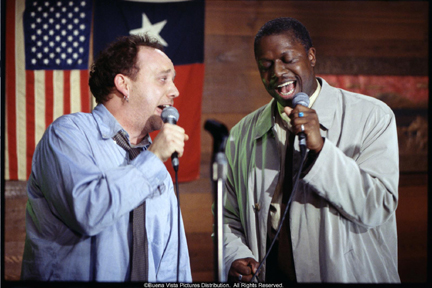
I like movies with heart. “Duets” is a movie with a big heart that nobody went to see. Well, almost nobody. Despite an intelligent, one-of-a-kind script and a star-studded cast, “Duets” tallied a mere 4.73 million dollars in domestic box office sales.* In terms of Hollywood studio economics this paltry sum is tantamount to a financial implosion.
“Duets” is (mostly) a feel-good road movie about people following their hearts and discovering who they are. I don’t see any harm in a story like that, particularly if you can add a few new twists and keep folks smiling. I thought “Duets” did both, but a lot of people disagreed.
I can find only two explanations why “Duets,” a movie I liked, was so universally overlooked by the movie-going public. Explanation 1: I have very bad taste. Explanation 2: An overwhelming number of negative reviews by movie critics cut off the hand that feeds the box office.
According to Metacritic® (www.metacritic.com) a sample of 29 professional movie critics gave “Duets” an average rating of 40 % out of 100. In contrast, a sample of twelve “Users” (people) gave the movie a rating of 8.8 points out of 10. (I realize this is a small sampling of “Users,” but let’s not forget that not many people saw this movie.)
According to this compact study then, “Duets” is a predominantly people friendly movie with an allergy to movie critics.
Here are a few typical movie critic reviews:
“Miserable as it crawls for two eternal hours towards being “life affirming.” Wesley Morris, San Francisco Examiner
“Simply creaks with contrivance—particularly in its overwrought finale.” Curtis Morgan, Miami Herald
“A leaden piece of whimsy that looks for profound life lessons among a group of karaoke bar aficionados.” Steve Daly, Entertainment Weekly
To be fair, some critics praised “Duets, as evidenced by these reviews:
“Her name was Lola. She was a show girl…dah de dah de dah. This movie was fun interesting and catchy. What is better?” James R.
“This movie is engaging, the story unfolds around the music, and Paul Giamatti is great. Apart some predictable things typical nowadays in American movies (family values, etc.), this movie is fun.” Pablo E.
“I loved it. Movie critics suck.” Stephanie R.
“The karaoke scenes were great…the film got me.” John O.
“Bette Davis Eyes…I like this song! Especially when Gwyneth Paltrow sang it.” Jiae K. (I agree with you, Jiae. Paltrow sings the song like a sultry angel in her own voice–no dubbing.)
It’s interesting to note the difference between the critical reviews and the “User” reviews. Critics, for the most part, write about the movie from a purely intellectual and artistic point of view. Believe it or not, I feel strongly this point of view does the movie-going public a disservice. For a more detailed explanation of what I mean by this, please read my earlier post, “Do Movie Critics Have a Heart?”
The people who commented on “Duets” experienced the movie in a completely different way than the critics. They connected with the movie emotionally. They had a good time. People primarily go to the movies to be entertained. I believe this is a fact most movie critics tend to forget.
Here is my own somewhat extended review of the movie.
The script weaves the stories of three sets of people into a road movie unified by the common thread of karaoke. I give the screenwriter, John Byrum, credit for coming up with this unique concept. Before watching the movie, I never knew karaoke bars existed, and people competed in karaoke competitions for cash prizes. I discovered an entire karaoke subculture and its attendant technology. One of the things a good movie will do is open a door to a world you’ve never experienced before. For me, Duets succeeded admirably in this regard.
Good music of any kind never fails to stir the human soul. This comes through in the “User review” excerpts. I found the music and the surprising singing talent of the “A” list actors showcased in “Duets” both refreshing and moving. I am astonished that movie critics, in large part, failed to respond to the musical dimension of “Duets.”
“Hard to take stone-cold sober,” writes critic Jack Matthews of the New York Daily Times.
Instead of asking, “Do movie critics have are heart,” I wonder if it might be more appropriate to ask, “Do movie critics have a heart beat?”
What about the acting? Well, Huey Lewis is definitely a better singer than actor. But I thought he basically got the job done in his role as a karaoke hustler and recalcitrant father. I have some questions about the choices Gwyneth Paltrow made in playing her role as Lewis’ long-lost daughter. I think she was going for innocent, but I didn’t feel it worked. I’d say this was the one major flaw in the film. I thought the other stars, Giamatti, Braugher, andMaria Bello all brought “A list” luster and ingenuity to their roles.
I found the three stories in the movie appealing, and yes, even insightful, some more than others. I enjoy movies that have the unmitigated gall (according to critics) to explore questions like “What the hell am I doing here?” or “What does it take to be a good person?”
I believe the emotional center of the movie revolves around the disillusioned-with-the American-Dream character of Paul Giamatti playing opposite Andre Braugher, an ex-con. Braugher (Life on the Street) brings his customary moral compass and dignity to the role, plus a singing voice you would not believe he commands if you had not heard it yourself. This can also be said for Gwyneth Paltrow, and to a slightly lesser degree, Paul Giamatti and Maria Bello.
I connected with “Duets” emotionally. Like John O said, “…this movie got me.”
I’ll close by saying it’s very hard to make a compelling, engaging movie that switches back and forth between three different stories.Yet here I am, twelve years later, still thinking about “Duets.” Am I smart or senile to like this movie? Why did it fail at the box office?” Did “Duets” make a comeback in movie rental receipts?
If you have the answers to any of these questions, I’d love to hear from you.
*September 17th to October 29, 2000. Source: Wolfram Alpha Computational Knowledge engine (www.wolframalpha.com)
I am trying to write my second novel. It is not easy, to say the least. I am confident, however, that this is a universal truth among authors attempting to write their first or seventy-first long piece of fiction or non-fiction. The reasons for this difficulty may vary from author to author. My main roadblock seems to be the increasing disenchantment of sitting in a room all by myself for long periods of time. Again, I suspect I am not alone in this predicament. The problem apparently extends far beyond the relatively small segment of the population on planet earth attempting to write novels. I know this because I have recently taken my laptop to a local Starbucks to resolve my isolation problem.
The Starbucks I now regularly inhabit is not your everyday Starbucks. Management recently retrofitted the place with long tables, benches actually, with stools and a strip of electrical outlets underneath to plug in battery cables. Droves of people come here, not just to chat and caffeinate, but to do WORK! This includes college-students doing real, actual homework, not wasting time on Facebook. Freelance, self- employed, and independent contractor types also hang out here. These people, like myself, are hard at work, despite the distractions of noisy conversation and often-times idiotic, piped-in music. I find this phenomenal and wonder,”Why do we come here?” Many, if not all of us, are surely not homeless.
I can only speak for myself. I come here to overcome loneliness—to make some sort of connection. And I’m happy to report that my new strategy is paying off. I’m writing my novel on a regular basis, slowly but surely.
Now that we may have some insight into the reason for the overwhelming success of the Starbucks chain, I would like to come to the point of this piece. Many years ago, I began listening to Prem Rawat speak about an inner experience of peace and contentment. At the time, I did not have to go to Starbucks to be around people. I had a full time, good-paying job, a girlfriend, my parents and cousins to surround me. Yet, something was missing.
Mr. Rawat’s message of peace captivated me in a way nothing had previously. I followed up on his promise to reveal a source of peace and contentment within myself. I practiced the techniques of what he calls Knowledge, and, to make a long story short, I have not been in the least bit disappointed. Well, perhaps that statement is not entirely true. I had the idea shortly after receiving the techniques of Knowledge that I would not need anything else, including people. To make another long story short, that idea turned out to be foolish and a bit funny, now that I look back on it.
But there is a point here, somewhere. Oh yes, here it is: I need outer connections—with colleagues in my chosen profession, with friends and family, even Facebook connections. Thanks to the experience of Knowledge, I’ve learned that I need something else. I need a connection with myself for my life to be complete. I’m not going to put a name to what I’ll call “myself,” because I’ve learned that names are insufficient to describe it. I will just say this: I was looking for a missing piece of the puzzle of my life. Prem Rawat helped me to find it. Now, I feel my life is complete. It is full, not stuffed with things on the outside, but from within. And my connections on the outside are more fulfilling, because I am a more full and complete person, with more to offer to others.