Comparatively speaking, writing a novel is the fun, easy, first step of the self-publishing process. The second step, creating an attention-getting book cover, offers its own unique set of challenges. However, the most intimidating and difficult undertaking, to most authors, is the third step—Online Marketing. These words strike terror in many authors’ sensitive little hearts because they want as little to do with the outside world as possible.
The most intimidating marketing question is: “Where do I begin?” In this blog, I’ll let you in on some of the advertising methods I’ve tried and the results I’ve had. I’ll save you time and money. I’ll guide you through the marketing process from the completion of your manuscript to the final strokes of your marketing plan.
Before we begin, bear in mind that more than a million books are published every year. Therefore, we have to be good at marketing. Damn good!
After completing your final rewrite and the inevitable tweaks that come afterwards, it’s finally time to upload your book to online retailers. Next, you announce it on your blog, your author website, your Facebook page, and your YouTube channel (optional).
Now what? Gulp…
This is the seriously hard part—driving people to these outposts in cyberspace.
Let’s take a look at what has worked for me and what hasn’t.
Book Covers
The first step in marketing your book online or ANYWHERE is to create a relatable, attention-getting cover. We’re taught not to judge a book by its cover. Ironically, this principle doesn’t apply to actual books.
I’ve read that the cover of a book needs to be genre specific. By this I mean your reader can quickly identify the subject matter inside, whether it be Romance, Action/Suspense/Adventure/ Thriller, Espionage, Science Fiction, Fantasy, and so on. The trick is to make your book genre specific without making it look like every other book in the space. The idea is to stand out from the crowd, not get lost in it. If you are an accomplished graphic artist, go ahead and do it yourself. Just be sure that you follow the specifications of your print on demand supplier. If you are not a great graphic artist, like me, go ahead and shop for an artist who can turn your cover vision into a commercially viable package.
Please choose an artist with a specialization in book cover design. This person can have other specialties, but they must also be fully versed in the art of book cover design. If you are creating the book cover, make sure to research the subject. There are many pitfalls, just as there are with writing a book.
I used three different artists to create the covers for the three novels I published. Besides the fact that I get bored easily, there may have been a method to my madness. Each of my novels is in a different genre. Some artists have genre preferences and do better work in those genres. There is no set rule. Some artists are good in any genre. They may be more talented and expensive than others, but you won’t have to go through the angst of breaking in new ones. And you may get a better overall result. Or not. Choose carefully.
If you have an idea of what you want in your book cover, great. If you don’t, that’s okay. Just be sure you choose a capable artist who you can communicate with. Don’t be guided solely by cost. Choose someone who knows what they are doing; who inspires your confidence, and “gets you.
Blogging
Blogging is a great way to get yourself and your work “out there.” It’s not hard to create a blog, even for graphically challenged people like me. WordPress and Wix are two of the most popular sites now. You don’t have to be an expert at coding to make a nice looking blog. You can also choose an upgrade plan that will give you more customizing options. I believe the upgrade plans are worth it. WordPress has a premium plan for only $99 per year.
Once your blog is created, don’t let it just sit in Cyberspace. Take a little time each day to read and comment on blogs by folks who write about subjects that interest you. Those people will then read and follow your blog if your content is good.
Take note of how other people promote their work on their blogs. I’ve found that the subtle approach is the best way to do it. Keep in mind that content is king. What you have to say and how you express it will ultimately determine your degree of success. And, make sure the template you use to create your blog is Smart Phone Friendly. I finally woke up to the fact that most people read blogs on their phones. Duh. I dumped my old templates and replaced them with new, easy to read, phone-friendly ones. Now, I’m attracting more followers than ever before, and I’m making many new friends.
Facebook Ads
I’ve experimented with ads on Facebook. I’ve racked up tons of likes and very few sales. In my humble opinion, paying for ads on Facebook is a total waste of time and money for self-published authors. I have an author friend who is running great ads on Facebook, but he’s not selling any books. I’m not saying ads in general don’t work on Facebook. They do. But you are an up-and-coming author struggling to find an audience. You aren’t Macy’s. You aren’t selling specialty items currently in demand like face masks. See what I mean?
Facebook Pages
A Facebook page isn’t essential, but I strongly suggest that you put some time and effort into making a good one. If nothing else, FB pages add credibility and overall impact to your marketing campaign. And they are FREE. You might even sell some books from your page using the SHOP NOW button. Pick a glowing book review and pin it at the top of your posts column. This little maneuver has increased views and engagements on all three of my Facebook pages.
Instagram
Upload a JPEG of your book cover with a link to your Facebook page. If you have lots of friends who spend half of their lives on Instagram, you might get lucky. I don’t use Instagram. Don’t ask me why.
Press Releases
I’ve created and distributed press releases on PR Web with a target audience of 30,000 journalists and bloggers. The idea is to drive traffic to your websites and generate publicity on major news sites and search engines. You can participate at various cost levels starting at $99. The more you spend, the bigger the audience. I participated at the second highest level at a cost of $289 per release. (The highest level currently costs $389). To add interest to the releases, I created a book trailer video. (A simple book trailer without actors will cost anywhere from $250 to $300 from a reputable company).
Bottom line: I could not relate any book sales to my press release adventures. Save your money.
Book Trailers
Book trailers are nice to have but they aren’t essential to your marketing campaign. When I first started marketing my books twelve years ago, the pundits all said that you were dead in the water if you didn’t have a book trailer. As it turns out, this is baloney. Book trailers are a nice addition to your marketing package, but they aren’t powerful generators of sales. I made trailers for my first novel, ThreeDays to Darkness, and my second one, Scarlet Ambrosia–Blood is the Nectar of Life. I had fun making them and they didn’t cost too much. Recently, I used the first trailer I made as the cover photo on my Facebook page. (Note: The video has to be two minutes or less to be uploaded to the cover section). To my amazement it worked. More than a thousand people visited myThree Days to Darkness page in the span of two weeks. I made some book sales at the rate of two percent of the visits. I’m still getting views. But here’s the thing: if you have a limited budget, use it where it will do the most good. I’m getting to that. Stay with me.
Audio Books
If you can swing the cost, make an audio version of your book. As you are no doubt aware, people don’t read as many books as they used to. Audio books are getting more popular every day. I used ACX to make the audio book for my third novel, Micromium:Clean Energy from Mars. I liked using ACX and they are part of Amazon. I signed an exclusive agreement with them, which means I get a bigger royalty (70%) on each audio book sale. With this agreement, your book is automatically uploaded to Amazon, Audible, and iTunes. The downside is, you don’t get exposure on sites like Hoopla, Overdrive, and Bibliotheca, which serve libraries. If you don’t go exclusive, ACX offers a non-exclusive agreement wherein you can distribute to any platform and get a 25% royalty.
If you hire a narrator for your audio book, which you can do through ACX, a good one will probably cost you between $100 and $150 per finished hour. Your narrator does the narration and all of the production work. You direct them and approve the finished product. I had a great time making my audio book with an amazing woman who did a fabulous job. I’ve done reasonably well with my audio book. I’ve noticed that having an audio version available has increased my overall book sales.
Paid Reviews
When you launch your book, you want to have a sufficient number of positive reader and editorial reviews available on retail sites and Goodreads to convert browsers into buyers. Unless you have twenty friends and a handful of book critics ready, willing, and able to post glowing reviews, it makes sense to purchase a few of these.
There are a number of sites available for these services. I have found the best and most reliable site for reader and editorial reviews to be indiereader.com. Check out their website. I bought reader reviews and an editorial review from them. I’m 100% satisfied with their service, reliability, and results. I’ve also used midwestbookreview.com for fair, reliable, and less expensive editorial reviews. Readers Favorite is an excellent site for FREE reviews. Check it out.
Amazon Advertising
Sponsored ads on Amazon.com are the most effective marketing tool I’ve used so far. If you have a limited budget, this is where to spend it. The ads are easy to create. You set your daily budget, write your copy, set your campaign dates, and off you go. If the ad doesn’t work, you can scrap it and try different keywords. You can see which keywords are working and which are not and adjust accordingly. Best of all, you can see how many books you’ve sold and how much it has cost you to sell those books. There’s no baloney and no guesswork. And, let’s face it, most of the books people buy are sold on Amazon. To create a campaign, sign in to your KDP account, select the book you want to advertise, click on the three dots to the far right of the book, and select promote and advertise.
I hope you will find these tips helpful. I wish you all the success in the world, and keep writing.
David Gittlin has written three feature length screenplays, produced two short films, and published three novels. Before quitting his day job, he spent more than thirty years as a marketing director building expertise in advertising, copy writing, corporate communications, collateral sales materials, website content/design and online marketing. For more information, please visit www.davidgittlin.com
The Vampire Lovers from the Novel “Scarlet Ambrosia” Copyright 2016 by David Gittlin
Most serious writers want to connect with an audience; preferably a big one. You have something to say. You have a story to tell. You want people to read it. One of the best ways to make people want to read your work is to create memorable and relatable central characters. Whether you are writing a short story, screenplay, or a novel, you want your readers to identify with and live the story through your main characters. To do this, you have to createthree dimensional characters that live and breathe in your reader’s imagination. I’d like to share with you a method I learned for from professional, published writers.
I started writing in earnest when I began a career in marketing communications. In my early thirties, it became clear to me that writing was the thing I enjoyed doing the most when it came to work. I wrote promotional copy and content for radio and TV ads, brochures, websites, press releases, Power Point® presentations, sales contests and salesperson motivation, and on and on. In my forties, I wrote a few not-so-good short stories. At the age of fifty, I decided to try my hand at writing screenplays. I was scared shitless. Deep down, I really didn’t think I could do it. Some crazy impulse pushed me towards the cliff’s edge and over it into the unknown.
Fortunately, I was old enough to realize I needed help. At fifty, I didn’t have the time or inclination to fall into the traps most beginning fiction writers do. I had already suffered enough scars from learning how to write business communications. I wanted to walk as straight a path as possible in this new world of fiction writing. I knew that mistakes were inevitable. I just wanted to avoid the detours.
Somehow, I found my way to the Online Writers’ Program at UCLA. One of the first things I learned in my online courses was the necessity of building an original and compelling Protagonist and Antagonist plus an interesting cast of supporting characters. Unless you are an incredibly gifted genius, you will need to know your characters thoroughly before you start writing your story. You must know them in detail, including the seminal events that made them who they are today, commonly called their backstory. Why is this necessary? Because if you don’t know who your characters are and what they need and want before you start writing, they will almost certainly be flat, two-dimensional cut outs. At the very least, they won’t be original and interesting.
If you craft your characters carefully and thoughtfully, your story will write itself. Your plot will be character driven, rather than contrived. Your readers will become emotionally attached to your characters.
Okay, I know what you’re thinking: Enough of this baloney. Tell me how to write amazing characters.
There are two methods I can suggest. You can sit down and write everything you know about your character. Hopefully, you’ll fill several pages with your biographical information. If you can do this effectively, more power to you. There’s only one catch: You better know what to include in your character’s bio because, as we’ve said, you have to know your character inside and out. That’s why I prefer the second method, especially if you are new to creating fictional characters.
The second method, which I deveoped from my online courses at UCLA, employs a character template to build your character. I feel it’s better than writing about your characters in an unstructured format because it forces you to answer questions about them that you might try to avoid or just plain leave out. Here’s the template you can use to create central characters with more originality, specificity, and complexity. Filling out the template takes a bit of work, but in the end, I believe it can expand your audience and pave the way to greater writing success.
Character Template
Physiology
Height/weight:
Appearance:
Hair/eyes:
Defects/scars:
Health/strength:
Complexion:
Clothing:
Athletic ability:
Voice quality:
Build or Figure:
Psychology
Fears/phobias:
Attitudes:
Prejudices:
Values/beliefs:
Inhibitions:
Pet peeves:
Superstitions:
Addictions:
Complexes:
Ambitions:
Motivations:
Personal problems:
Secrets:
Disposition:
Needs:
Moral stands:
Imaginations:
Temperament
Likes/dislikes:
Intelligence:
Sociology
Occupation:
Education:
Criminal record:
Birthplace:
Ethnic roots:
Religion:
Past/present home life:
Political views:
Social status:
Hobbies:
Affiliations:
Work history:
Personal life:
Emotional state:
David Gittlin has written three feature length screenplays, produced two short films, and published three novels. For more information, please visit www.davidgittlin.com
I’ve been working towards a spiritual awakening for most of my adult life, and it seems I’m on the brink of a promising development in my growth process. There are many paths to “higher consciousness” and many kinds of spiritual awakenings. In fact, each of us is destined for his or her own unique awakening. For the past five years, I’ve been involved in something called “Waking Down in Mutuality.” WDM is a path that nurtures an embodied individual awakening through energetic transmission and various forms of study and group participation. There are no gurus. It is not a cult. The people who help other people to awaken are teachers and facilitators. There is no hierarchy. There is no dogma. There are no “shoulds” or “oughts.”
The chances are that you’ve never heard of anything like WDM. You’re not alone. Less than one percent of the world’s population is interested in transformative spiritual awakening. You may be wondering why I’m interested. The answer is simple: I want to experience more peace, love and joy in my life than most other pursuits can provide.
Thanks to the evolution of consciousness and the opportunities and modalities provided by WDM and its close relative, Trillium Awakening, I don’t have to be a monk or a saint to awaken. I don’t have to destroy or surrender my ego. I can just be me, whatever that is. I don’t have to separate spirit and matter. I can live a relatively normal life while opening myself to the treasures of the Heart, every chance I get.
Recently, I’ve made a discovery. It’s a big one. It’s really more of an experience than a mental concept. I’ve realized that self-worth ultimately has nothing to do with accomplishment. Equating self-worth with achievement is a trap that most of us fall into.
I’m not saying there is anything wrong with striving to accomplish things, or to be a better you, or in getting better at whatever it is you do. It definitely feels good to get things done and to improve. As an example, I enjoy the feeling of writing this. It feels good to create something new. But writing a best-selling novel will never give me the deep down satisfaction, wholeness, and completeness that my heart craves. This type of satisfaction can only be found buried deep within my heart. The same is true for you.
I’m not sure where I’m going from here, but I’m confident it will lead to more and more happiness and self-satisfaction. It won’t happen overnight. What’s important is that it’s happening. As WDM founder and spiritual teacherSaniel Bonder likes to say, “The Sun in Your Heart is Rising.” That sounds pretty good to me.
This is going to be a rant of sorts with some upside. It’s also going to be a little embarrassing. Maybe more than a little. Anyway, here goes.
I am a very active person. To avoid boring you with the particulars, let’s just say that I lead a busy life chock full of errands and enjoyable pastimes strung together with “work” that I try to make meaningful. I put the word “work” in quotes because I believe that work has to be enjoyable to yield measurable, positive results.
I have done things I really didn’t want to do called “work.” My father once told me that “you can’t always do what you want to do.” This is true, but I think I took what he said to an extreme.
I have read and observed that highly successful people enjoy what they do. They work very hard because they enjoy it. Now, “working very hard” has to be put into perspective in my case. I have never, ever, worked very hard compared to someone like Tom Brady, or Warren Buffet, or my investment adviser.
However, I have worked very hard (for me) at writing. I am passionate about writing. And looking back on forty plus years of writing, I see that what I’ve written has had very little impact as far as making the world a better place to live in. This includes the latest novel I wrote with a subtext about the energy and environmental crisis (Micromium: Clean Energy from Mars.)
This bothers me because I have put a ton of myself into the three books I’ve written, particularly the last one which is available in digital, paperback and audio formats. Another thing that bothers me is the world, not just the Amazon forests, is on fire. We are facing extinction due to the environmental crisis we have managed to visit upon ourselves. The environmental issue has finally become a big topic of discussion, but we aren’t taking the radical steps that are required to confront the problem. That’s why I wrote Micromium a year ago, but it didn’t help. Not the way I wanted it to.
So, if I’ve been doing what I truly want to do for the past thirty odd years, why isn’t it working?
Well, it seems that I finally have a clue. I have not been as successful as I’d like to be because I DON’T BELIEVE IN MYSELF ENOUGH. I’ve learned that a strong belief in oneself and in what one is doing is essential for success. I’ve known about this principle for a long time, but knowing about it and doing something about it are two distinctly different things.¹ Just like the environmental issue.
Recently, I’ve found a way to significantly cut through my self-doubt. It’s called Somatic Experiencing. Since starting this training a month ago, my energy is more focused and it is coming from a deeper place. I’ve already witnessed some positive results. Nothing big mind you, but definitely positive in relation to myself and other people. I’m in the beginning stages of this process, and I hope there will be much more growth to come. Who knows? Maybe I’ll make some positive waves in this troubled world. It’s never too late.
Thanks for reading this. Hope it helped.
¹I’d also like to mention that it helps to do the thing or things you are designed for. It’s important to find your true purpose. This isn’t always as easy as it sounds.
David Gittlin has written three feature length screenplays, produced two short films, and published three novels. Before quitting his day job, he spent more than thirty years as a marketing director building expertise in advertising, copy writing, corporate communications, collateral sales materials, website content/design and online marketing.
I merge with the beauty that I am and the beauty that we are. I sing the body ecstatic. I consciously raise my vibration out of the ordinary into the extraordinary.
I am no longer bound by the constraints of frustration and the boredom of routine. This is the new world I have been seeking. In this moment, amidst the peace and the flow, nothing else matters.
The problems of the world don’t exist. My perceived problems don’t exist because the wall of separation is breaking down—like the Berlin Wall.
The minor irritations don’t exist because everything is taken care of in this moment of sublime peace and bliss.
Yes, it is possible to live in an ocean of tranquility; to drink divine nectar; to radiate joy to every person I meet; to live beyond prescribed norms.
The Heart of Life opens. I jump from my perch of uncertainty and the light opens its arms to me. It is a good light. It will not hurt me. I trust it will take me where my heart truly wants to go.
I am not alone. I fear no evil. I have faith. I have trust. I believe in myself and the essential goodness of my creator.
I am love. I am beauty. I am everything I want to be and beyond.
There is no end to the depths and heights of this glorious reality.
David Gittlin has written three feature length screenplays, produced two short films, and published three novels. Before quitting his day job, he spent more than thirty years as a marketing director building expertise in advertising, copy writing, corporate communications, collateral sales materials, website content/design and online marketing.
“We don’t stop playing because we grow old; we grow old because we stop playing.”
George Bernard Shaw
There is a child in me that wants to romp and play in sunlit fields.
If there are no sunlit fields to play in, then the child invents one with his imagination.
The child knows that there is a real world beset with serious problems and pitfalls. The child also knows that there are admirable people who face these problems head on every day to make the world a better place. These people have a calling to do what they do.
The child prefers to live in sunlit fields, dreaming of a better life. The child knows that if it can make its dreams come true, then others will be inspired to do the same.
Perhaps dreaming is the child’s calling.
I have dreamed big dreams. Some of them have come true. I cannot measure the impact that my dreams have had on others, nor should I care. I can only go on dreaming and manifesting them.
David Gittlin has written three feature length screenplays, produced two short films, and published three novels. Before quitting his day job, he spent more than thirty years as a marketing director building expertise in advertising, copy writing, corporate communications, collateral sales materials, website content/design and online marketing.
Something is prompting me to write this, even though I’m far from an expert on the subject. I’m writing about an inkling. This mysterious prompting tells me that the inkling is a precursor to the direct knowledge of the something prompting me. If I’m confusing you, I promise to be more clear in what follows.
What I’ve heard, read, and now feel strongly, is that each one of us carries a seed of the divine within us. And, believe it or not, the ultimate purpose of human life is to discover this seed, water it, and watch it bloom into a gorgeous individual expression of the divine. Please don’t be put off by the word “divine”. I have to use a word to describe this miracle. It can be described by many names, so I invite you to choose one that you feel comfortable with.
I’m going to go way out on a limb and try to describe what the divine means to me. First of all, it’s a feeling or combination of feelings rather than an idea. It is peace, joy and love. It is a sense of “all rightness.” It is the certain knowledge that the divine is benevolent. It wants what is good for me. It does not want to hurt me. I feel this very deeply, although my mind often tries to tell me not to trust it.
When we access the divine within, we find that it is a place of peace. It is a refuge from the troubled world outside. We can access this inner world through a daily practice of meditation. In the case of an awakened being, the divine can be accessed by the simple awareness of what’s happening in the present; an awareness of everything that is arising from within and the deeper sense of peace, joy and love underneath what is arising.
Accessing this place on a daily basis keeps me sane.
The divine is so much more than mere words can express. It is so much more than I’ve expressed here. That’s all I have to say for now.
Oh, wait. I promised to talk about the light streaming through my body that I described at the end of my last blog “Innate Goodness.” I’ll try to keep this brief, because I know I’ve already blabbed for too long.
There’s a lot of stuff happening in the world that is bad—really bad. We know this, and we tend to focus on the bad stuff. So, I’m asking myself: what is good?
For starters, we are good—even the worst of us. The trick is; how do we get to that goodness?
I have found that it takes some work to get to the goodness. In my case, it’s taken a hell of a lot of work. It’s taken constant digging. I know what I should do and what I’m supposed to do. I’ve gotten pretty good at doing the stuff I need to do and should do. For example, I’m thinking about working for the best democratic presidential candidate that I can find. Am I excited about doing this? Not really. It’s just a matter of necessity. We have to remove the lunatic currently occupying the White House.
Okay, so there are all sorts of things we have to do and should do. What about the good stuff? What about the place inside where goodness happens naturally? It’s a feel-good place and the source of true inspiration.
When I meditate in the morning, I have, on many occasions, experienced the good place inside me. I’ve experienced peace, love, and joy. I like these feelings. Who wouldn’t? The problem is that these feelings fade away too quickly. I often wonder how so many people do so many good things consistently. I’m thinking of people like doctors and nurses, of gifted mental health counselors, of social workers, of accountants who work hard under heavy pressure to provide essential services to businesses and individuals. The list goes on. How do you guys do it EVERY DAY? If you are a hard-working person, please clue me in.
Why do I wonder? Well, I like to PLAY. I try to make a game out of everything I do, except going in for a colonoscopy. I admit that one is a bit of a challenge. Not too long ago, I held down honest jobs in sales, marketing, and real estate. I even did accounting for a while. I worked in a family business for thirty years doing all of the above–not hard work, mind you–just plain old don’t kill yourself work. After all of those years of (ahem) work, you would think I’ve changed, matured, and learned to accept that life is hard and full of work. Nope. I haven’t changed one bit. I still like to play. I envy people who like to work. I imagine it’s much easier to live in the world as an adult if you like to work. I wouldn’t know, of course.
Are you resonating with any of this? If yes, please drop me a line or two.
Let’s get back to the essential goodness inside each one of us. How do I (we) tap into it more consistently? It drives me nuts how it comes and goes. If I’m feeling more peace, more love, more joy, than I can be and do more for other people. I’m working on making these good feelings more consistent. If I can pull it off, I’ll be sure to brighten your day with some goodness first aid.
Update: I have found a way to make this happen with something called Somatic Experiencing. In my third session, I felt and visualized light pulsating throughout my body and mind. Now, I feel more grounded. I feel more ALIVE. Since I know blogs are not supposed to be too long, I’ll write more about this in my next post. Stay tuned.
David Gittlin has written three feature length screenplays, produced two short films, and published three novels. Before quitting his day job, he spent more than thirty years as a marketing director building expertise in advertising, copy writing, corporate communications, collateral sales materials, website content/design and online marketing.
My father is back. He’s forty-five-years-old. He looks just like himself, except he’s learned not to smoke. He’s learned a lot of things in heaven, not the least of which is how to be a better human being. Ever since he died in 2006, I have thought of my father as Morton rather than my father. As you might have guessed, Morton and I were not exactly bosom buddies before this new version came along.
This new Morton has a beautiful new wife who is not my mom. She’s a brunette, tall, with a model’s figure, and she’s smart and very good at human relations. She has to be to get along with Morton. She doesn’t take abuse from anyone, including Morton. She is a deeply rooted human being who can correct Morton when he gets mean or when he gets too into his work and forgets to be a person. Her name is Jennifer. Her maiden name is Jennifer Ward-Allen. She’s from a mixed Jewish and Irish family, which is odd. Her hair is red and her complexion is fair. She has green eyes. She doesn’t look Jewish, but she is Jewish, which works for Morton. Jennifer exudes an inner as well as an outer beauty. Although I had no problem with my original mother, I sense that this woman is much more caring, present and aware.
Last week, I went to sleep as a seventy-year-old family man, and woke up as a twenty-five-year-old single man. After recovering from the shock of looking in the mirror, I take stock of my surroundings. I quickly discover that I’m not living in the beautiful home my wife, Bonnie, has made for me. It’s a sterile apartment where I used to live in North Miami. The place has since been torn down and redeveloped into two luxury condo towers, but now it’s back to being an aging complex known as “The Summer Winds Apartments.”
My first concerns as a twenty-five-year-old are for my wife and daughter. Will I ever meet my loyal and devoted wife Bonnie again? If I do, will we have our precious daughter, Danielle? As I contemplate these disturbing eventualities, the phone rings. I go into the galley-sized kitchen to answer it.
“Hello?”
“This is your father calling. Remember me?”
“Who is this? You have some nerve calling and impersonating my father. If you are a telemarketer, I’m going to report you to the FTC and the Florida Attorney General’s office, and to any other law enforcement agency that will listen.”
“Calm down, David. It’s really me.”
“How can it be you? You died thirteen years ago.”
“It’s me, son. You kept thinking about the good times we had with the racing stable after we sold the business and you got married. You were wishing for those good times again. You were wishing you could be young again. Well, someone up there must like you, because I’m back, stronger than ever. You remember that Wall-Tex commercial where they used that slogan after they settled the plant workers strike.”
“How can I forget? How can I forget anything we did? But how can this be you? You expect me to believe this is some kind of miracle?”
Morton sighs heavily. “Oy vey, David. Don’t make this harder than it has to be.”
“Okay. If you’re my father, then what was the name of the horse we owned that won the In-Reality Division of the Florida Stallion Stakes?”
“The last shall be first.”
“His name was Silver Sunsets.”
“How did he run?”
“He came from dead last at the quarter pole to first place at the wire.”
“Oh my God. It’s really you.”
“Live and in living color, my boy. Now, can we get down to business?”
Morton asks me if I might be interested in doing marketing for his new company.
The company is a custom packaging manufacturer equipped with an expert design team and all of the latest online ordering applications. The company’s potential is worldwide and unlimited. Morton plans to develop a top notch, multi-lingual sales force under one roof using state-of-the-art, virtual training programs. He tells me to be ready to work if I come on board, because, “You know I don’t settle for anything except hitting our goals, and I set high goals, in case you forgot.”
I say, “How could I ever forget.” He says, “Good. Show up to meet this guy at nine at such and such a place.”
I meet Morton’s new Vice President of Marketing and CEO. He has the combined personality of two of my previous bosses, plus, I sense that he’s better at making money than either of them. He just understands what is required to make money. He has the instincts and the knack for it that can’t be taught, just like Morton.
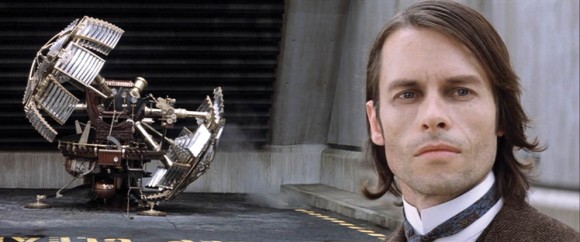
The guy’s name is Guy Pearce, like the actor. He’s thirty-two with brown hair and hazel eyes. Incredibly, he bears a striking resemblance to the actor. When I ask him if he is THE GUY PEARCE, he shakes his head and says, “never heard of the guy, I mean, you know, that Guy.” “Funny,” I say. “You look just like him.” Then I ask him if he’s seen the HBO version of the movie “The Time Machine” starring Pearce. He just stares right through me. This Guy is a no nonsense guy.
Pearce asks me what I’ve been doing. I show him a paperback edition of “Micromium: Clean Energy from Mars.” I show him my website, my blog, the digital book, and the audio book. I show him the other two digital books I’ve written, “Scarlet Ambrosia” and “Three Days to Darkness.” I talk about how I conceived Micromium, wrote it, and created four versions of it. He reads the copy on the back. He asks me what I did in my last job. It seems like the last honest job I had was in a previous incarnation. I don’t tell that to Pearce. I tell him the highlights of Fulfillment Online and Business Cards Online, two proprietary, ground-breaking online ordering applications that I marketed at a direct mail, printing, and fulfillment company my family owned. I tell him I created a mailer that landed more than fifty Fortune Five Hundred Companies as clients. I tell him that I have created just about every type of marketing and communications campaign imaginable at the two previous companies where I worked as marketing director. I conveniently leave out the fact that my previous bosses were instrumental in my success.
He picks up the Micromium full color print edition and tells me, “This right here shows me that you’re qualified to do what this company needs. You can create content and packaging and sell it. That’s marketing A to Z. If you can take direction, then I’m proud to welcome you aboard. Do you want the job? I nod my head. I’m not sure that I want an honest job again, but what the hell. It’s getting lonely writing books that are really tough to sell.
I watch anxiously as Pearce picks up the phone and calls Morton. He says, “I just hired David.” I overhear Morton saying “Good. It’s about time he got back to work.”
I guess the twenty year vacation is over. Now I have a REAL job to get up for every morning. I feel important, valued. That’s what I want. I don’t enjoy being irrelevant. It’s very easy to become irrelevant at my age. Oops, I mean my former age.
I suddenly remember this new edition of Morton telling me as a young boy things like: “When you grow up, you will be in a world much different than the one you’re in now. Everything won’t come easily to you. You’ll have to earn the respect of your peers and your supervisors. You’ll have to earn everything. It won’t be given to you like it is now.
“You can start right now by believing in yourself. You can see that I’ve accomplished something in my life, and I have much more to accomplish. You can accomplish and be a winner too if you believe in yourself. Listen to the things I tell you. What I tell you will always be for your own good. You can trust me and you can trust what I tell you. You don’t always have to agree with me, but I’m asking you to listen first, and then we can discuss things. There will be many situations that come up and they will be learning experiences. We need to talk about them. Don’t be afraid to talk to me. My door will always be open if you need to talk.
“There are winners and losers in this world, David. You want to be a winner. Winners are generally happy people. I’ve never met a happy loser.”
These are the things a father needs to tell his son. These are the sort of things Morton never told me. Hey, I’m not feeling sorry for myself. I’m just sayin’. If you are young and you are reading this, make sure your Dad tells you these things, and if he doesn’t, then remember what I just said. Got it? Good.
I also have new memories of going to the racetrack with Morton to watch the horses run. I remember him teaching me how to read the racing form. In my first life with Morton, I never even knew he went to the racetrack occasionally with my mother. It wasn’t until he started a racing stable and asked me to be a partner in Three G Stable that I learned of Morton’s interest in horses and the the amazing sport of horse racing. Not many people have the opportunity to see the sport from the inside like I did. It’s something I’m extremely grateful for. I’ll always treasure sharing those experiences with my parents and my daughter Danielle. There really was a Three G Stable. I really did go to the barn and the petting zoo with Danielle. We really did have many claiming and allowance winners and stakes winners.
Oops. I’m waxing nostalgic. Gotta get back to business.
The new Morton decides to buy a farm in Ocala to breed, race, and sell thoroughbred race horses. We purchase two freshman sires, one from the Galileo/Saddlers Wells line for turf horses, and one from the Northern Dancer and Mister Prospector cross for dirt horses that can also potentially run on the turf. Both of these Florida Stallions turn out to be leading sires, not just in Florida, but in the Eastern United States including Kentucky. We get offers from Kentucky to buy the two stallions, but we keep them in Florida. We buy well-bred stakes winning mares at auction to breed to our stallions. We keep a few of the offspring to race ourselves. We claim horses to fill out the stable. My love of breeding horses and the sport of racing is rekindled. I enjoy working in the packaging company and what I do with the horses is a labor of love.
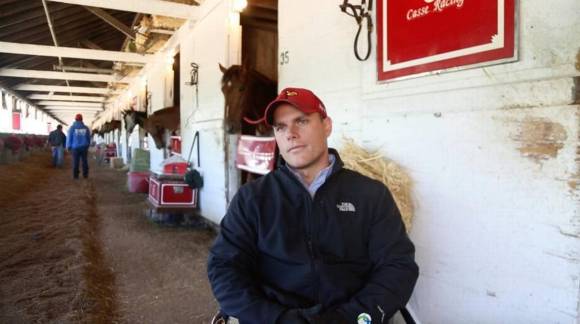
We hire Mark Casse to be our trainer. Mark is the son of the legendary Norman Casse, a Florida breeder, owner, and Co-founder of the Ocala Breeder’s Sales Company. Mark is destined to become a world class trainer. At the time we hire him, he is a young man starting out in his career with a reputation as a patient handler with a knack for developing every horse in his care to their fullest potential. I find Mark to be a quiet, humble man with an innate love for his horses. He treats all of them as individuals, and gives them the time and the attention they need to mature into winners.
One of the horses Morton and I breed shows great promise as a yearling. We decide to keep him and race him when he doesn’t reach his reserve at public auction as a two-year-old. He is by Classic Empire out of an Unbridled mare who has already produced two graded stakes winners. We name him “Beautiful Dreamer,” after the title of my second screenplay. We call him “Dreamer” for short.
Dreamer matures slowly. He shows no aptitude for short races in his early training. He wins his first race at a mile and then runs second in the Foolish Pleasure Stakes at Gulfstream Park. It is a prep race for the In-Reality stakes, the biggest race at Gulfstream for Florida-bred two-year-old colts and Geldings. Like Silver Sunsets, Dreamer has a grey coat and wins the In-Reality Stakes. Beautiful Dreamer goes on to run third in the Breeder’s Cup Juvenile at Churchill Downs. We put him away at our farm for the winter after the Breeders Cup, and run him back at a mile on the turf in an allowance race in January at Gulfstream Park. He runs second in the race. From there, he runs second in the Fountain of Youth Stakes. Mark encourages us to run in the Florida Derby against the best thoroughbreds stabled on the east coast. We listen to his advice, and Dreamer wins the Florida Derby at the relatively long odds of eleven-to-one. The fact that Dreamer was not one of the favorites in the field is an indication of the high quality of the horses he beat.
The Florida Derby win qualifies Dreamer for a spot in the Kentucky Derby. After huddling with Mark, we decide to enter Dreamer in the mile and a quarter first leg of the Triple Crown. He draws post ten in a full twenty horse field. He’s a horse that possesses tactical speed, but he doesn’t break alertly when the gates open. He’s ridden by Julian Leparoux, an excellent rider, who manages to recover after the bobbled start. “Dreamer” circles wide around horses at the quarter pole turning for home and rallies furiously down the stretch to finish third at odds of seven-to-one. It’s a respectable showing, but we’re disappointed. We now know that Dreamer had a legitimate chance to win the race with a better start. It hurts, but that’s horse racing.
We think about going on to the Preakness Stakes, but decide against it, opting instead to enter the Haskell invitational Stakes for three-year-old colts at Monmouth Park. The track comes up muddy on a rainy day. Dreamer stalks the winner all the way around the mile and an eight race, but he can’t get past a clear front runner who is bred for wet tracks and scores at odds of nineteen-to-one. Dreamer goes off second choice in the race at odds of five-to-two. The nine-to-five favorite finishes third.
Should we go for the Grade One Travers Stakes at Saratoga Race Track in upstate New York? We decide against it, opting instead to enter Beautiful Dreamer in the Suburban Stakes at Belmont as a Fall prep for the Breeders’ Cup Classic later in November if he does well. Once again, Dreamer finishes second after tracking in fourth place behind a fast pace. Dreamer looks like a winner seventy yards from the wire, but another horse passes him five yards from the wire. We decide that Dreamer is good enough to run in the Breeders’ Cup Classic. Mark elects to change riders for the race. First, we ask Jose Ortiz to ride Dreamer in the Classic, but he has another commitment. Then we ask his brother, Irad Ortiz Junior to ride for us. He accepts the mount. He likes our trainer, and he wants to give Mark a chance to put his name down in racing lore. We’re confident that Irad will give us a better chance of winning with his impeccable sense of timing. Irad has had his eye on our horse for a while, and he’s confident that he can move Dreamer up several lengths with the right ride.
Meanwhile, my father, stepmother and I are having the time of our lives with this horse. This year, Gulfstream Park is hosting the Breeders’ Cup races for the first time in twenty years. It makes it much easier on our horse. Dreamer is familiar with the track because he is based at Gulfstream and trains there. He also doesn’t have to travel, which for many horses can be an energy-draining and disconcerting experience. Horses get nervous when their routines are interrupted, and they don’t like being cramped up in unfamiliar spaces. After hundreds of years of inbreeding, thoroughbreds still have their deeply ingrained instinct to run at the first signs of danger. It’s hard to run from danger in the cargo hold of a jet plane.
Finally, Breeders’ Cup Day dawns bright and sunny with no rain in the forecast. We’re relieved, because we don’t want to be wired on a wet track by a freak front runner like what happened in the Haskell. Dreamer has been training brilliantly for the race. Our trainer, Mark, says he’s in peak form. Dreamer is the fourth choice in a fourteen-horse field behind two heavy favorites and another highly regarded horse owned by John Magnier, the super-rich founder of Ladbrokes, a chain of sports betting parlors in England. We have our work cut out for us. Mark is his usual quiet and calm self. He’s never been much of a talker, but we can tell that he’s excited about the race and our chances. He can’t wait to get Dreamer in the gate.
We watch and bet the races, having fun and forgetting about the big race. It’s an interesting day with favorites and long shots winning and placing throughout the card. The European horses win most of the turf races while the American horses generally prevail on the dirt. The Breeders’ Cup racing card is probably the most fun card to bet all year. The fields are big and almost every horse in each race has a chance to win because they’re all so good. So, I like to get creative, which usually results in me losing my butt. Still, it’s fun.
At five-thirty, we leave our seats and a courtesy golf cart designated exclusively for the Breeders’ Cup owners transports us to the barn where beautiful Dreamer is waiting. He’s happy to see us. His big head bobs up and down and his front hoof paws the straw in the bed of his stall. Carefully opening the stall door, Mark attaches a chain to Dreamer’s halter and leads him out. He stands before us at attention, his gray coat dappled, radiating energy and health. He knows it’s time to race, and somehow, I sense that Dreamer knows that what he’s about to do is special. Horses are creatures of habit, and Dreamer know it’s later in the day than he’s ever run before. His eyes dart from Mark to Morton and to me, as if he’s asking for an explanation of what’s going on. Mark places a reassuring hand on Dreamer’s shoulder, and I stroke his flank gently to let him know everything is alright. Mark says something into Dreamer’s ear. He flicks it forward to listen. Whatever Mark said, it calms Dreamer down immediately. He’s ready to do whatever is asked of him.
We accompany Dreamer and Mark all the way from the barn to the saddling enclosure where Mark will saddle and prepare Dreamer for the race. The crowd in the stands and on the grounds has swelled to over one hundred thousand people. Police officers patrol the saddling enclosure looking for possible trouble and to make sure the onlookers stay behind the ropes and temporary fences where they belong. I feel very important to be one of the relatively few people on the other side of the barriers. Dreamer is taking in all of the excitement like a pro. I sense that he has his mind on running, and somehow, he knows the horses that he’ll be competing against are better than most of the ones he’s faced before. He looks down and shakes his head and long silvery mane, as if to shake out any last remaining knots of tension. Mark strokes Dreamer’s shoulder and head to keep him calm and relaxed.
Irad Ortiz enters the enclosure. He shakes our hands. We wish him luck. He gives Dreamer a few reassuring pats on the shoulder. The horse immediately feels at ease with Irad. Irad has been aboard Dreamer to breeze him five eights of a mile a week before the race to get acquainted. The two of them are a team now, as if they’ve known each other for years. The call comes for “riders up.” Mark has already spoken to Irad about the race earlier in the day to give him his riding instructions. Now, all he has to do is to give Irad a leg up and tell him to “have a good trip.” Irad expertly guides Dreamer away. We watch them disappear into the tunnel leading to the racetrack. Mark gives us a thumbs up. He likes to watch the races by himself when he saddles a horse, so we go our separate ways back to the owner’s box and Mark to his observation post.
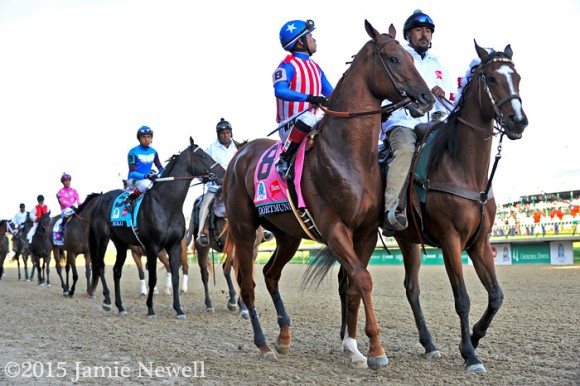
The horses for the Breeders’ Cup Classic file by the stands in the post parade. There are fourteen horses in the race. Dreamer has post position seven. His post position gives Irad an excellent opportunity to settle Dreamer optimally going into the first turn of the mile and a quarter race. The major objective for Irad is to secure a good stalking position without going wide. All of the jockeys will be trying to save as much horse as they can going around the first turn and up the backstretch. If the horse is a front runner, the jockey will be trying to slow the pace down as much as possible. The other jockeys have to be alert to the pace and settle their horses accordingly. If the pace is slow, the horses that run from mid pack and beyond will have to stay closer than they normally would if the pace is honest. The first half of the race is just as important as the last half. A jockey’s mistake in judgement can cost a horse all chances of winning before they reach the half-mile pole.
Dreamer is prancing on his toes with his head held high as he passes us in the post parade. Mark has obviously done the most anyone can do to prepare Dreamer for the race. Now, the rest is up to the horse. Dreamer is a solid fourth choice at odds of five-to- one. Morton bets a hundred on him on the nose—typical Morton. I bet twenty on Dreamer to win. I know that Mark never bets on the horses he trains. It’s a good habit. Many lesser trainers bet on their horses because they think they will make a big score and they need the money. Sometimes they make that big score, but it’s just not a classy thing to do. The top trainers don’t do it.
Ten minutes later, the horses have warmed up and are entering the starting gate. Mark has instructed Irad to do a minimal prep for the race, just a slow, short gallop to get his legs and muscles loose. We watch the loading through binoculars. The horse in slot six is acting up, delaying the start. We can see Irad stroking Dreamer’s mane to keep him from getting upset by the unruly horse next door. Finally, all of the horses are loaded. We wait nervously for the starter to open the gates. It seems like an eternity, then the gates spring open and the horses explode out of the gate with pent up energy. The number five horse from England veers in and knocks the four horse off stride. Irad deftly guides Dreamer away from the trouble. The rest of the field sorts itself out naturally after the troubled break.
Due to the mishap, Dreamer runs third in the fourteen-horse field, closer to the pace than he normally likes to be. Irad lets him settle back into fourth, but the bulky field is tightly bunched behind the two horses battling for the lead. The number four and ten horses cut out the first quarter in twenty-three seconds flat, which is fast for the mile and a quarter distance. The number ten horse backs off and lets the four horse have the lead. They go the half in forty-seven and one fifth seconds, a more reasonable pace. Irad keeps Dreamer poised in fourth place. As the horses reach the three-quarter pole, the number ten horse moves up to challenge the four horse for the lead again. The pace quickens. Irad stays put as other horses pass him on the outside. I grow concerned that Dreamer will not be up to the challenge of running against the best horses in the world. In my imagination, I see Dreamer floundering on the rail and falling behind as the serious run for the finish line begins.
The front runners reach the quarter pole in one minute ten and four fifths seconds. It’s an honest pace for horses of this caliber. Now, Dreamer starts to move up on the rail as the horses turn for home. Irad is taking the shortest distance home. The danger of another horse blocking him looms. It’s a risky move that Irad attempts, but he has no other choice. He will lose too much ground if he tries to go around horses. Irad has one of the best clocks in his head of any jockey alive. I know that his timing is impeccable, but the rail in front of him is suddenly blocked by the tiring front runners which are slowing and shortening their strides. Irad has to make a move; now or never.
Irad angles Dreamer off of the rail. I see another horse rushing up behind Dreamer vying for the same lane to the wire. Irad taps Dreamer on the shoulder with his whip and the horse responds with a burst of acceleration, beating another horse to the three-path.
Dreamer blows by the faltering front runners and opens a clear lead down the homestretch. With a similar explosion of speed, I watch the number one horse, named Bal Harbour Boss, burst out of the pack in mid-stretch. It gobbles up ground from behind Dreamer with every stride. The fast-closing “Boss” reaches Dreamer’s flank on the inside and they run in tandem, neck and neck to the wire. As Dreamer and his adversary pound to the wire lengths in front of the rest of the field, I expect Bal Harbour Boss to tire because it has had to cover more ground with a wide ride outside of horses up the backstretch all the way to the quarter pole. Except the damn horse is resolute. It won’t give an inch.
The hundred thousand plus throng of spectators bellows so loud that it feels like the ground is shaking and an earthquake is coming. The Jockeys urge their mounts onward. The race announcer’s voice crescendos as Dreamer and Bal Harbour Boss bob heads to the finish line. Photo finish. I can’t tell if Dreamer got his head up in time. It’s impossible to tell with the naked eye which horse has won the race. So much is on the line. The first-place purse is worth three million dollars. The winning horse will command a high stud fee. And then, there’s the thrill, prestige, and satisfaction of winning one of the biggest races in the world.
Morton is white as we wait for the results to be posted. I give him a hug and tell him. “No matter what, we proved that Dreamer has the genes and the heart of a champion.” Morton says nothing. He stands there, white as a sheet. I know what he’s thinking. Second place is “nowheresville” in Morton’s vocabulary.
The results flash on the tote board in the infield. The number one is posted on top of Dreamer’s number seven. Morton slumps. We’ve lost. We’ve been nosed of the win. Then a red square appears around the two top numbers. Next to it, the words “DEAD HEAT” flash in red. It’s a tie. Beautiful Dreamer is a co-champion with Bal Harbour Boss. I hug Morton. I hug my stepmother. We are delirious. Sharing the top honors beats the hell out of losing. The dead heat is the first in Breeders’ Cup Classic history.
We meet Mark in the winners’ circle. I can tell that he’s beside himself. He doesn’t show emotion easily, but he’s obviously overcome by the biggest achievement of his training career. The winners’ ceremony is a long one because both horses and their entourages have to be photographed. I hug Mark. I hug Irad Ortiz. They are both slightly taken aback by my display of emotion, but I can tell they understand. Mark and the Jockey are both ecstatic, albeit a bit more quietly.
The sight of Beautiful Dreamer wearing the Breeders Cup Champion yellow garland of flowers will be forever etched in my memory. Sharing a moment like this with signicant others goes beyond any feeling I can describe. I can’t remember anything immediately after the race. I’m just somewhere else, and it’s a very good place to be. The next thing I know, I’m driving to a restaurant in North Miami for a victory dinner.
After several hours of intense celebrating with my father and Jennifer at an excellent Italian restaurant named Il Tulipano, I return to my humble one bedroom apartment and stumble into bed. I’m asleep in seconds from the sheer exhaustion of a long day filled to the brim with exciting moments. When I wake up, I’m back home with my wife, seventy-years-old again. My first reaction is bitter disappointment, but then I realize that I have my wife and daughter back again. I remember what my father said at dinner in Il Tulipano, another ghost of the past that has disappeared and moved on. With his wine glass raised, my father said: “We’re fortunate to have won this race, but what’s most important is that we’re together and we care about each other.” My father’s words remind me to appreciate the people who are with me now.
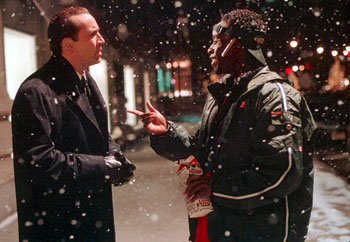
Was it all a dream, or did it really happen? I decide it was just a glimpse, like in the movie “Family Man” with Nicolas Cage, Tea Leoni, and Don Cheadle. An angel has given me a glimpse of what my life actually was and might have been, like Don Cheadle did for Nicolas Cage in the movie. Yeah, that’s what it was; a beautiful dream that became real for a few fleeting moments in time; a precious glimpse that has taught me to appreciate my life and loved ones; past, present and possible.
Nicolas Cage and Don Cheadle Copyright 2000 Universal Studios
Where does self-confidence come from? Where does it go when we need it most?
How does an energetic child with a mountainous capacity for curiosity grow into a narrow-minded, emotionally constricted adult full of hopelessness and suffering?
The answer is simple. We lose the key to the door that opens to a satisfying existence; belief in ourselves and the faith that every day can be sculpted into a masterpiece of joy.
Self-confidence is an elusive commodity that fluctuates with life’s events including, but not limited to; our mood, brain chemistry, the weather, acceptance or rejection. It is a fragile, unpredictable elixir; here today, gone tomorrow. Yet for a fortunate few, it is a constant, a second nature, a faithful servant and friend.
With self-confidence, we can create the next, great wonder of the world. Without it, we walk bent over through life, a mere shadow on the wall, a faint reflection of our glorious and noble human potential.
If your self-confidence is at a low ebb, you can take the first step towards a more joyful and productive life by LOVING YOURSELF. Forgive yourself for past transgressions, whether real or imagined. Start each day with a clean slate. The past is dead. The future is a possibility based on how you think and what you chose to do in this very moment.
Think with hope in your heart. Hopeful thoughts are positive, creative, loving thoughts. Hopeful thoughts will fill you with possibilities. They will fill you with confidence in yourself because they come from your TRUE SELF; the real you.
There are always two roads stretching before us. One road leads to freedom and JOY. The other one leads to misery and limitation. Take the time, right now, to cast away doubt and fear. Listen to your inner voice, the one that wants to set you free.
Self-confidence comes from being the person you truly are; your best self. Trust yourself. Love yourself. Let the flame of love grow in your heart. Seek the sources that support and nurture your truest and best self. Self-confidence will bloom automatically, along with passion and the freedom to enjoy life.
David Gittlin has written three feature length screenplays, produced two short films, and published three novels. Before quitting his day job, he spent more than thirty years as a marketing director building expertise in advertising, copy writing, corporate communications, collateral sales materials, website content/design and online marketing.











 Heart Banter by David Gittlin