When Jim Brickman began taking piano lessons at the age of five, his first teacher reported to the boy’s parents that he showed little promise as a future pianist. The student didn’t follow directions. He did things his own way.
I can think of four reasons why Jim’s first teacher thought so little of his potential. Either the boy was unusually rebellious, lacking in talent, or mentally ill. The fourth reason proved to be the right one. Jim was born with extraordinary talent.
Fast forward a half-century. Jim Brickman is known as one of the world’s foremost Romantic songwriters and solo pianists.
Brickman started his career writing advertising jingles. To call the man persistent is probably an understatement.
To his credit, Jim has recorded twenty-one number-one albums, thirty-two top radio hits, and he has been nominated for two Grammy Awards. He is also a published author and appears on his own radio show, “The Jim Brickman Hour.” Not bad for a kid with no potential.
Many of Jim’s songs have been covered by leading pop singers such as Carley Simon, Olivia Newton-John, Johnny Mathis, Kenny Logins, and others.
“The Love of My Life” is one of Jim’s better-known and typically beautiful songs. I’ve adapted it for the acoustic guitar. Here’s my version.
By Developing the Habit of Focus and DisciplineYou Will See Your Dreams Come True.
Don McLean released his iconic album, “American Pie,” in 1971. The title song epitomizes the era of the nineteen-sixties. A famous lyric from the title song, “The Day the Music Died,” refers to the day Buddy Holly’s plane went down. Holly and the other passengers, including Ritchie Valens and The Big Bopper, all died in the crash. The song “American Pie” lasts for nearly nine minutes, memorializing other landmark events of the era through rich metaphors. Some of the other outstanding songs on the album include “And I Love You So,” “Crossroads,” “Empty Chairs,” and “Vincent.” I’ve covered these songs in earlier posts on this blog.
“Winterwood” is an upbeat love song featuring McLean’s typically vivid imagery. Technically, the title of the song does not exist in the English language. McLean invented the name to evoke the sights and sounds of a snowy mid-winter day with the sun peaking through barren tree branches and birds chirping in the background. The image came to Mclean as he rode through mid-winter streets recalling fond memories with his wife by his side. The image and the related memories stayed with the artist for six months until he finally wrote “Winterwood.”
The technique is a departure from the finger-picking method I used in many of the other songs I’ve posted. “Winterwood” is played entirely with a guitar pick (flat picking). I abbreviated the introductory lick because it might have taken me six months to learn.
“True Colors” is a song with legs. It started out as a song written for a mother in a traditional ballad format. Billy Steinberg and Tom Kelly wrote the song in 1986 and offered it to Anne Murray, a popular singer at the time. Murray passed on the song. Cyndi Lauper took it and creatively revamped the format into a stark and breathtaking version.
The song became a hit worldwide because of its universal appeal. The songwriters acknowledge that Lauper was the perfect artist to adapt the song partly because of her bold style. Released as the title song on Lauper’s 1986 album, “True Colors,” is the only original song on the album that the artist did not help to write.
In 1998, Phil Collins covered the song on his “Greatest Hits” album. Australian country music star Kasey Chambers covered the song as the theme for the 2003 Rugby World Cup. In 2007, Cindy Lauper launched “The True Colors Tour” to support gay rights and fight hate crimes. In 2016, Justin Timberlake and actress Anna Kendrick used the song in the soundtrack for the movie “Trolls.” Kodak also used the song to advertise their film stock.
Like I said: The song has legs. Here’s my version.
When someone shows you their true colors, don’t try to repaint them.
Time After Time is a Cyndi Lauper song. I’ve never been a big fan of her music, but that doesn’t mean it doesn’t resonate with others. She has a big enough audience without me. This song caught my attention when I heard Eva Cassidy sing it in her beautiful, unique style. It has taken me a few weeks to learn because the fingering is complicated. Eva Cassidy is known for her divine vocals, but trust me, she can play the damn guitar.
The meaning behind a lyric can create a strong connection to a song. It can help you to form a bond with a singer-songwriter. It lets you know the artist has gone through some of the same things you have. Cyndi Lauper’s hit Time After Time is one of those songs for many people. The song was the second single for her debut album, She’s So Unusual. It was actually the last song written for the album, but it made a lasting impact on the album and Lauper’s career.
A TV Guide advertisement for a science fiction movie sparked the idea for the song. Using a simple set of piano chords, Lauper co-wrote the song with Rob Hyman. As the piece evolved, for Lauper it became a response to an ex-lover who was lost and in need of help. She can’t move forward without him by her side.
Over a two-week period, Time After Time was written, recorded, and mastered straight to the album. There wasn’t time for a demo. The song went on to become a number-one hit in the United States. Here’s my version of Time After Time “Eva Style.”
Breaking a big project down into little steps makes it possible to achieve the final result.
In these troubling times, it seems like the world could go off a cliff at any moment.
I remember what it was like in the nineteen-sixties when we lived under the threat of nuclear devastation. Today, we live under the veil of multiple threats: COVID, cyber attacks, totalitarian regimes, Jihad, the environmental crisis and a few others topping the list. Taken together, I believe these threats have made the world a more dangerous place to live in than ever before.
Can I/we do anything about these threats? Let’s try to answer the question with some self-inquiry.
I’ve noticed on WordPress that there is a lot of blogging about the pain of life: heartbreak, lost loves, loneliness, anxiety, and more. Sure, pain is part of life, and people can relate to it. My question is: Is there something else?
The news carries stories constantly about the daily tragedies that occur around the world. Last night, for example, I was listening to a CNN report about a horrible flash flood in Germany. It’s good to know about these things, but is there something else I can focus on?
If I am a compassionate person and I listen to the suffering of others, is there someplace I can go to find peace, strength, and even, God forbid, Joy?
How many people in the world interrupt their complaining to find this place? Does it exist? Have you found it?
And finally, if I find peace within myself, will the world be a better and more peaceful place to live in?
Think about it.
Before we close, I’d like to continue the inquiry with some questions surrounding the hot topic of vaccinations.
If you don’t want to get vaccinated because the short or long-term effects are unknown, do you stand a better chance of survival if you get the more virulent COVID Delta Variant?
Did you know if the rate of Delta infections keeps rising, there is a very good chance the virus will mutate into even more virulent strains? Quite possibly, these new variants could be immune to our current vaccines.
Do you realize that not getting vaccinated puts not only you, but everyone else in the world at high risk?
If you are in good health, what is your reason(s) for choosing not to be vaccinated?
It seems I can’t end without singing you a song. Talking about the sixties, here’s one that goes back there. It’s from Steve Gillette’s debut album released in 1967. In my opinion, every song on this album is outstanding, except maybe the first one. Steve Gillette never made it to the top of the charts, but he’s a very talented artist.
“Back On The Street Again” is one Gillette’s best known songs. The song is about a lost love (there I go contradicting myself). It’s also about getting back up and moving on. I find the song to be touching and stirring. Maybe you will too.
“The universe buries strange jewels deep within us all, and then stands back to see if we can find them.”
This is the prologue to the new edition of “Three Days to Darkness.” I’ve extensively rewritten the original novel (first published in 2010) to bring it up to date. It’s amazing how the world has changed in eleven years, but some things never change, like the themes grounding the story. I’ve also added a paperback edition to the digital edition, along with a spiffy new interior design. Don’t miss this heartwarming, humorous, and action-packed saga available at major online retailers worldwide.
Darius McPherson never saw it coming. His thoughts were elsewhere. On the kids. The ones he could save. They weren’t kids, really. Some of them were older than him. They were all tough and uneven around the edges, but a few of them were diamonds in the rough. They were the ones he considered his kids. They had real potential. They just needed someone to care about them. They needed a role model and some inspiration. Darius was happy to provide both. Not a bad summer gig for a guy waiting for his first year of law school to begin.
He pressed the bell on the side of the barred wooden door. The royal blue paint under the ugly bars gleamed in the direct sunlight and looked completely out of place in the burned-out industrial neighborhood in midtown Detroit.
He waited patiently to be buzzed into the youth counseling center. “Be right with you, Darius,” his supervisor said through the intercom. He liked Allison Turner. In her late thirties and twice divorced, she had managed to stay kind-hearted despite rough circumstances. She was also extremely capable. Allison had taught him more about inner-city teenagers than he could have learned in a decade on his own.
The door opened and a group of youthful offenders burst into the street. Darius knew several of them. They were attending classes at the center as part of their plea bargains. Darius smiled at them, even though he knew most of them were as dangerous as plastic explosive wired to detonate at the slightest provocation.
“Hey La Vonn” Darius called to the tallest boy in the group. “I hope you learned something today.”
“Yeah. How to stay outta’ the crowbar hotel,” the slender boy replied.
“Do you mean learning how to game the system or how to stay out of jail?”
Darius noticed La Vonn’s eyes open wide. He turned around in time to see a gray Lincoln Navigator with shiny, twenty-inch wheels and dark tinted windows round a nearby corner. No rap music blared from inside the car, which made Darius suspicious. He heard the sound of footsteps running away from him. He thought it undignified to run. And why would anyone in the neighborhood want to harm him? When the windows came down in unison, a cold chill went through his body. Darius saw young men wearing ski masks inside the car. He had no time to react.
The first shots hit the cinderblock wall of the youth center. Not unlike fireworks on the Fourth of July, Darius remembered thinking before a bullet pierced his chest. At first, he felt like an ice pick had stabbed him in the heart. Then there was a burning sensation. He remembered seeing his body lying on the cracked sidewalk in a pool of blood. The last thoughts that went through his brain were of his parents, his older brother and younger sister, and of course, Rebecca. After that, he sensed his awareness swirling down a dark tunnel opening at the far away end into some kind of scintillating light.
eBook and Paperback Available on Amazon and Online Retailers Worldwide
“Fields of Gold” is one of Sting’s most famous songs. It is a stunning and thoughtful track about the journey of commitment. The song first appeared on Sting’s 1993 solo album “Ten Summoner’s Tales.”
Sting wrote the track after he bought a house near a barley field. The sunsets and the colors of the field helped inspire the lyrics, along with Sting’s love for Trudie Styler, who he married in 1992.
“Fields of Gold” can be seen as a fulfilling romance from beginning to end. It is about courtship, marriage, and finally, death.
The romance of the couple in the song is so strong that even the sky and “its jealous sun” are envious of the relationship.
Before the male narrator dies, he tells his lover that she will never forget him and the time they shared. They will always walk and lie together in golden fields of sun drenched barley.
Here is my version of the song played with Eva Cassidy‘s guitar technique.
“The heart is always the place to go. Go home into your heart, where there is warmth, appreciation, gratitude and contentment.”
A photographic interpretation of the Kate Wolf song “Muddy Roads.” Visit http://www.davidgittlin.net for the full post titled “Through Her Music.”
Lately, I’ve been posting on Facebook images of late 18th century impressionist paintings and 1930-40’s Art Deco cars and architecture. I’ve also been listening to and playing a lot of Kate Wolf’s music. I believe the unifying theme of these adventures is BEAUTY.
What I’m about to say may seem odd, self-inflated, or downright delusional, but what the hell. I’m going to say it anyway. It seems that I’m undergoing a dramatic shift in consciousness. I’m focusing on, feeling, and sensing the beauty and light within me and around me.
I’m choosing to focus on this beauty, not as some kind of self-improvement practice. It’s something I want to do. I don’t have to impose it on myself. You might say “the sun in my heart is rising,” finally, after all these years of struggling to arise out of the negativity in and around me. It’s not that the negativity has gone away. It’s just easier and more desirable to focus on something better.
It’s something that comes from inside and outside of me. It’s something that is beautiful, peaceful, and fulfilling. It’s something that beats the hell out of the over-controlled grind of daily life.
I started with the intention of sharing a selection of the beautiful images and music I mentioned earlier. I may have gotten a bit side-tracked along the way. So, without further delay:
Frank Lloyd Wright’s 1935 Falling Water House shown here at twilight.
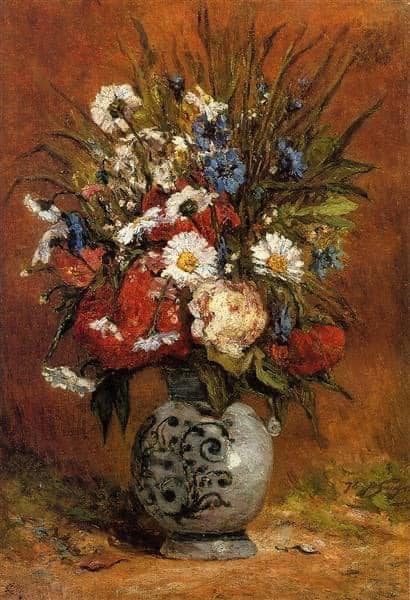
This is a truly beautiful painting. “Daisies and Peonies in Blue Vase” by Paul Gauguin.
Painting by Claude Monet from his famous water-lilies series. Monet painted about 250 water-lily studies from his garden during the last thirty years of his life.
My version of “Poet’s Heart” written by Kate Wolf Copyright 1985
I choose to wander in sunlight to avoid the riptide of darkness threatening to engulf our world.
I prefer to see and hear beauty.
I endeavor to open my heart to love. Not the love that comes and goes. Rather, to eternal love.
I am human. I need love and beauty as much as air and water.
Lately, I’ve been bathing in beauty, love, and light by listening and playing music. Specifically, one person’s music. Listen to my cover of Kate Wolf‘s “Muddy Roads” recorded on her last album (1986) Poet’s Heart. Tell me what you hear and feel.
“When we are connected — to our own purpose, to the community around us, and to our spiritual wisdom — we are able to live and act with authentic effectiveness.”
The Edge Will Follow by Javolenus (c) copyright 2012 Ethereal Space by Snowflake (c) copyright 2011 Homework by gurdonark (c) copyright 2010 Reverie (small theme) by ghost (c) copyright 2010
“Lay me Down Easy” is technically a blues song. To me, the song sounds upbeat with a whisper of the blues in the background. And there’s definitely an element of wry humor in the mix. Maybe “bitter sweet” is a better description of “Lay Me Down Easy.”
I’ve been playing many of Kate Wolf’s songs lately. The beauty of Kate’s music steals its way into my heart the more I listen to one of her songs. As illustrated by the photos, I’m feeling the joy and the love in the song more than the backdrop of the blues. Listen, and let me know how you receive it.
Photo by Vlada Karpovitch on Pexels
We must continually choose love in order to nourish our souls and drive away fear, just as we eat to nourish our bodies and drive away hunger.