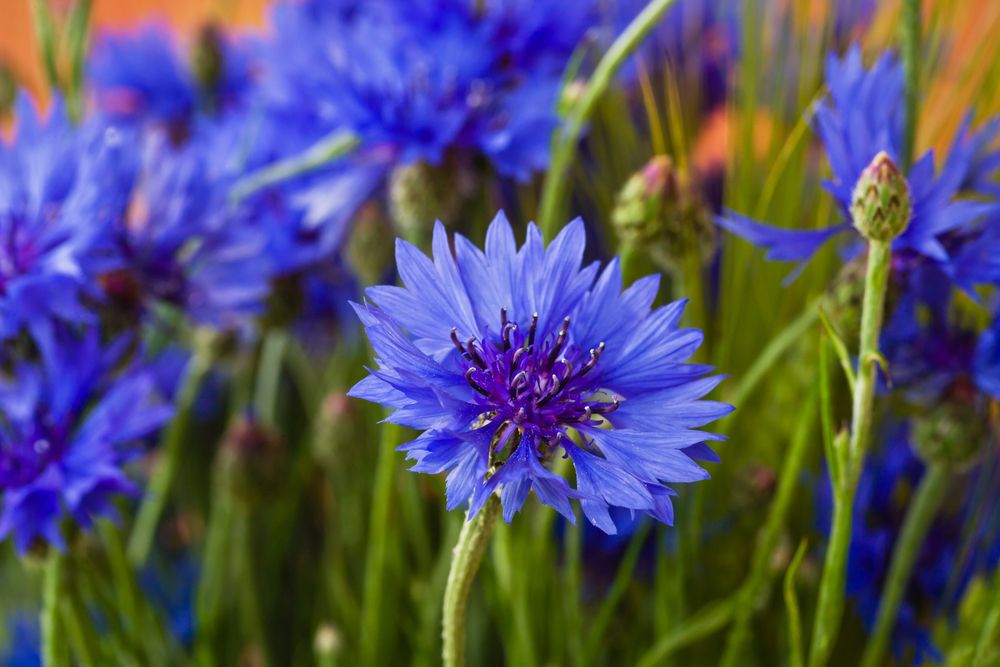
I first heard “Cornflower Blue” as the opening song on Kate Wolf’s 1983 double album “Give Yourself to Love.” As I listened to the album many times over, “Cornflower Blue” grew on me (no pun intended). I began to appreciate the exquisite beauty in the lyrics and in Kate’s lovely singing voice.
Oftentimes, songs like this one will find their way into my heart and I feel compelled to play them myself. With this song, I had my doubts. The chances were good that I might not pull it off. Learning how to play “Cornflower Blue” like Kate does was like learning how to walk again. The style is completely counterintuitive to what I’m used to, but I’m glad I made the effort. I hope my cover of the song conveys some of the mystery and beauty of the original.
“Pluck” is the word that comes to mind when I think of Nanci Griffith and her music. In terms of stature, Nanci can be described as diminutive, or perhaps petite is a better, if overused, description. Ironically, the essence of Nanci Griffith is anything but small. She imbued her songs with a crystal clear, powerful voice and confident stage presence. In her simple way, Griffith is remembered as a giant among country and folk singer/songwriters. With twenty-four albums released from 1978 to 2002, Griffith has left a lasting impression on an art form she once described as “folkabilly.” Nanci’s music merges the elegant folk of her early years with the folk-rock of her later years.
I’ve covered many of Nanci’s songs on this blog, including this latest, “Trouble In The Fields.” It’s a penetrating and beautiful song inspired by Griffith’s recollections of her great-grandparents’ struggles with drought and hard economic times during the 1930s. “Trouble In The Fields” is dedicated to Nanci’s great aunt and uncle, Nettie Mae and Tootie, farmers for eighty years near Lubbock, Texas.
Tom Paxton released “The Last Thing On My Mind” in 1964 on his album, Ramblin’ Boy.” The inspiration for the song came from Dave Van Ronk and Bob Dylan’s versions of “He Was A Friend of Mine.” This lost love ballad became one of Paxton’s biggest hits. He is also known for his protest songs against the Vietnam War and other social injustices. (What Did You Learn In School Today?)
“The Last Thing On My Mind” was one of the first songs I learned some forty years ago when I started playing the guitar. This is the first time I’ve released my cover publicly. The themes of the song include friendship, loss, and the passage of time.
Bob Dylan recorded the first version of “Tomorrow Is A Long Time” in 1962. He didn’t release it until 1971 on his “Greatest Hits Album.” Oddly, Ian and Sylvia were the first recording artists to release the song in 1963 on their album “Four Strong Winds.”
The song is about longing for a loved one, specifically Suze Rotolo, who Dylan dated from 1961 to 1964. It is widely believed that another Dylan song, “Girl From The North Country,” is also about Rotolo.
“Girl From The North Country” is another one of those songs that popped into my head from out of nowhere. I can’t decide if it’s a message from the Beyond or just a little piece of my subconscious rising like a sunspot from the deep layers of my skin with aging. Whatever the case, “Girl From The North Country” is one of Dylan’s earliest recorded songs, written in England in 1961 and released in 1963. Listening to it now, I find the ballad enchanting.
As a young adult, I followed Dylan’s work tangentially only because it was prominent in the mainstream. Lately, I’ve developed a deep appreciation for Dylan’s music and the man himself. I’ve covered several Dylan songs in this blog, including “Mr. Tambourine Man,”“My Back Pages,” and now this one.
“Girl From The North Country” is a beautiful ballad recounting a lost love. Many believe the woman in the song is Suze Rotolo. At the time, Dylan had just dropped out of college to pursue his musical career in New York City. Rotolo had just graduated from high school and entered the Greenwich Village folk scene. Their first meeting took place at the First Riverside Church concert in New York City. Dylan described the meeting in his memoir: “Cupid’s arrow had whistled past my ears before, but this time it hit me in the heart, and the weight of it dragged me overboard.”
Eventually, the couple lived together in Greenwich Village and then grew apart when Dylan went to England, and Rotolo went to Italy to continue her education.
After some time passed, Dylan went to Italy to find Retolo. At the same time, Rotolo returned to New York City. The couple finally reunited and lived in Dylan’s apartment until their final breakup.
The album cover of Dylan’s second album, Freewheeling, features Dylan and Rotolo walking arm in arm down a Greenwich Village street.
“Day Is Done” is a simple song about a clandestine relationship. Since very little has been written about the song, it is difficult to pinpoint its exact meaning. It could be about two married adults having an illicit affair. The lyrics and tone, however, indicate a relationship between two adolescents forbidden by parents or society.
The drawings on the album cover of “Lost Dogs and Mixed Blessings,” where the song is one of the tracks, tend to support the theory of a prohibited young love.
In “Day is Done,” Prine has written a charming little song with universal implications. Many of his songs deal with the intricacies of human relationships and are laced with Prine’s subtle sense of humor. Lost Dogs and Mixed Blessings was John’s fourteenth album. Released in 1995, it is another example of the artist’s exploration of the human condition.
From humble beginnings, John Prine came a long way in his fifty-year career. He won Grammy Awards and was posthumously inducted into the Country and Folk Music Hall of Fame. What struck me, however, is this early recollection of his career. It is taken directly from Prine’s official website:
“Prine still remembers the first three songs he performed on any stage: Sam Stone, Hello in There, and Paradise. With humility, he recalls, “I sang those three songs and people just sat there and looked at me. I thought, ‘Wow, those are really bad.’ They wouldn’t even applaud.”
Things changed dramatically when a young journalist named Roger Ebert dropped into a Chicago folk club for a beer while John was on stage. Ebert wrote a glowing review of Prine’s performance in the Chicago Sun-Times which essentially launched John’s career.
Bob Dylan wrote and recorded the original version of “Mr. Tambourine Man,” but The Byrds’ electrified folk-rock version shot it to #1 on both the US and UK charts. The song hadn’t been released when The Byrds learned it from a demo Dylan gave to their manager, Jim Dickson.
Dylan released Tambourine Man in March 1965 on his Bringing It All Back Home album.
What is “Mr. Tambourine Man” about? On the surface, this tambourine man is a wandering musician whose music has captured Dylan under its spell. The song is considered by many to be about drug experiences, with lines like “Take me for a trip upon your magic swirling ship” and “Take me disappearin’ through the smoke rings of my mind.” Phrases like these suggest a marijuana or LSD trip. Dylan is famously close-lipped about explaining his songs, but in his 1985 Biograph compilation album, he revealed that “Mr. Tambourine Man” is not about drugs. Instead, he said the song was inspired by a backup folk musician named Bruce Langhorne, who played a large tambourine in one of Dylan’s recording sessions.
To me, the song’s poetic images are like impressionist paintings. The melody is haunting and mesmerizing. The song stands alone as a true work of art. Here’s my version.
Have you heard of Steve Gillette? If you were alive in the 1960s and liked folk music, there’s a chance the name rings a bell. Gillette never reached the top of the charts, but he’s a very talented singer/songwriter. Many of his songs have been performed by artists you have heard of, including John Denver, Gordon Lightfoot, Ian and Sylvia, Nanci Griffith, and Linda Ronstadt.
The Bells in the Evening appears on Gillette’s debut album released in 1967. The album, simply titled “Steve Gillette,” stands as one of Steve’s finest recordings. “The Bells” is a bittersweet (actually sweet bitter) song of love blossoming in the spring and fading away in the fall. It’s a song full of immense joy and sorrow that combine in a mixture of incredible beauty. The song is also replete with imagery. When you listen, what images come to your mind?
I’ve revisited “The Bells of the Evening” adding some embellishments and the sound of my new guitar. Here’s my cover.
In a ten-year career tragically cut short by Leukemia, Kate Wolf wrote and performed over 200 songs. Her music is poignant, straightforward, honest, and beautiful. She performed at venues throughout her native state of California. Since her passing in 1986 at the age of 44, Kate’s audience has grown steadily as people like me discover her music. “September Song” (recorded on Kate’s 1979 album “Safe at Anchor”) is one of my favorites.
The song is replete with images. I particularly like the image conjured in the second verse illustrated below:
“The ghost of a frontier lady walks through the tall rooms/Of an old Ontario farmhouse under the full moon.”
Hi everyone. The voice I’m referring to here is not mine. It belongs to Kate Wolf (1942-1986). She wrote and performed (mostly in her native California) over 200 songs. Her music comes directly from the heart and tends to be bittersweet. In 1980, Kate released her fourth album on her own label, Owl Records. The album is titled “Close to You.” Many of the songs on the album have become fan favorites, including some I have posted on this blog: Across the Great Divide, An Unfinished Life, Here in California, and Stone in the Water.
A recording of Kate playing a song by Tom Paxon called “Hold On to Me Babe” drew me to Wolf’s music again. Her voice is transcendent as it is in most of her recordings. I haven’t been listening to Kate’s music lately, and her version of Paxon’s song reminded me of the beautiful realms she takes me to.
Another song on the album reminded me of the precious few people I have been close to in this life. Here is my cover of “Friend of Mine” with an original accompaniment.