Who doesn’t remember Simon and Garfunkle singing Kathy’s song? The answer is probably tons of people under the age of thirty, but who’s counting? The remarkable Paul Simon wrote Kathy’s Song. It was released in 1966 on the album Sounds of Silence. Along with the title tune, Kathy’s Song remains one of the duo’s most popular tracks. It is poetic, lyrical, and deeply moving.
Nearly thirty years later, along comes Eva Cassidy with her celestial voice and consummate guitar playing. Her version of Kathy’s song is characteristically unique and beautiful beyond words. If you like this kind of music, I urge you to listen to Eva’s version on YouTube. Eva doesn’t need an orchestra or a band to back her up. She plays and sings Kathy’s Song solo, and steals your heart away.
I’ve enjoyed learning how to play this song “Eva Style.” I found a good online tutorial by a guy who calls himself Ivor Sorefingers. Here’s my version.
Paddy and Tom Clancy came to America intending to develop lucrative acting careers. Little did they know they were destined to succeed enormously in the music business while making a tremendous contribution to the form, awareness, and appreciation of classic Irish folk music.
After arriving in Greenwich Village in 1951, the enterprising duo quickly established themselves as successful Broadway, Off-Broadway, and television actors. During this period, the brothers also created their own theater production company which they named: “Trio Productions.” To help raise money for the new company, Tom and Paddy sang old Irish folk songs they had learned as children. They rented The Cherry Lane Theater in the Village and performed shows regularly on Saturday nights. Soon, they were joined by notable folk singers like Pete Seeger, Woody Guthrie, and Jean Ritchie.
Liam, the youngest of the three brothers, came to America in 1956. He joined his brothers in the singing group, along with his good friend, Tommy Makem. The group came to be known simply as “The Clancy Brothers and Tommy Makem.” The group distinguished themselves with their rousing style of singing Irish folk songs and ballads, while staying true to some of the slower and more mournful tunes.
The group adopted a trademark uniform after their mother, it is said, read about the inclement New York winters. She sent her boys Aran jumpers (sweaters) to keep them warm. The boys wore the sweaters for the first time at the Blue Angel nightclub in Manhattan as part of their regular winter attire. The group’s manager, Marty Erlichman, had been searching for a kind of logo-look for the group. When he saw the sweaters, he knew he had found the “special look” he was searching for. Erlichman asked the group to wear the sweaters for their first TV appearance on the Ed Sullivan Show. After that appearance, the Clancy Brothers and Makem wore the sweaters whenever they performed.
The Sullivan TV appearance aired to an audience of forty million. The TV show and the group’s nightclub appearances attracted the attention of a Columbia Records executive. They signed a $100,000 recording contract (a staggering sum at the time) with Columbia and recorded seven albums with the studio. While the members of the group changed from time to time, their success and influence on modern folk music has endured. In all, the group recorded 24 albums on various labels. In 1964, their albums accounted for one third of all the record albums sold in Ireland.
I first saw the Clancy Brothers at Carnegie Hall when I was a callow lad of seventeen. I went to the concert with my best friend. He remains my best friend today, even though he is half a world away. The song I’m about to sing has two names: “Will Ye Go Lassie Go” and “The Wild Mountain Thyme.” It’s a Clancy Brothers favorite. This one’s for you, Danny Boy.
“I live for a sense of a feeling of purposefulness in this world, you know, that I could stop my life at any point and feel that my life has been worthwhile; that the people I’ve loved and my children have all reached a point where their lives are now going to come to fruition. And as far as something I live by, it’s to try to be as alive as possible and feel free to make my mistakes and try to be as honest as I can with myself.”
Kate Wolf–Singer Songwriter–1942-1986
Perhaps Kate Wolf had these thoughts in mind when she wrote the song “Unfinished Life.” It’s a haunting ballade filled with hard-won wisdom, exquisite beauty, grace, and focused determination. The song is also ironically prophetic. Kate Wolf died tragically of Leukemia at the age of forty-four. Despite her abbreviated lifespan, she wrote over two hundred songs and performed them at venues in her native state of California and around the world. Kate’s life was, indeed, unfinished, but she left behind a treasure trove of beautiful music.
I first recorded “Unfinished Life” using a free-form guitar strumming method. Recently, while driving in my car, I listened to the song with a different pair of ears. I noticed the unique and highly effective guitar-picking technique Kate used to express the words and melody of the song. After some trial and error, I’ve come up with a version that approximates Kate’s recording.
“The future is not some place we are going, but one we are creating. The paths are not to be found but made. And the activity of making them changes both the maker and the destination.”
I choose to wander in sunlight to avoid the riptide of darkness threatening to engulf our world.
I prefer to see and hear beauty.
I endeavor to open my heart to love. Not the love that comes and goes. Rather, to eternal love.
I am human. I need love and beauty as much as air and water.
Lately, I’ve been bathing in beauty, love, and light by listening and playing music. Specifically, one person’s music. Listen to my cover of Kate Wolf‘s “Muddy Roads” recorded on her last album (1986) Poet’s Heart. Tell me what you hear and feel.
“When we are connected — to our own purpose, to the community around us, and to our spiritual wisdom — we are able to live and act with authentic effectiveness.”
The Edge Will Follow by Javolenus (c) copyright 2012 Ethereal Space by Snowflake (c) copyright 2011 Homework by gurdonark (c) copyright 2010 Reverie (small theme) by ghost (c) copyright 2010
“Lay me Down Easy” is technically a blues song. To me, the song sounds upbeat with a whisper of the blues in the background. And there’s definitely an element of wry humor in the mix. Maybe “bitter sweet” is a better description of “Lay Me Down Easy.”
I’ve been playing many of Kate Wolf’s songs lately. The beauty of Kate’s music steals its way into my heart the more I listen to one of her songs. As illustrated by the photos, I’m feeling the joy and the love in the song more than the backdrop of the blues. Listen, and let me know how you receive it.
Photo by Vlada Karpovitch on Pexels
We must continually choose love in order to nourish our souls and drive away fear, just as we eat to nourish our bodies and drive away hunger.
“With a voice that has all the sweetness of a California morning and the loneliness of the sea beating against its rocky shores, it’s a mystery why Kate Wolf went unnoticed for so long. Listening to her songs, you never feel like you’re hearing studio recordings made many years ago. Instead, it feels like the singer’s sitting next to you, picking a guitar and telling stories near to her heart. With just a few words, Kate Wolf creates a great sense of intimacy.”*
Certain songs speak to me. Kate Wolf’s “The Trumpet Vine” is one of them. It typifies the aching beauty of her music. Here’s my cover of the song.
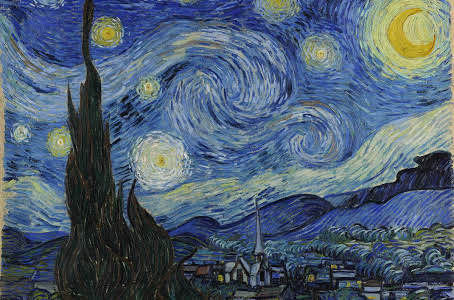
“Starry, starry night/ Paint your palette blue and grey/ Look out on a summer’s day/ With eyes that know the darkness in my soul.”
Those words came to Don McLean as he looked at Vincent Van Gogh’s 1889 painting “The Starry Night.” Soon, he had a masterpiece of his own: “Vincent,” a 1972 hit that he released right on the heels of his defining epic “American Pie.”
Like Van Gogh’s painting, Mclean’s “Vincent” has touched a wide range of creative spirits over the last 50 years. The song, the painting, and the book “Dear Theo,” written by Van Gogh’s brother, have certainly touched my heart again and again. I’ve always thought that Vincent’s style was at least in part inspired by his mental illness. To me, the brush strokes reflect an altered state of perception similar to the hallucinogenic patterns seen under the influence of Mescaline or LSD.
Van Gogh labored in obscurity until his self-inflicted death at the age of thirty-seven. He sold only a few of his paintings during his lifetime. Today, Van Gogh is a household word, and his paintings each sell for fifty million dollars or more. “The Starry Night” is one of Van Gogh’s most famous paintings.
Here’s my interpretation of Mclean’s homage to the masterpiece.
Like the title of the song “Back On The Street Again,” we are all, in a sense, starting over thanks to the CV pandemic. It has caused untold suffering for millions of people around the world. And yet, in the midst of this dark night of the soul, it is becoming obvious that we will emerge, like a new-born butterfly, into the sunlight. We will resurface in these baptismal waters with more compassion, new skills, and better ways of doing things large and small.
“Back On the Street Again” originated on an album simply titled “Steve Gillette.” Released in 1968 by Vanguard Records, Gillette’s debut album became an immediate success. Many of his songs have since been recorded by other well-known folk music artists. “Back On the Street Again” and “Darcy Farrow” are two of Steve’s most popular songs. I’m also a big fan of two other songs on the album: “A Number And A Name” and “The Bells In The Evening.”
Enough said. Here’s my cover of “Back On The Street Again.”
Nanci Griffith was a popular singer/songwriter who came to prominence in the 1980s. I bought one of her albums recorded in 1988 and then tracked back to discover more and more of her music. She wrote and performed her first song at the age of twelve.
Griffith was the daughter of musical parents, and she spent her childhood involved with theater and literature as well as music. She began playing clubs around Austin at the tender age of 14 and continued to perform during her college years at the University of Texas, as well as during her stint as a kindergarten teacher in the mid-’70s. Nanci finally decided to make music her full-time ambition in 1977.
One observer said of Nanci, “She found it easier to deal with the cowboys in bars at night than she did with her kindergarten students during the day.”
Nanci Griffith’s world tours are now the stuff of memories and YouTube videos, but her heart and soul will endure for years to come. She recorded and released more than twenty albums during her brilliant career. The video above features me playing one of Nanci’s rousing songs titled “Say It Isn’t So.”
David Gittlin has written three feature-length screenplays, produced two short films, and published three novels. Before quitting his day job, he spent more than thirty years as a marketing director, building expertise in advertising, copywriting, corporate communications, collateral sales materials, website content/design, and online marketing. He plays guitar as a hobby.









 Heart Banter by David Gittlin