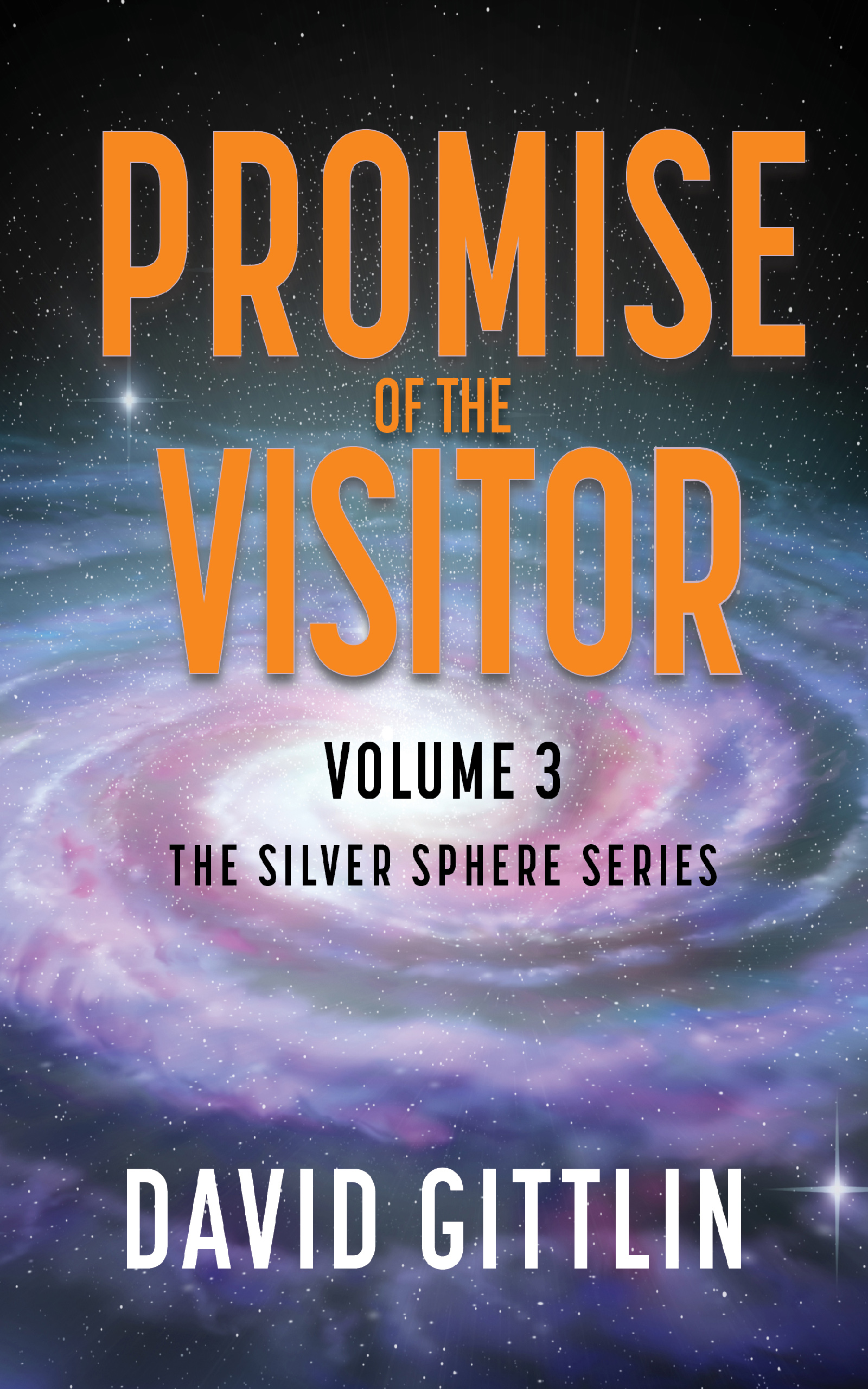
The Explosive Conclusion to the Silver Sphere Series
Volume 3 Coming Early April
On Amazon Worldwide
An unconscious body lies on the kitchen floor. Two Daytona Police deputies are knocking on the front door of the beach house mystery writer Jacob Cassel rents. It’s going to be an interesting morning for Jacob, his super-smart girlfriend, Amy, and Arcon, an AI from the other side of the Milky Way. If they can survive the morning without being thrown in jail, they are expecting a visitor to arrive from the planet Aneleya later in the evening bearing a cornucopia of gifts for the human race. Instead of gifts, the visitor arrives with dire news about a doomsday device threatening the destruction of planet Earth and the entire solar system.
Don McLean released his iconic album, “American Pie,” in 1971. The title song epitomizes the era of the nineteen-sixties. A famous lyric from the title song, “The Day the Music Died,” refers to the day Buddy Holly’s plane went down. Holly and the other passengers, including Ritchie Valens and The Big Bopper, all died in the crash. The song “American Pie” lasts for nearly nine minutes, memorializing other landmark events of the era through rich metaphors. Some of the other outstanding songs on the album include “And I Love You So,” “Crossroads,” “Empty Chairs,” and “Vincent.” I’ve covered these songs in earlier posts on this blog.
“Winterwood” is an upbeat love song featuring McLean’s typically vivid imagery. Technically, the title of the song does not exist in the English language. McLean invented the name to evoke the sights and sounds of a snowy mid-winter day with the sun peaking through barren tree branches and birds chirping in the background. The image came to Mclean as he rode through mid-winter streets recalling fond memories with his wife by his side. The image and the related memories stayed with the artist for six months until he finally wrote “Winterwood.”
The technique is a departure from the finger-picking method I used in many of the other songs I’ve posted. “Winterwood” is played entirely with a guitar pick (flat picking). I abbreviated the introductory lick because it might have taken me six months to learn.
“True Colors” is a song with legs. It started out as a song written for a mother in a traditional ballad format. Billy Steinberg and Tom Kelly wrote the song in 1986 and offered it to Anne Murray, a popular singer at the time. Murray passed on the song. Cyndi Lauper took it and creatively revamped the format into a stark and breathtaking version.
The song became a hit worldwide because of its universal appeal. The songwriters acknowledge that Lauper was the perfect artist to adapt the song partly because of her bold style. Released as the title song on Lauper’s 1986 album, “True Colors,” is the only original song on the album that the artist did not help to write.
In 1998, Phil Collins covered the song on his “Greatest Hits” album. Australian country music star Kasey Chambers covered the song as the theme for the 2003 Rugby World Cup. In 2007, Cindy Lauper launched “The True Colors Tour” to support gay rights and fight hate crimes. In 2016, Justin Timberlake and actress Anna Kendrick used the song in the soundtrack for the movie “Trolls.” Kodak also used the song to advertise their film stock.
Like I said: The song has legs. Here’s my version.
When someone shows you their true colors, don’t try to repaint them.
Time After Time is a Cyndi Lauper song. I’ve never been a big fan of her music, but that doesn’t mean it doesn’t resonate with others. She has a big enough audience without me. This song caught my attention when I heard Eva Cassidy sing it in her beautiful, unique style. It has taken me a few weeks to learn because the fingering is complicated. Eva Cassidy is known for her divine vocals, but trust me, she can play the damn guitar.
The meaning behind a lyric can create a strong connection to a song. It can help you to form a bond with a singer-songwriter. It lets you know the artist has gone through some of the same things you have. Cyndi Lauper’s hit Time After Time is one of those songs for many people. The song was the second single for her debut album, She’s So Unusual. It was actually the last song written for the album, but it made a lasting impact on the album and Lauper’s career.
A TV Guide advertisement for a science fiction movie sparked the idea for the song. Using a simple set of piano chords, Lauper co-wrote the song with Rob Hyman. As the piece evolved, for Lauper it became a response to an ex-lover who was lost and in need of help. She can’t move forward without him by her side.
Over a two-week period, Time After Time was written, recorded, and mastered straight to the album. There wasn’t time for a demo. The song went on to become a number-one hit in the United States. Here’s my version of Time After Time “Eva Style.”
Breaking a big project down into little steps makes it possible to achieve the final result.
“Crossroads” is another great song by Don McLean. It first appeared on his hit album, “American Pie.” Although the song is not as well-known as the title song and some of the other songs on the album (“Vincent”“And I Love You So” and “Empty Chairs“) Crossroads is nonetheless moving and beautiful.
On the surface, the song is about a man remembering a long-lost love with a sense of regret and a desire to turn back time. I believe the subtext of the song has a larger and more universal meaning: hope and happiness can be found with anything that joins us on the inevitable journey of life. It doesn’t have to be a lover or anyone in particular. It can be an idea, a thought, an emotion, or even an absence of something or someone. An absence can be as strong a motivator as a presence.
On the album, McLean performs the song on Piano. Fortunately, my good friend and tutor, Jerry’s Guitar Bar, has transposed the song for guitar. Here’s my version.
BELIEVE IN YOURSELF. BELIEVE IN A POSITIVE OUTCOME. AND, IT WILL BE SO.
It’s not really been that long. I just said that to get your attention. Have I got it? Good.
Coming Soon!
When Jacob Cassel and his intra-galactic associate, Arcon, discover a dead body on a lonely beach, it is only the beginning of an adventure that holds the fate of our world and other worlds in the balance.
Fifty years have flown by at supersonic speed. I can flash back on memories of my childhood and adolescence and remember them clearly as if they happened yesterday. I try to be present for each remaining moment. I forget. I get lost in my head. Again and again. A week slips by in a day. Does time go slower when we are young? I think it does.
How is time going by for you?
I thought Joni Mitchell wrote and popularized “Who knows Where The Time Goes.” It turns out a British folk rocker named Sandy Denny wrote the song and Judy Collins made it famous. A little research can go a long way. Here’s my version of the song based on the way the late great Eva Cassidy played it.
Science Fiction Writing Tip For Today:
“You have to be out of your mind while knowing what you’re doing most of the time.”
In these troubling times, it seems like the world could go off a cliff at any moment.
I remember what it was like in the nineteen-sixties when we lived under the threat of nuclear devastation. Today, we live under the veil of multiple threats: COVID, cyber attacks, totalitarian regimes, Jihad, the environmental crisis and a few others topping the list. Taken together, I believe these threats have made the world a more dangerous place to live in than ever before.
Can I/we do anything about these threats? Let’s try to answer the question with some self-inquiry.
I’ve noticed on WordPress that there is a lot of blogging about the pain of life: heartbreak, lost loves, loneliness, anxiety, and more. Sure, pain is part of life, and people can relate to it. My question is: Is there something else?
The news carries stories constantly about the daily tragedies that occur around the world. Last night, for example, I was listening to a CNN report about a horrible flash flood in Germany. It’s good to know about these things, but is there something else I can focus on?
If I am a compassionate person and I listen to the suffering of others, is there someplace I can go to find peace, strength, and even, God forbid, Joy?
How many people in the world interrupt their complaining to find this place? Does it exist? Have you found it?
And finally, if I find peace within myself, will the world be a better and more peaceful place to live in?
Think about it.
Before we close, I’d like to continue the inquiry with some questions surrounding the hot topic of vaccinations.
If you don’t want to get vaccinated because the short or long-term effects are unknown, do you stand a better chance of survival if you get the more virulent COVID Delta Variant?
Did you know if the rate of Delta infections keeps rising, there is a very good chance the virus will mutate into even more virulent strains? Quite possibly, these new variants could be immune to our current vaccines.
Do you realize that not getting vaccinated puts not only you, but everyone else in the world at high risk?
If you are in good health, what is your reason(s) for choosing not to be vaccinated?
It seems I can’t end without singing you a song. Talking about the sixties, here’s one that goes back there. It’s from Steve Gillette’s debut album released in 1967. In my opinion, every song on this album is outstanding, except maybe the first one. Steve Gillette never made it to the top of the charts, but he’s a very talented artist.
“Back On The Street Again” is one Gillette’s best known songs. The song is about a lost love (there I go contradicting myself). It’s also about getting back up and moving on. I find the song to be touching and stirring. Maybe you will too.
“The universe buries strange jewels deep within us all, and then stands back to see if we can find them.”
This is the prologue to the new edition of “Three Days to Darkness.” I’ve extensively rewritten the original novel (first published in 2010) to bring it up to date. It’s amazing how the world has changed in eleven years, but some things never change, like the themes grounding the story. I’ve also added a paperback edition to the digital edition, along with a spiffy new interior design. Don’t miss this heartwarming, humorous, and action-packed saga available at major online retailers worldwide.
Darius McPherson never saw it coming. His thoughts were elsewhere. On the kids. The ones he could save. They weren’t kids, really. Some of them were older than him. They were all tough and uneven around the edges, but a few of them were diamonds in the rough. They were the ones he considered his kids. They had real potential. They just needed someone to care about them. They needed a role model and some inspiration. Darius was happy to provide both. Not a bad summer gig for a guy waiting for his first year of law school to begin.
He pressed the bell on the side of the barred wooden door. The royal blue paint under the ugly bars gleamed in the direct sunlight and looked completely out of place in the burned-out industrial neighborhood in midtown Detroit.
He waited patiently to be buzzed into the youth counseling center. “Be right with you, Darius,” his supervisor said through the intercom. He liked Allison Turner. In her late thirties and twice divorced, she had managed to stay kind-hearted despite rough circumstances. She was also extremely capable. Allison had taught him more about inner-city teenagers than he could have learned in a decade on his own.
The door opened and a group of youthful offenders burst into the street. Darius knew several of them. They were attending classes at the center as part of their plea bargains. Darius smiled at them, even though he knew most of them were as dangerous as plastic explosive wired to detonate at the slightest provocation.
“Hey La Vonn” Darius called to the tallest boy in the group. “I hope you learned something today.”
“Yeah. How to stay outta’ the crowbar hotel,” the slender boy replied.
“Do you mean learning how to game the system or how to stay out of jail?”
Darius noticed La Vonn’s eyes open wide. He turned around in time to see a gray Lincoln Navigator with shiny, twenty-inch wheels and dark tinted windows round a nearby corner. No rap music blared from inside the car, which made Darius suspicious. He heard the sound of footsteps running away from him. He thought it undignified to run. And why would anyone in the neighborhood want to harm him? When the windows came down in unison, a cold chill went through his body. Darius saw young men wearing ski masks inside the car. He had no time to react.
The first shots hit the cinderblock wall of the youth center. Not unlike fireworks on the Fourth of July, Darius remembered thinking before a bullet pierced his chest. At first, he felt like an ice pick had stabbed him in the heart. Then there was a burning sensation. He remembered seeing his body lying on the cracked sidewalk in a pool of blood. The last thoughts that went through his brain were of his parents, his older brother and younger sister, and of course, Rebecca. After that, he sensed his awareness swirling down a dark tunnel opening at the far away end into some kind of scintillating light.
eBook and Paperback Available on Amazon and Online Retailers Worldwide
“Fields of Gold” is one of Sting’s most famous songs. It is a stunning and thoughtful track about the journey of commitment. The song first appeared on Sting’s 1993 solo album “Ten Summoner’s Tales.”
Sting wrote the track after he bought a house near a barley field. The sunsets and the colors of the field helped inspire the lyrics, along with Sting’s love for Trudie Styler, who he married in 1992.
“Fields of Gold” can be seen as a fulfilling romance from beginning to end. It is about courtship, marriage, and finally, death.
The romance of the couple in the song is so strong that even the sky and “its jealous sun” are envious of the relationship.
Before the male narrator dies, he tells his lover that she will never forget him and the time they shared. They will always walk and lie together in golden fields of sun drenched barley.
Here is my version of the song played with Eva Cassidy‘s guitar technique.
“The heart is always the place to go. Go home into your heart, where there is warmth, appreciation, gratitude and contentment.”