Many of Yusuf/Cat Stevens’ songs convey underlying messages about childhood and the relationships between children and adults, such as ‘Father & Son’ and ‘Oh Very Young,’ to name a few. “Where Do the Children Play?” is no exception. It becomes increasingly timely with each passing day, given the environmental crisis we are facing.
The song refers to the destruction of natural spaces caused by overdevelopment and industrialization. It asks a fundamental question: What future awaits our children when the spaces where they play are increasingly paved over and polluted?
“Where Do The Children Play” prompts us to consider the inherent features of the ‘progress’ we are making, as well as Humanity’s impact on planet Earth. Essentially, this beautiful and simple song begs for a balanced relationship between Human Beings and nature.
Typical of a Cat Stevens song, the rhythm is quite unique. Here’s my cover.
Bob Dylan recorded the first version of “Tomorrow Is A Long Time” in 1962. He didn’t release it until 1971 on his “Greatest Hits Album.” Oddly, Ian and Sylvia were the first recording artists to release the song in 1963 on their album “Four Strong Winds.”
The song is about longing for a loved one, specifically Suze Rotolo, who Dylan dated from 1961 to 1964. It is widely believed that another Dylan song, “Girl From The North Country,” is also about Rotolo.
Relationships, and especially love relationships are difficult. Here’s my cover of “I Thought I Was A Child,” a song about the universal search for love and Browne’s admiration of the wisdom of an older woman.
In her brief lifetime, which was cut short by Leukemia, Kate Wolf became a major influence on the folk scene with songs like “Give Yourself to Love,” “Across the Great Divide,” “Green Eyes,” “September Song,” and many more. Kate’s audience has continued to grow since her unfortunate passing. As an example, I found her late in my life. Here’s my cover of “Green Eyes.”
“Girl From The North Country” is another one of those songs that popped into my head from out of nowhere. I can’t decide if it’s a message from the Beyond or just a little piece of my subconscious rising like a sunspot from the deep layers of my skin with aging. Whatever the case, “Girl From The North Country” is one of Dylan’s earliest recorded songs, written in England in 1961 and released in 1963. Listening to it now, I find the ballad enchanting.
As a young adult, I followed Dylan’s work tangentially only because it was prominent in the mainstream. Lately, I’ve developed a deep appreciation for Dylan’s music and the man himself. I’ve covered several Dylan songs in this blog, including “Mr. Tambourine Man,”“My Back Pages,” and now this one.
“Girl From The North Country” is a beautiful ballad recounting a lost love. Many believe the woman in the song is Suze Rotolo. At the time, Dylan had just dropped out of college to pursue his musical career in New York City. Rotolo had just graduated from high school and entered the Greenwich Village folk scene. Their first meeting took place at the First Riverside Church concert in New York City. Dylan described the meeting in his memoir: “Cupid’s arrow had whistled past my ears before, but this time it hit me in the heart, and the weight of it dragged me overboard.”
Eventually, the couple lived together in Greenwich Village and then grew apart when Dylan went to England, and Rotolo went to Italy to continue her education.
After some time passed, Dylan went to Italy to find Retolo. At the same time, Rotolo returned to New York City. The couple finally reunited and lived in Dylan’s apartment until their final breakup.
The album cover of Dylan’s second album, Freewheeling, features Dylan and Rotolo walking arm in arm down a Greenwich Village street.
Nanci Griffith introduced her third album with its title song, “Once in a Very Blue Moon,” on the Austin City Limits TV show in 1984. She sang to a live audience with her typically bold and beautiful voice, which continues to endear this singer/songwriter to millions of people around the world after her passing.
This poignant song could easily sound sad, but not the way Nanci performs it. With her crystal-clear voice, it actually sounds uplifting. A quality comes through Griffith’s songs. It sounds to me like “nothing will ever get me down.” I’m sure Ms. Griffith endured many hardships and obstacles in her life, but she always came out on top. I dedicate my cover to the memory of this inspiring woman.
John Fogerty wrote this song, in part, for his son, Josh. Josh was three years old at the time, and John could barely wait for his son to hear him sing the song on the radio, especially the part that goes: “Doot doot doo lookin’ out my back door.”
In the song’s chorus, a passing parade is mentioned. Fogerty says the lyric is inspired by a Dr. Seuss book he read as a child, “To Think I Saw It On Mulberry Street.”
Some people say the lyric “Won’t you take a ride on the flying spoon” is a reference to cocaine or heroin. Fogrety vehemently denies this. He discouraged drug use by any of his band members, saying drugs interfered with their music and their jobs.
Credence Clearwater Revival gained prominence in the late 1960’s. The band split up acrimoniously in 1972. John Fogerty is still performing as of this writing.
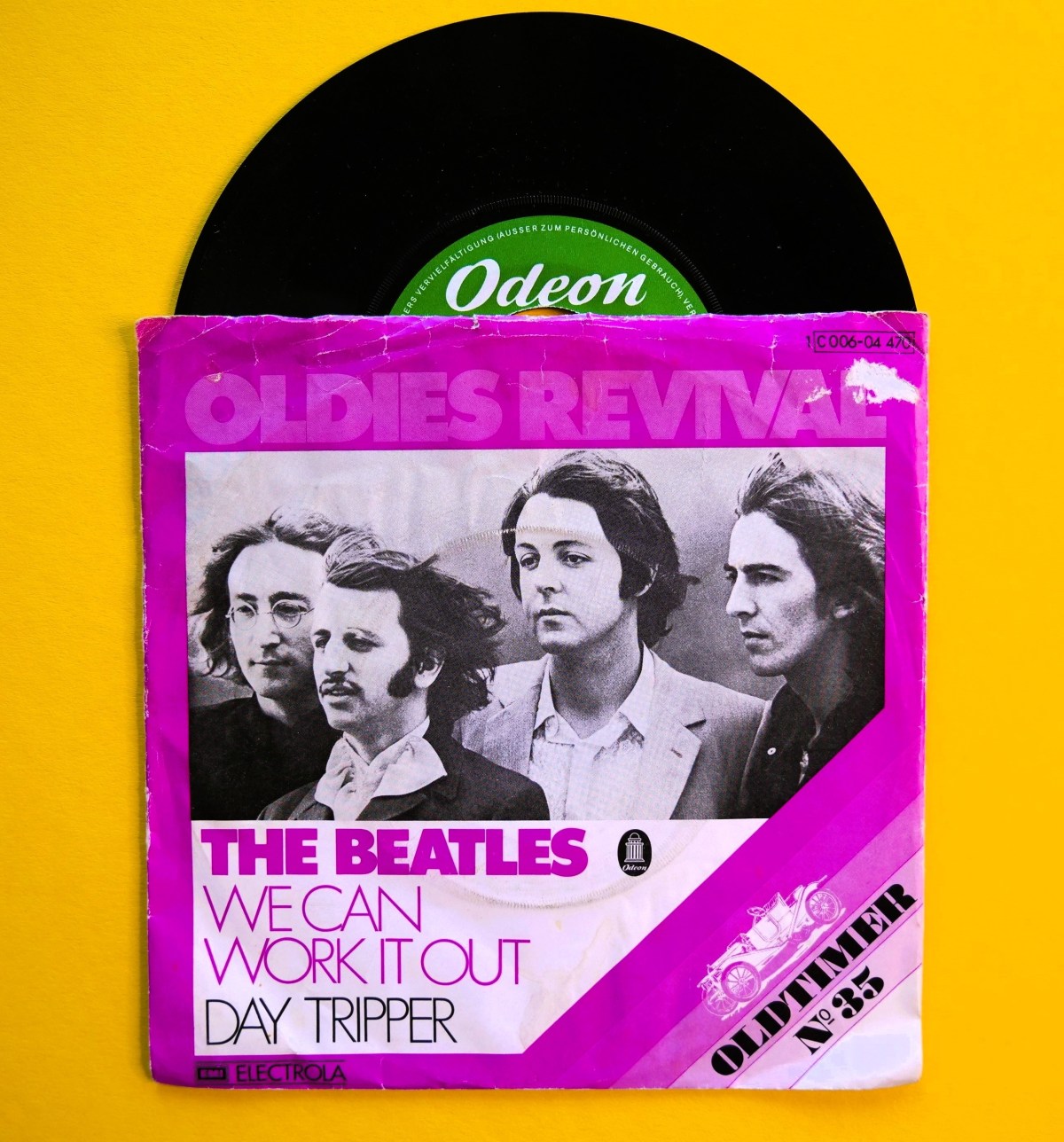
Back in the days when recording artists released singles, “We Can Work It Out” made its debut in 1965. The Beatle’s manager, Brian Epstein, felt that the other song on the record, “Day Tripper,” was more commercial and so, should be the lead song. Typically, the lead song of a single is recorded on the top side (A side) and the other song (B side) goes beneath it. Since both songs became hits, the record turned out to be the first double “A” single ever recorded.
John Lennon and Paul McCartney wrote the song with Paul writing the optimistic verses and John writing the more pessimistic chorus, in this case, the bridge.
The song sprang from a disagreement Paul had with his then-girlfriend, actress Jane Asher. Jane and her mother, Margaret, had a powerful impact on Paul’s life. The couple stayed together for five years from 1963 to 1968.
Cat Stevens’ song “The Boy With A Moon And Star On His Head” is a poetic and mystical tale that expresses themes of love, destiny, and the unknown and unexpected.
The song’s lyrics are replete with metaphors and symbolism, for example, the “holy magnolia” and “naked earth,” which elicit a sense of purity and connection to the universe. Cat Stevens, known for his introspective and spiritual songwriting, uses this narrative to convey a deeper message about the power of love and the unpredictable ways in which destiny unfolds. It is a beautiful story in song, rendered in Stevens’ unique style. Here’s my cover.











 Heart Banter by David Gittlin