Categories
acoustic guitar Arts & Entertainment music

Another Slice of “American Pie”


Don McLean released his iconic album, “American Pie,” in 1971. The title song epitomizes the era of the nineteen-sixties. A famous lyric from the title song, “The Day the Music Died,” refers to the day Buddy Holly’s plane went down. Holly and the other passengers, including Ritchie Valens and The Big Bopper, all died in the crash. The song “American Pie” lasts for nearly nine minutes, memorializing other landmark events of the era through rich metaphors. Some of the other outstanding songs on the album include “And I Love You So,” “Crossroads,” “Empty Chairs,” and “Vincent.” I’ve covered these songs in earlier posts on this blog.

“Winterwood” is an upbeat love song featuring McLean’s typically vivid imagery. Technically, the title of the song does not exist in the English language. McLean invented the name to evoke the sights and sounds of a snowy mid-winter day with the sun peaking through barren tree branches and birds chirping in the background. The image came to Mclean as he rode through mid-winter streets recalling fond memories with his wife by his side. The image and the related memories stayed with the artist for six months until he finally wrote “Winterwood.”

The technique is a departure from the finger-picking method I used in many of the other songs I’ve posted. “Winterwood” is played entirely with a guitar pick (flat picking). I abbreviated the introductory lick because it might have taken me six months to learn.

Time and Opportunity Wait for No One.

Categories
acoustic guitar Arts & Entertainment music

True Colors


“True Colors” is a song with legs. It started out as a song written for a mother in a traditional ballad format. Billy Steinberg and Tom Kelly wrote the song in 1986 and offered it to Anne Murray, a popular singer at the time. Murray passed on the song. Cyndi Lauper took it and creatively revamped the format into a stark and breathtaking version.

The song became a hit worldwide because of its universal appeal. The songwriters acknowledge that Lauper was the perfect artist to adapt the song partly because of her bold style. Released as the title song on Lauper’s 1986 album, “True Colors,” is the only original song on the album that the artist did not help to write.

In 1998, Phil Collins covered the song on his “Greatest Hits” album. Australian country music star Kasey Chambers covered the song as the theme for the 2003 Rugby World Cup. In 2007, Cindy Lauper launched “The True Colors Tour” to support gay rights and fight hate crimes. In 2016, Justin Timberlake and actress Anna Kendrick used the song in the soundtrack for the movie “Trolls.” Kodak also used the song to advertise their film stock.

Like I said: The song has legs. Here’s my version.

When someone shows you their true colors, don’t try to repaint them.

Categories
Arts & Entertainment music profiles

Time After Time


Cyndi Lauper Time After Time

Time After Time is a Cyndi Lauper song. I’ve never been a big fan of her music, but that doesn’t mean it doesn’t resonate with others. She has a big enough audience without me. This song caught my attention when I heard Eva Cassidy sing it in her beautiful, unique style. It has taken me a few weeks to learn because the fingering is complicated. Eva Cassidy is known for her divine vocals, but trust me, she can play the damn guitar.

The meaning behind a lyric can create a strong connection to a song. It can help you to form a bond with a singer-songwriter. It lets you know the artist has gone through some of the same things you have. Cyndi Lauper’s hit Time After Time is one of those songs for many people. The song was the second single for her debut album, She’s So Unusual. It was actually the last song written for the album, but it made a lasting impact on the album and Lauper’s career.

A TV Guide advertisement for a science fiction movie sparked the idea for the song. Using a simple set of piano chords, Lauper co-wrote the song with Rob Hyman. As the piece evolved, for Lauper it became a response to an ex-lover who was lost and in need of help. She can’t move forward without him by her side.

Over a two-week period, Time After Time was written, recorded, and mastered straight to the album. There wasn’t time for a demo. The song went on to become a number-one hit in the United States. Here’s my version of Time After Time “Eva Style.”

Breaking a big project down into little steps makes it possible to achieve the final result.

Categories
Arts & Entertainment folk guitar music

“American Pie” Gold Nuggets


“Crossroads” is another great song by Don McLean. It first appeared on his hit album, “American Pie.” Although the song is not as well-known as the title song and some of the other songs on the album (“Vincent” “And I Love You So” and “Empty Chairs“) Crossroads is nonetheless moving and beautiful.

On the surface, the song is about a man remembering a long-lost love with a sense of regret and a desire to turn back time. I believe the subtext of the song has a larger and more universal meaning: hope and happiness can be found with anything that joins us on the inevitable journey of life. It doesn’t have to be a lover or anyone in particular. It can be an idea, a thought, an emotion, or even an absence of something or someone. An absence can be as strong a motivator as a presence.

On the album, McLean performs the song on Piano. Fortunately, my good friend and tutor, Jerry’s Guitar Bar, has transposed the song for guitar. Here’s my version.

nuggets of gold

BELIEVE IN YOURSELF. BELIEVE IN A POSITIVE OUTCOME. AND, IT WILL BE SO.

Categories
Arts & Entertainment folk guitar music

Kathy’s Song Eva Style


drizzle of the rain

Who doesn’t remember Simon and Garfunkle singing Kathy’s song? The answer is probably tons of people under the age of thirty, but who’s counting? The remarkable Paul Simon wrote Kathy’s Song. It was released in 1966 on the album Sounds of Silence. Along with the title tune, Kathy’s Song remains one of the duo’s most popular tracks. It is poetic, lyrical, and deeply moving.

Nearly thirty years later, along comes Eva Cassidy with her celestial voice and consummate guitar playing. Her version of Kathy’s song is characteristically unique and beautiful beyond words. If you like this kind of music, I urge you to listen to Eva’s version on YouTube. Eva doesn’t need an orchestra or a band to back her up. She plays and sings Kathy’s Song solo, and steals your heart away.

I’ve enjoyed learning how to play this song “Eva Style.” I found a good online tutorial by a guy who calls himself Ivor Sorefingers. Here’s my version.

Categories
Arts & Entertainment folk music memories music

The Clancy Brothers: Re-Imagining Irish Folk Music


The Clancy Brothers Wore Aran Jumpers On Stage
A Little Boy Wearing an Aran Jumper

Paddy and Tom Clancy came to America intending to develop lucrative acting careers. Little did they know they were destined to succeed enormously in the music business while making a tremendous contribution to the form, awareness, and appreciation of classic Irish folk music.

After arriving in Greenwich Village in 1951, the enterprising duo quickly established themselves as successful Broadway, Off-Broadway, and television actors. During this period, the brothers also created their own theater production company which they named: “Trio Productions.” To help raise money for the new company, Tom and Paddy sang old Irish folk songs they had learned as children. They rented The Cherry Lane Theater in the Village and performed shows regularly on Saturday nights. Soon, they were joined by notable folk singers like Pete Seeger, Woody Guthrie, and Jean Ritchie.

Liam, the youngest of the three brothers, came to America in 1956. He joined his brothers in the singing group, along with his good friend, Tommy Makem. The group came to be known simply as “The Clancy Brothers and Tommy Makem.” The group distinguished themselves with their rousing style of singing Irish folk songs and ballads, while staying true to some of the slower and more mournful tunes.

The group adopted a trademark uniform after their mother, it is said, read about the inclement New York winters. She sent her boys Aran jumpers (sweaters) to keep them warm. The boys wore the sweaters for the first time at the Blue Angel nightclub in Manhattan as part of their regular winter attire. The group’s manager, Marty Erlichman, had been searching for a kind of logo-look for the group. When he saw the sweaters, he knew he had found the “special look” he was searching for. Erlichman asked the group to wear the sweaters for their first TV appearance on the Ed Sullivan Show. After that appearance, the Clancy Brothers and Makem wore the sweaters whenever they performed.

The Sullivan TV appearance aired to an audience of forty million. The TV show and the group’s nightclub appearances attracted the attention of a Columbia Records executive. They signed a $100,000 recording contract (a staggering sum at the time) with Columbia and recorded seven albums with the studio. While the members of the group changed from time to time, their success and influence on modern folk music has endured. In all, the group recorded 24 albums on various labels. In 1964, their albums accounted for one third of all the record albums sold in Ireland.

I first saw the Clancy Brothers at Carnegie Hall when I was a callow lad of seventeen. I went to the concert with my best friend. He remains my best friend today, even though he is half a world away. The song I’m about to sing has two names: “Will Ye Go Lassie Go” and “The Wild Mountain Thyme.” It’s a Clancy Brothers favorite. This one’s for you, Danny Boy.

Categories
Arts & Entertainment folk guitar folk music Interviews music

An Unfinished Life


“I live for a sense of a feeling of purposefulness in this world, you know, that I could stop my life at any point and feel that my life has been worthwhile; that the people I’ve loved and my children have all reached a point where their lives are now going to come to fruition. And as far as something I live by, it’s to try to be as alive as possible and feel free to make my mistakes and try to be as honest as I can with myself.”

Kate Wolf–Singer Songwriter–1942-1986

Perhaps Kate Wolf had these thoughts in mind when she wrote the song “Unfinished Life.” It’s a haunting ballade filled with hard-won wisdom, exquisite beauty, grace, and focused determination. The song is also ironically prophetic. Kate Wolf died tragically of Leukemia at the age of forty-four. Despite her abbreviated lifespan, she wrote over two hundred songs and performed them at venues in her native state of California and around the world. Kate’s life was, indeed, unfinished, but she left behind a treasure trove of beautiful music.

I first recorded “Unfinished Life” using a free-form guitar strumming method. Recently, while driving in my car, I listened to the song with a different pair of ears. I noticed the unique and highly effective guitar-picking technique Kate used to express the words and melody of the song. After some trial and error, I’ve come up with a version that approximates Kate’s recording.

“The future is not some place we are going, but one we are creating. The paths are not to be found but made. And the activity of making them changes both the maker and the destination.”

JOHN SCHAAR

Categories
folk guitar music poetry Videos

Through Her Music


I choose to wander in sunlight to avoid the riptide of darkness threatening to engulf our world.

I prefer to see and hear beauty.

I endeavor to open my heart to love. Not the love that comes and goes. Rather, to eternal love.

I am human. I need love and beauty as much as air and water.

Lately, I’ve been bathing in beauty, love, and light by listening and playing music. Specifically, one person’s music. Listen to my cover of Kate Wolf‘s “Muddy Roads” recorded on her last album (1986) Poet’s Heart. Tell me what you hear and feel.

“When we are connected — to our own purpose, to the community around us, and to our spiritual wisdom — we are able to live and act with authentic effectiveness​.”

MALIDOMA PATRICE SOMÉ

Gratefulness.org

Background Music Credits For Intro Video:

The Edge Will Follow by Javolenus (c) copyright 2012 
Ethereal Space by Snowflake (c) copyright 2011 
Homework by gurdonark (c) copyright 2010  
Reverie (small theme) by ghost (c) copyright 2010 

Categories
Arts & Entertainment

Vincent: A True Lover


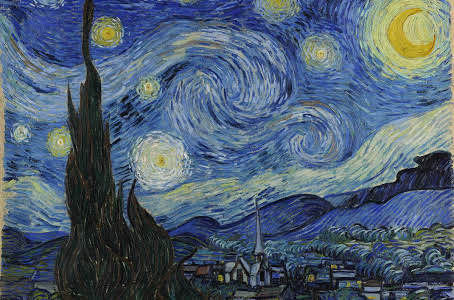
The Starry Night, Famous Oil Painting,

“Starry, starry night/ Paint your palette blue and grey/ Look out on a summer’s day/ With eyes that know the darkness in my soul.”

Those words came to Don McLean as he looked at Vincent Van Gogh’s 1889 painting “The Starry Night.” Soon, he had a masterpiece of his own: “Vincent,” a 1972 hit that he released right on the heels of his defining epic “American Pie.”

Like Van Gogh’s painting, Mclean’s “Vincent” has touched a wide range of creative spirits over the last 50 years. The song, the painting, and the book “Dear Theo,” written by Van Gogh’s brother, have certainly touched my heart again and again. I’ve always thought that Vincent’s style was at least in part inspired by his mental illness. To me, the brush strokes reflect an altered state of perception similar to the hallucinogenic patterns seen under the influence of Mescaline or LSD.

Famous Oil Paintings By Vincent Van Gogh

Van Gogh labored in obscurity until his self-inflicted death at the age of thirty-seven. He sold only a few of his paintings during his lifetime. Today, Van Gogh is a household word, and his paintings each sell for fifty million dollars or more. “The Starry Night” is one of Van Gogh’s most famous paintings.

Here’s my interpretation of Mclean’s homage to the masterpiece.

Categories
acoustic guitar Arts & Entertainment folk music Folk Song Covers music Videos

Nanci Griffith: A 1980s Singer/Songwriter Legacy


Nanci Griffith was a popular singer/songwriter who came to prominence in the 1980s. I bought one of her albums recorded in 1988 and then tracked back to discover more and more of her music. She wrote and performed her first song at the age of twelve.

Griffith was the daughter of musical parents, and she spent her childhood involved with theater and literature as well as music. She began playing clubs around Austin at the tender age of 14 and continued to perform during her college years at the University of Texas, as well as during her stint as a kindergarten teacher in the mid-’70s. Nanci finally decided to make music her full-time ambition in 1977.

One observer said of Nanci, “She found it easier to deal with the cowboys in bars at night than she did with her kindergarten students during the day.”

Nanci Griffith’s world tours are now the stuff of memories and YouTube videos, but her heart and soul will endure for years to come. She recorded and released more than twenty albums during her brilliant career. The video above features me playing one of Nanci’s rousing  songs titled “Say It Isn’t So.”

David Gittlin has written three feature-length screenplays, produced two short films, and published three novels. Before quitting his day job, he spent more than thirty years as a marketing director, building expertise in advertising, copywriting, corporate communications, collateral sales materials, website content/design, and online marketing. He plays guitar as a hobby.