“Crossroads” is another great song by Don McLean. It first appeared on his hit album, “American Pie.” Although the song is not as well-known as the title song and some of the other songs on the album (“Vincent”“And I Love You So” and “Empty Chairs“) Crossroads is nonetheless moving and beautiful.
On the surface, the song is about a man remembering a long-lost love with a sense of regret and a desire to turn back time. I believe the subtext of the song has a larger and more universal meaning: hope and happiness can be found with anything that joins us on the inevitable journey of life. It doesn’t have to be a lover or anyone in particular. It can be an idea, a thought, an emotion, or even an absence of something or someone. An absence can be as strong a motivator as a presence.
On the album, McLean performs the song on Piano. Fortunately, my good friend and tutor, Jerry’s Guitar Bar, has transposed the song for guitar. Here’s my version.
BELIEVE IN YOURSELF. BELIEVE IN A POSITIVE OUTCOME. AND, IT WILL BE SO.
I’m reposting a blog previously titled “Vincent: A True Lover.” I’ve decided to re-learn the song closer to the original.
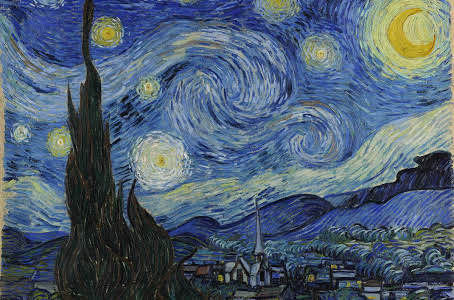
“Starry, starry night/ Paint your palette blue and grey/ Look upon a summer’s day/ With eyes that know the darkness in my soul.”
Those words came to Don McLean as he gazed at Vincent Van Gogh’s 1889 painting “The Starry Night.” Soon, he had a masterpiece of his own: “Vincent,” a 1972 hit that he released right on the heels of his defining epic “American Pie.”
Like Van Gogh’s painting, Mclean’s “Vincent” has touched a broad array of hearts and minds over the last 50 years. The song, the painting, and the book “Dear Theo,” written by Van Gogh’s brother, have certainly touched my heart again and again. I’ve always thought that Vincent’s style was at least in part inspired by his mental illness. To me, the brush strokes reflect an altered state of perception similar to the hallucinogenic patterns seen under the influence of Mescaline or LSD.
Van Gogh labored in obscurity until his self-inflicted death at the age of thirty-seven. He sold only a few of his paintings during his lifetime. Today, Van Gogh is a household word, and his paintings each sell for fifty million dollars or more. “The Starry Night” is one of Van Gogh’s most famous paintings.
Here’s the updated version of “Vincent” played closer to the original recording by Don Mclean.
Thought for the Day
When your world shrinks, your issues amplify. Keep your world and your perspective broad, for your own happiness, and the happiness of others.
In 1964, Gordon Lightfoot wrote one of his most memorable songs: Early Morning Rain. Lightfoot, a Canadian singer-songwriter, has become a folk legend. Along with his crystal clear singing voice and accomplished guitar playing, Lightfoot has written a library of outstanding folk songs depicting historical events and all manner of love relationships. To single out a smattering of Lightfoot’s top hits is to do the man an injustice. “Early Morning Rain” appears on his 1966 debut album Lightfoot! Before he released the song, another Canadian duo, Ian and Sylvia, recorded it in 1964. Many other folk singing notables (Peter, Paul, and Mary) also adopted the song.
The genesis of “Early Morning Rain” can be traced to Gordon’s 1960 stay in Westlake, Los Angeles. At the time, Lightfoot became homesick for his Canadian roots. He remembers going to the Los Angeles International Airport on rainy days to watch the aircraft take off and land. The memories of the flights launching into the overcast skies stayed with him. In 1964, while caring for his 5-month-old son, Lightfoot remembers thinking, “I’ll put him over here in his crib, and I’ll write myself a tune.” In that moment, “Early Morning Rain” was born.
The lyrics refer to someone down on his luck who stands at an airport fence to watch the thunderous take-off of a Boeing 707 airliner. The theme of the song suggests a jet-age musical allegory to a hobo of bygone days loitering at a railroad yard to steal a train ride home. Lightfoot credits the popularity of the song to his steady improvement as a songwriter.
I’ve always loved this song. Lightfoot strums it. When I heard Eva Cassidy perform the song using a picking technique, I had to learn it her way. Unfortunately, there were no guitar tutorials available. Since Eva plays “Early Morning Rain” close to her version of “Kathy’s Song,” I was able to figure out how to play EMR three-quarters of the way she does.
Why do I bother to learn how to play these songs the way these great artists do? It’s simple. I become a better guitarist with each song I learn. Most importantly, I enjoy it immensely. Here’s my cover of the song.
Thought for the Day
Am I doing the world a favor if I add one more sad voice to the wailing, no matter how artfully I express it?
Who doesn’t remember Simon and Garfunkle singing Kathy’s song? The answer is probably tons of people under the age of thirty, but who’s counting? The remarkable Paul Simon wrote Kathy’s Song. It was released in 1966 on the album Sounds of Silence. Along with the title tune, Kathy’s Song remains one of the duo’s most popular tracks. It is poetic, lyrical, and deeply moving.
Nearly thirty years later, along comes Eva Cassidy with her celestial voice and consummate guitar playing. Her version of Kathy’s song is characteristically unique and beautiful beyond words. If you like this kind of music, I urge you to listen to Eva’s version on YouTube. Eva doesn’t need an orchestra or a band to back her up. She plays and sings Kathy’s Song solo, and steals your heart away.
I’ve enjoyed learning how to play this song “Eva Style.” I found a good online tutorial by a guy who calls himself Ivor Sorefingers. Here’s my version.
Paddy and Tom Clancy came to America intending to develop lucrative acting careers. Little did they know they were destined to succeed enormously in the music business while making a tremendous contribution to the form, awareness, and appreciation of classic Irish folk music.
After arriving in Greenwich Village in 1951, the enterprising duo quickly established themselves as successful Broadway, Off-Broadway, and television actors. During this period, the brothers also created their own theater production company which they named: “Trio Productions.” To help raise money for the new company, Tom and Paddy sang old Irish folk songs they had learned as children. They rented The Cherry Lane Theater in the Village and performed shows regularly on Saturday nights. Soon, they were joined by notable folk singers like Pete Seeger, Woody Guthrie, and Jean Ritchie.
Liam, the youngest of the three brothers, came to America in 1956. He joined his brothers in the singing group, along with his good friend, Tommy Makem. The group came to be known simply as “The Clancy Brothers and Tommy Makem.” The group distinguished themselves with their rousing style of singing Irish folk songs and ballads, while staying true to some of the slower and more mournful tunes.
The group adopted a trademark uniform after their mother, it is said, read about the inclement New York winters. She sent her boys Aran jumpers (sweaters) to keep them warm. The boys wore the sweaters for the first time at the Blue Angel nightclub in Manhattan as part of their regular winter attire. The group’s manager, Marty Erlichman, had been searching for a kind of logo-look for the group. When he saw the sweaters, he knew he had found the “special look” he was searching for. Erlichman asked the group to wear the sweaters for their first TV appearance on the Ed Sullivan Show. After that appearance, the Clancy Brothers and Makem wore the sweaters whenever they performed.
The Sullivan TV appearance aired to an audience of forty million. The TV show and the group’s nightclub appearances attracted the attention of a Columbia Records executive. They signed a $100,000 recording contract (a staggering sum at the time) with Columbia and recorded seven albums with the studio. While the members of the group changed from time to time, their success and influence on modern folk music has endured. In all, the group recorded 24 albums on various labels. In 1964, their albums accounted for one third of all the record albums sold in Ireland.
I first saw the Clancy Brothers at Carnegie Hall when I was a callow lad of seventeen. I went to the concert with my best friend. He remains my best friend today, even though he is half a world away. The song I’m about to sing has two names: “Will Ye Go Lassie Go” and “The Wild Mountain Thyme.” It’s a Clancy Brothers favorite. This one’s for you, Danny Boy.
Fifty years have flown by at supersonic speed. I can flash back on memories of my childhood and adolescence and remember them clearly as if they happened yesterday. I try to be present for each remaining moment. I forget. I get lost in my head. Again and again. A week slips by in a day. Does time go slower when we are young? I think it does.
How is time going by for you?
I thought Joni Mitchell wrote and popularized “Who knows Where The Time Goes.” It turns out a British folk rocker named Sandy Denny wrote the song and Judy Collins made it famous. A little research can go a long way. Here’s my version of the song based on the way the late great Eva Cassidy played it.
Science Fiction Writing Tip For Today:
“You have to be out of your mind while knowing what you’re doing most of the time.”
“I live for a sense of a feeling of purposefulness in this world, you know, that I could stop my life at any point and feel that my life has been worthwhile; that the people I’ve loved and my children have all reached a point where their lives are now going to come to fruition. And as far as something I live by, it’s to try to be as alive as possible and feel free to make my mistakes and try to be as honest as I can with myself.”
Kate Wolf–Singer Songwriter–1942-1986
Perhaps Kate Wolf had these thoughts in mind when she wrote the song “Unfinished Life.” It’s a haunting ballade filled with hard-won wisdom, exquisite beauty, grace, and focused determination. The song is also ironically prophetic. Kate Wolf died tragically of Leukemia at the age of forty-four. Despite her abbreviated lifespan, she wrote over two hundred songs and performed them at venues in her native state of California and around the world. Kate’s life was, indeed, unfinished, but she left behind a treasure trove of beautiful music.
I first recorded “Unfinished Life” using a free-form guitar strumming method. Recently, while driving in my car, I listened to the song with a different pair of ears. I noticed the unique and highly effective guitar-picking technique Kate used to express the words and melody of the song. After some trial and error, I’ve come up with a version that approximates Kate’s recording.
“The future is not some place we are going, but one we are creating. The paths are not to be found but made. And the activity of making them changes both the maker and the destination.”
Kate Wolf left a legacy of over two hundred songs that she recorded and performed in live concert. I’ve played a number of those songs here and in online groups. I’ve tried to embody and share Kate’s love, beauty, compassion, pathos, and joy. Now, it seems my journey with Kate’s music is ending with a few songs from her last albums. Here’s an upbeat one titled “Stone In The Water.”
Bonus Track
Linda Ronstadt made this song famous. I’m playing Eva Cassidy’s version of “It Doesn’t Matter Anymore” close to the style she used to perform it. Paul Anka wrote the ballad for Buddy Holly, and Holly was the first to perform it in 1958. The song reached number 13 on the charts at the time.
Ronstadt and Cassidy, two great artists, are no longer with us. They both sang like angels and their legends have grown over time. Their music lives on and is enjoyed by a worldwide audience. This track is dedicated to the memory of Linda Ronstadt and Eva Cassidy.
I had never heard of Carrie Newcomer before a friend played one of her songs in an online gazing/meditation class. “The Gathering of Spirits” bounced around in my head until I finally had to learn it.
I bought Newcomer’s album of the same name, and I have to say the other songs on it are, for me, an acquired taste. However, I’m glad I was introduced to Carrie’s music and to this song in particular. She’s a unique individual and an unusually talented artist, as you’ll see by clicking on the link above. Here’s my version of “The Gathering of Spirits.” *
In case this blog is too short, here’s my version of another song by Kate Wolf titled “An Unfinished Life.”
*On the album, Alison Krause sings harmony on the song.
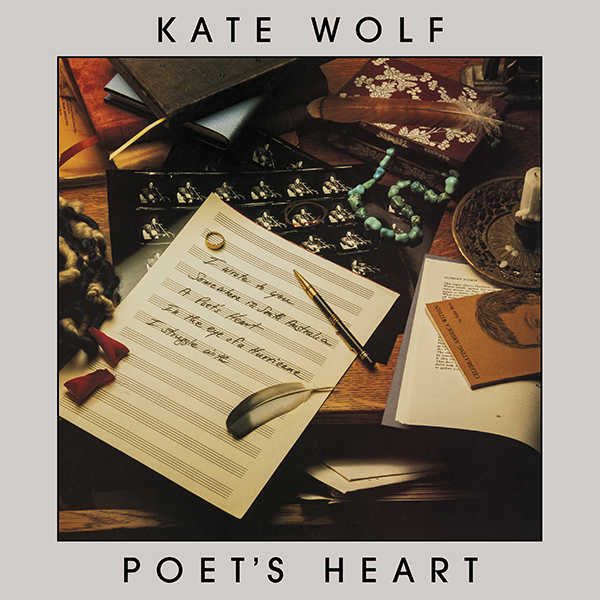
Born in San Francisco, Kate Wolf started her musical career in the band Wildwood Flower before recording ten records as a solo artist. Her songs have since been recorded by famous artists such as Nanci Griffith and Emmylou Harris. “Poet’s Heart,” recorded in 1985, is the last album Kate released before her untimely death at the age of forty-four. During her life, Wolf’s music was not widely known beyond the borders of her home state of California. Over the years, Kate has attracted a broader audience of millions who appreciate her beautiful voice, poetic song lyrics, and guitar/piano artistry. “Poet’s Heart” features several songs which have touched me deeply such as, “Slender Thread,” “Brother Warrior,” and the title song, “Poet’s Heart.”