Bob Dylan recorded the first version of “Tomorrow Is A Long Time” in 1962. He didn’t release it until 1971 on his “Greatest Hits Album.” Oddly, Ian and Sylvia were the first recording artists to release the song in 1963 on their album “Four Strong Winds.”
The song is about longing for a loved one, specifically Suze Rotolo, who Dylan dated from 1961 to 1964. It is widely believed that another Dylan song, “Girl From The North Country,” is also about Rotolo.
Relationships, and especially love relationships are difficult. Here’s my cover of “I Thought I Was A Child,” a song about the universal search for love and Browne’s admiration of the wisdom of an older woman.
In her brief lifetime, which was cut short by Leukemia, Kate Wolf became a major influence on the folk scene with songs like “Give Yourself to Love,” “Across the Great Divide,” “Green Eyes,” “September Song,” and many more. Kate’s audience has continued to grow since her unfortunate passing. As an example, I found her late in my life. Here’s my cover of “Green Eyes.”
Cat Stevens ( Yusuf Islam) has never publicly said what this song is about, so we are left to offer our own interpretations.
When I read the lyrics, I get a picture of a farmer of indiscriminate age waking up at the crack of dawn and looking out through a window at his fields. At the very instant when the sun rises, there is barely sound. Our farmer reflects back on his youth and how it felt every day to awaken with a song in his heart and the dreams he envisioned to pursue.
The last refrain floated into my head from out of nowhere:
“There’ll be the evening,
In the end,
But ’till that time arrives,
You can rest your eyes,
And begin again.”
The lyrics are beautiful and express the child-like innocence found in many of Cat Stevens’ songs. I interpret this last refrain to mean: Take advantage of and be grateful for every moment you are alive.
Most of the lyrics in “Danny’s Song” were inspired by a letter Kenny Loggins’ brother, Dan, wrote to him in 1968 after Dan’s son, Colin, was born. In the letter, Dan said he planned to marry the boy’s mom, Sheila, and they planned to move to Berkley, California, even though they had no money.
Kenny Loggins wrote the song in 1970 and released it as a single. It went nowhere. Later that year, Kenny teamed up with Jim Messina and released the song on their first album, “Sittin’ In.” Again the song went nowhere. If nothing else, “Danny’s Song” showcased Loggins’ talent for capturing a feeling for a moment in time.
It was not until Anne Murray covered the song and released it as a single in 1973 that it became a hit, reaching #1 in Canada and #7 on the charts in America. The song’s success put Loggins and Messina on the map.
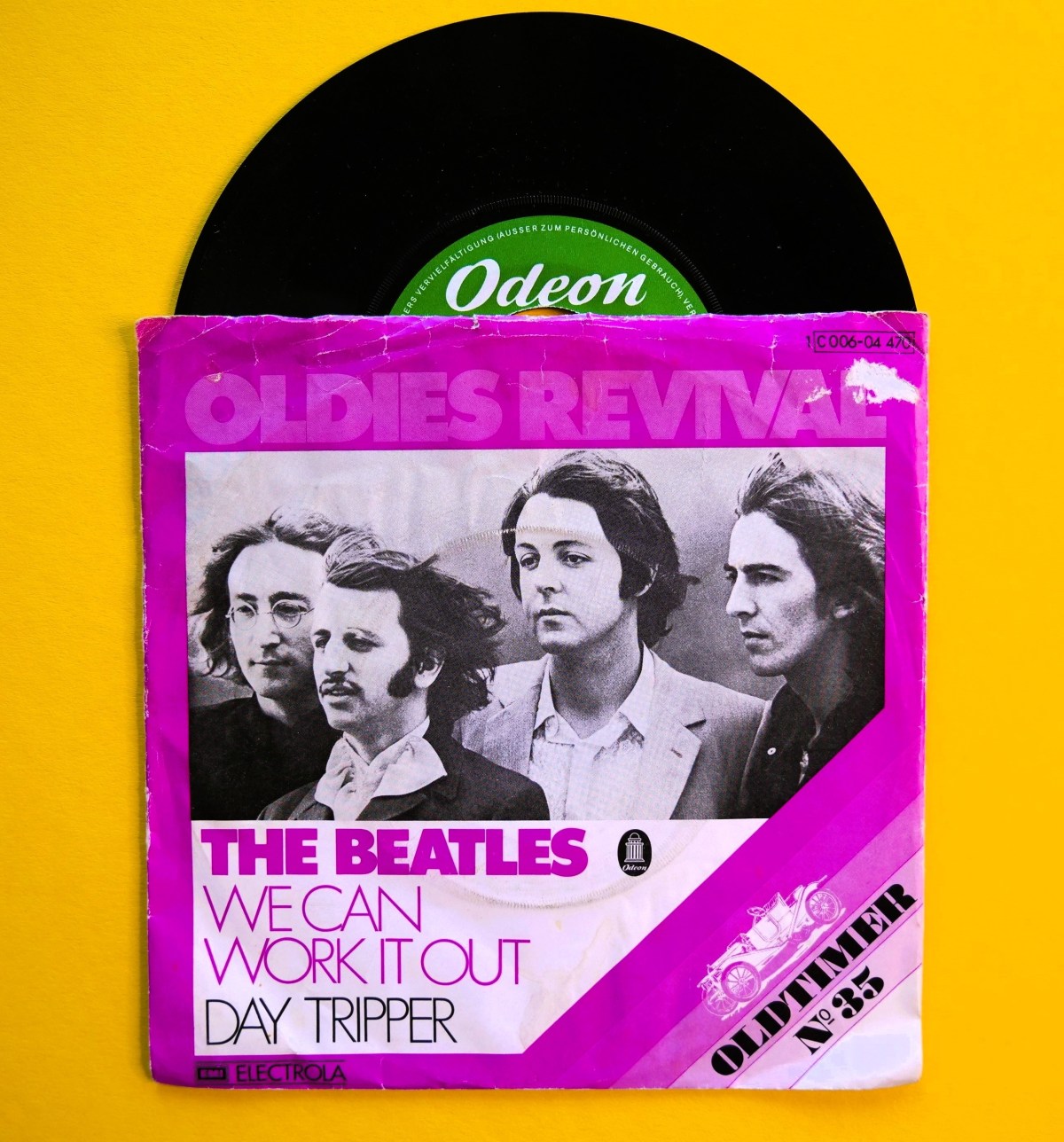
Back in the days when recording artists released singles, “We Can Work It Out” made its debut in 1965. The Beatle’s manager, Brian Epstein, felt that the other song on the record, “Day Tripper,” was more commercial and so, should be the lead song. Typically, the lead song of a single is recorded on the top side (A side) and the other song (B side) goes beneath it. Since both songs became hits, the record turned out to be the first double “A” single ever recorded.
John Lennon and Paul McCartney wrote the song with Paul writing the optimistic verses and John writing the more pessimistic chorus, in this case, the bridge.
The song sprang from a disagreement Paul had with his then-girlfriend, actress Jane Asher. Jane and her mother, Margaret, had a powerful impact on Paul’s life. The couple stayed together for five years from 1963 to 1968.
In this life, change is constant. This is not news to most of us. However, some things never change. A good example is the music of the artist profiled in this post. In 1977, after years of contemplation and a near-death experience with tuberculosis, Cat Stevens converted to Islam and radically changed his lifestyle. He is now known as Jusuf Islam, but the beauty and truth of his music haven’t changed. Jusuf’s songs have endured and are still relevant almost fifty years after they were released. His unique guitar style and vocalizations have remained bright, new, and refreshing through the intervening decades.
“On The Road To Find Out” is a song about a young man who sets out on a journey to clear his mind and see what he can discover. The song parallels Stevens’ life experiences. After a seven-month recovery from tuberculosis, Stevens felt a deep emptiness in his life and a yearning for something more. Out of these ashes, “On the Road to Find Out” was born. The lyrics are not about traveling in a physical sense. They are about Stevens discovering who he was and the purpose, if any, of his existence. Stevens achieved fame and fortune in 1967 at the age of only eighteen when his first three singles hit the charts in his native England. Like many of his recording artist peers, Stevens examined his noteworthy accomplishments and found they had not brought him the peace of mind or happiness he envisioned.
Many of Stevens’ songs reflect his quest for existential answers and a deep sense of fulfillment. I can only hope he found it.
Here’s my cover of this song’s rich lyrics and beautiful melody.
“Song for a Winter’s Night” is one of Gordon Lightfoot’s earliest love songs. It is also one of his biggest hits.
As folk music became commercially viable in the late sixties, clubs blossomed featuring promising folk musicians. Gordon Lightfoot landed a job in one of them in downtown Toronto. He stood apart from the crowd because he performed many of his own songs in a characteristically pure voice. After he developed a following, a club owner invited Lightfoot to perform at his club across the street at twice the salary. Lightfoot gratefully accepted the invitation to perform at the Riverboat, Toronto’s premier folk music club.
With his beautiful voice and prolific outpouring of quality music, it was only a matter of time before Warner/Reprise records rewarded Lightfoot with a one million dollar recording contract, an unheard-of number for a Canadian singer.
Lightfoot recorded “Song for a Winter’s Night in 1967 on his album, “The Way I feel.” Many recording artists covered it, including Sarah McLachlan in the soundtrack for the film “Miracle on 34th Street.”
Gordon wrote the song on a hot summer night while performing in Cleveland. He missed his wife at the time, Brita Ingegerd Olaisson, and his thoughts turned to winter. Here’s my cover.








 Heart Banter by David Gittlin