“True Colors” is a song with legs. It started out as a song written for a mother in a traditional ballad format. Billy Steinberg and Tom Kelly wrote the song in 1986 and offered it to Anne Murray, a popular singer at the time. Murray passed on the song. Cyndi Lauper took it and creatively revamped the format into a stark and breathtaking version.
The song became a hit worldwide because of its universal appeal. The songwriters acknowledge that Lauper was the perfect artist to adapt the song partly because of her bold style. Released as the title song on Lauper’s 1986 album, “True Colors,” is the only original song on the album that the artist did not help to write.
In 1998, Phil Collins covered the song on his “Greatest Hits” album. Australian country music star Kasey Chambers covered the song as the theme for the 2003 Rugby World Cup. In 2007, Cindy Lauper launched “The True Colors Tour” to support gay rights and fight hate crimes. In 2016, Justin Timberlake and actress Anna Kendrick used the song in the soundtrack for the movie “Trolls.” Kodak also used the song to advertise their film stock.
Like I said: The song has legs. Here’s my version.
When someone shows you their true colors, don’t try to repaint them.
Time After Time is a Cyndi Lauper song. I’ve never been a big fan of her music, but that doesn’t mean it doesn’t resonate with others. She has a big enough audience without me. This song caught my attention when I heard Eva Cassidy sing it in her beautiful, unique style. It has taken me a few weeks to learn because the fingering is complicated. Eva Cassidy is known for her divine vocals, but trust me, she can play the damn guitar.
The meaning behind a lyric can create a strong connection to a song. It can help you to form a bond with a singer-songwriter. It lets you know the artist has gone through some of the same things you have. Cyndi Lauper’s hit Time After Time is one of those songs for many people. The song was the second single for her debut album, She’s So Unusual. It was actually the last song written for the album, but it made a lasting impact on the album and Lauper’s career.
A TV Guide advertisement for a science fiction movie sparked the idea for the song. Using a simple set of piano chords, Lauper co-wrote the song with Rob Hyman. As the piece evolved, for Lauper it became a response to an ex-lover who was lost and in need of help. She can’t move forward without him by her side.
Over a two-week period, Time After Time was written, recorded, and mastered straight to the album. There wasn’t time for a demo. The song went on to become a number-one hit in the United States. Here’s my version of Time After Time “Eva Style.”
Breaking a big project down into little steps makes it possible to achieve the final result.
“Crossroads” is another great song by Don McLean. It first appeared on his hit album, “American Pie.” Although the song is not as well-known as the title song and some of the other songs on the album (“Vincent”“And I Love You So” and “Empty Chairs“) Crossroads is nonetheless moving and beautiful.
On the surface, the song is about a man remembering a long-lost love with a sense of regret and a desire to turn back time. I believe the subtext of the song has a larger and more universal meaning: hope and happiness can be found with anything that joins us on the inevitable journey of life. It doesn’t have to be a lover or anyone in particular. It can be an idea, a thought, an emotion, or even an absence of something or someone. An absence can be as strong a motivator as a presence.
On the album, McLean performs the song on Piano. Fortunately, my good friend and tutor, Jerry’s Guitar Bar, has transposed the song for guitar. Here’s my version.
BELIEVE IN YOURSELF. BELIEVE IN A POSITIVE OUTCOME. AND, IT WILL BE SO.
Fifty years have flown by at supersonic speed. I can flash back on memories of my childhood and adolescence and remember them clearly as if they happened yesterday. I try to be present for each remaining moment. I forget. I get lost in my head. Again and again. A week slips by in a day. Does time go slower when we are young? I think it does.
How is time going by for you?
I thought Joni Mitchell wrote and popularized “Who knows Where The Time Goes.” It turns out a British folk rocker named Sandy Denny wrote the song and Judy Collins made it famous. A little research can go a long way. Here’s my version of the song based on the way the late great Eva Cassidy played it.
Science Fiction Writing Tip For Today:
“You have to be out of your mind while knowing what you’re doing most of the time.”
In these troubling times, it seems like the world could go off a cliff at any moment.
I remember what it was like in the nineteen-sixties when we lived under the threat of nuclear devastation. Today, we live under the veil of multiple threats: COVID, cyber attacks, totalitarian regimes, Jihad, the environmental crisis and a few others topping the list. Taken together, I believe these threats have made the world a more dangerous place to live in than ever before.
Can I/we do anything about these threats? Let’s try to answer the question with some self-inquiry.
I’ve noticed on WordPress that there is a lot of blogging about the pain of life: heartbreak, lost loves, loneliness, anxiety, and more. Sure, pain is part of life, and people can relate to it. My question is: Is there something else?
The news carries stories constantly about the daily tragedies that occur around the world. Last night, for example, I was listening to a CNN report about a horrible flash flood in Germany. It’s good to know about these things, but is there something else I can focus on?
If I am a compassionate person and I listen to the suffering of others, is there someplace I can go to find peace, strength, and even, God forbid, Joy?
How many people in the world interrupt their complaining to find this place? Does it exist? Have you found it?
And finally, if I find peace within myself, will the world be a better and more peaceful place to live in?
Think about it.
Before we close, I’d like to continue the inquiry with some questions surrounding the hot topic of vaccinations.
If you don’t want to get vaccinated because the short or long-term effects are unknown, do you stand a better chance of survival if you get the more virulent COVID Delta Variant?
Did you know if the rate of Delta infections keeps rising, there is a very good chance the virus will mutate into even more virulent strains? Quite possibly, these new variants could be immune to our current vaccines.
Do you realize that not getting vaccinated puts not only you, but everyone else in the world at high risk?
If you are in good health, what is your reason(s) for choosing not to be vaccinated?
It seems I can’t end without singing you a song. Talking about the sixties, here’s one that goes back there. It’s from Steve Gillette’s debut album released in 1967. In my opinion, every song on this album is outstanding, except maybe the first one. Steve Gillette never made it to the top of the charts, but he’s a very talented artist.
“Back On The Street Again” is one Gillette’s best known songs. The song is about a lost love (there I go contradicting myself). It’s also about getting back up and moving on. I find the song to be touching and stirring. Maybe you will too.
“The universe buries strange jewels deep within us all, and then stands back to see if we can find them.”
Kate Wolf left a legacy of over two hundred songs that she recorded and performed in live concert. I’ve played a number of those songs here and in online groups. I’ve tried to embody and share Kate’s love, beauty, compassion, pathos, and joy. Now, it seems my journey with Kate’s music is ending with a few songs from her last albums. Here’s an upbeat one titled “Stone In The Water.”
Bonus Track
Linda Ronstadt made this song famous. I’m playing Eva Cassidy’s version of “It Doesn’t Matter Anymore” close to the style she used to perform it. Paul Anka wrote the ballad for Buddy Holly, and Holly was the first to perform it in 1958. The song reached number 13 on the charts at the time.
Ronstadt and Cassidy, two great artists, are no longer with us. They both sang like angels and their legends have grown over time. Their music lives on and is enjoyed by a worldwide audience. This track is dedicated to the memory of Linda Ronstadt and Eva Cassidy.
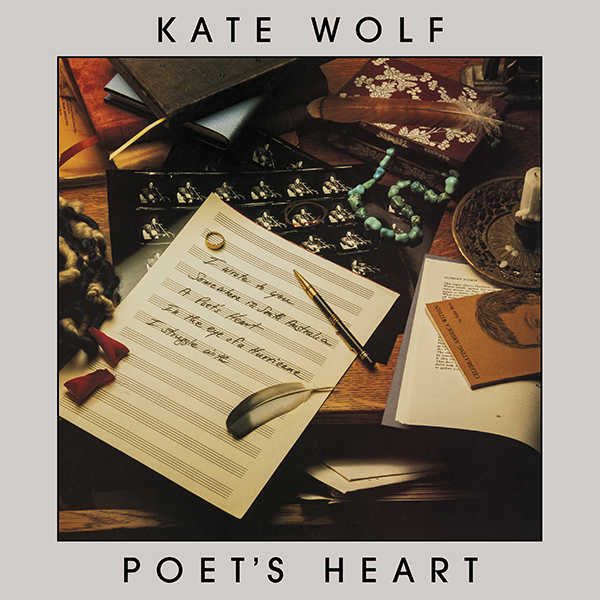
Born in San Francisco, Kate Wolf started her musical career in the band Wildwood Flower before recording ten records as a solo artist. Her songs have since been recorded by famous artists such as Nanci Griffith and Emmylou Harris. “Poet’s Heart,” recorded in 1985, is the last album Kate released before her untimely death at the age of forty-four. During her life, Wolf’s music was not widely known beyond the borders of her home state of California. Over the years, Kate has attracted a broader audience of millions who appreciate her beautiful voice, poetic song lyrics, and guitar/piano artistry. “Poet’s Heart” features several songs which have touched me deeply such as, “Slender Thread,” “Brother Warrior,” and the title song, “Poet’s Heart.”
There is beauty within us. There is beauty everywhere in the world. All we have to do is to want to feel it and see it.
Even in the midst of darkness, this is the dawn of a new age. It may be difficult to believe it or see it, but it’s happening. Nothing can deny us our destiny in love. Not doubt. Not ignorance. Not fear.
Some of us are on the cutting edge of this new world. Kate Wolf was one of these visionaries. I’m a great admirer of her work and her music.
“With a voice that has all the sweetness of a California morning and the loneliness of the sea beating against its rocky shores, it’s a mystery why Kate Wolf went unnoticed for so long. Listening to her songs, you never feel like you’re hearing studio recordings made many years ago. Instead, it feels like the singer’s sitting next to you, picking a guitar and telling stories near to her heart. With just a few words, Kate Wolf creates a great sense of intimacy.”*
Certain songs speak to me. Kate Wolf’s “The Trumpet Vine” is one of them. It typifies the aching beauty of her music. Here’s my cover of the song.
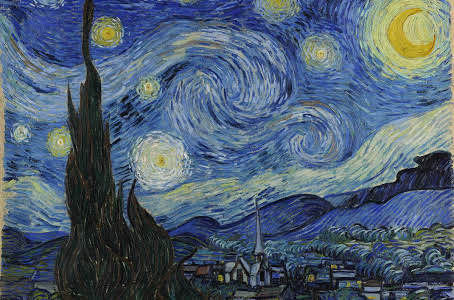
“Starry, starry night/ Paint your palette blue and grey/ Look out on a summer’s day/ With eyes that know the darkness in my soul.”
Those words came to Don McLean as he looked at Vincent Van Gogh’s 1889 painting “The Starry Night.” Soon, he had a masterpiece of his own: “Vincent,” a 1972 hit that he released right on the heels of his defining epic “American Pie.”
Like Van Gogh’s painting, Mclean’s “Vincent” has touched a wide range of creative spirits over the last 50 years. The song, the painting, and the book “Dear Theo,” written by Van Gogh’s brother, have certainly touched my heart again and again. I’ve always thought that Vincent’s style was at least in part inspired by his mental illness. To me, the brush strokes reflect an altered state of perception similar to the hallucinogenic patterns seen under the influence of Mescaline or LSD.
Van Gogh labored in obscurity until his self-inflicted death at the age of thirty-seven. He sold only a few of his paintings during his lifetime. Today, Van Gogh is a household word, and his paintings each sell for fifty million dollars or more. “The Starry Night” is one of Van Gogh’s most famous paintings.
Here’s my interpretation of Mclean’s homage to the masterpiece.














 Heart Banter by David Gittlin