At the risk of stating the obvious, I’m fed up with movie critics. Critics are supposed to help me find good movies, and they tend to fail miserably at this.
My purpose here is not to be unkind to movie critics. Instead, I’m trying to understand by thinking out loud on paper why movie critics are so unreliable.
Most movie scripts share a common shape. By this I mean the stories are grouped into three acts designed to build dramatic tension, climax, and ultimately resolve the conflict. A number of precise rules for screenwriting success are drilled into the heads of screenwriting students. I have experienced this first-hand as a screenwriting student at UCLA. There are pros and cons to the three-act formula. The good news is that the structure works fairly well. The bad news is that it can impede creativity. Most writers and film makers need a structure or a shared convention to shape their work, no matter how badly they resent it. Genius writers and filmmakers break the rules at will and succeed handsomely. You just have to know where you fit in.
The point I’m trying to make is that there is a basic flow to most movie stories. I don’t think most movie-goers mind the similarity. Critics do. They complain bitterly about it. Unfortunately, not too many people can come up with a movie like Quentin Tarantino’s “Pulp Fiction” every time they pull the trigger.
Critics know this. They aren’t dumb, after all. They are just bored with watching so many stories that unfold in a similar manner. They also get tired of the same themes, over and over again. And the movie they are reviewing often reminds them of one of the many others they’ve seen. They conveniently forget there is nothing new under the sun and filmmakers tend to influence one another. So the pro critic is prone to bouts of grumpiness, a jaded outlook, and unreasonableness.
My intention is not to make excuses for bad movies. We all know there are too many sub-par films hitting the streets every day. I do need to point out, however, that it’s hard to make a decent movie. Many elements have to come together gracefully and, in a way, miraculously.
A good film begins with a good script. After the filmmaker pens or acquires a good script, no easy feat in itself, he or she must assemble a cast of competent actors. In Hollywood, they have to be “A” list actors to get financing. Trying to get a few people from a small pool of famous actors interested in your script isn’t the easiest thing to do in the world.
Add cinematography, sound, makeup, costumes, editing, scenery and other artistic functions requiring a high degree of talent and expertise, and you have an accident waiting to happen unless everyone involved knows what they are doing. Add another intangible element like the chemistry that develops or fails to develop between cast members and crew, and you can see why filmmaking is a risky business.
Obviously, a great deal of blood sweat and tears, not to mention money, goes into making a “major motion picture.” There is no doubt that a lot of movies fall far short of the artistic vision that breathed life into them. But there are a lot of movies that deserve more credit than critics are willing to give them.
I understand that a critic’s job is to criticize. Go ahead and nitpick about whatever aspects of a movie that may not work. But please, I beg, pay a little more attention to the overall effect the movie evokes. That’s what People care about.
In my next post, I’m going to talk about Duets, another movie I felt received short shrift from professional movie critics.
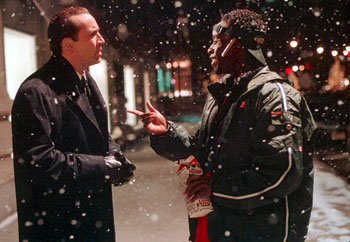
Nicolas Cage and Don Cheadle in a scene from “The Family Man” Copyright 2000 Universal Studios
If there is a hall of fame for under-appreciated or misunderstood movies, then “The Family Man” belongs in it.
For the record, I have studied screenwriting at UCLA, have written three screenplays, and watch at least two to three movies a week. I mention this only to point out that my opinion is not entirely uninformed (off the wall—maybe—uninformed—no.)
Despite this informed opinion, “The Family Man,” starring Nicolas Cage and Tea Leoni, met with lukewarm reviews by critics and movie fans when it came out in 2000.
The story opens with a day in the life of Jack Campbell, a thirty-something, wealthy investment banker who captains a boutique investment firm on Wall Street. Jack is intelligent, ambition consumed, bold, self-centered, and charming. Even though his life revolves around the pursuit of money and the pleasures of the flesh, he is hard not to like. His appreciation of classical music and opera displayed in the opening scenes hints at the presence of a soul.
When this movie was made, Nick Cage was still at the height of his acting career. I believe Jack Campbell is one of his more memorable roles. All of the characters in the movie, for that matter, are finely drawn and acted.
After becoming acquainted with Jack Campbell and the world he inhabits, the screenwriters (David Diamond and David Weissman) waste no time in spinning the tale. Jack drops into a fast-food mart after work on Christmas Eve to buy eggnog and stumbles into an armed altercation between a disgruntled customer and the store owner. Jack intervenes to prevent a violent incident by offering to buy a lottery ticket the owner claims is a fake.
In the aftermath, outside of the store, Jack speaks with the disgruntled customer, played by Don Cheadle. Cheadle happens to be an angel on a routine mission designed to teach the Chinese convenience store owner a lesson in racial tolerance. The owner doesn’t learn his lesson, which puts the angel in a foul mood. Unwittingly, Jack contributes to the angel’s frustration with the human condition by making a condescending remark indicative of his superior attitude. The angel decides to teach Jack a lesson by sending him into an alternate reality that “might have been” if he had not deserted his college sweetheart to launch his career as an intern at an investment firm in England. The angel gives Jack a chance to get a “glimpse” into a life based on a completely different set of values than the values he now holds dear.
Tea Leoni and Nicolas Cage Copyright 2000 Universal Studios
A big dog slurping Jack’s face wakes him up in bed next to the woman he left cold “in real life.” He is shocked and horrified when two young children pile on top him. The kids are under the ridiculous impression that Jack, a lone wolf of Wall Street, is their father.
In “The Family Man” Jack’s disdain for middle class values slowly turns into respect, caring, and finally a deep concern for the people who surround him. This synopsis really doesn’t do the movie justice. I found almost every scene in the movie poignant. Many of the scenes are multi-layered with subtle observations about human nature and social issues. The dialogue and situations are clever and insightful without a hint of cliché.
The movie moved me to the point of tears in three or four scenes. One example involves Jack’s relationship with the little girl who would have been his daughter in his alternate life. The little girl, Annie, senses Jack is not her “real father.” She concludes Jack is an alien and asks him where the mother ship is so she can get her father back.
In a scene towards the end of the movie, Jack and Annie frolic in the snow on Christmas morning. By now, Jack has formed a bond with the child. Jack falls down and Annie crawls onto his chest. With a precious smile, she says, “I knew you’d come back.”
I lost it right there.
Many critics commented that the movie over-sentimentalized middle class life. I disagree. I feel the movie artfully portrayed the bumps and warts of middle-class existence, as well as the pitfalls and emptiness of Jack’s investment-banker life. Neither of the two Jacks had it all. Regardless, I found the lifestyle issue secondary. The element of the movie that spoke to me the loudest was Jack’s transformation.
Makenzie Vega and Nicolas Cage Copyright 2000 Universal Studios
“The Family Man” isn’t the only movie I liked that critics and movie fans, in disturbing numbers, deemed “overly sentimental.” Either my sensibilities are inverted, or I’m incredibly sane. Whatever the case, I’m sticking to my guns. I just want to point out that as the world grows more cynical and hardened, it appears good movies are becoming an endangered species. I believe there is a direct connection here. Think about it.
Fictional movies reflect our world while creating their own realities. They are, by definition, abstractions. However, good movies have the power to inspire us to rise above fears and other roadblocks in the way of a better life and a better world. They teach us, often, to listen to our hearts. This isn’t always easy. One has to develop a relationship with one’s heart to hear it.
Feeling, I find, is a first step in cultivating a relationship with the heart. I believe that cultivating a relationship with the heart is essential to leading a full life. There is no one way to do it, but I feel strongly that the human heart needs to be cultivated, just like abs, biceps, WordPress blogs, and Facebook pages.
I liked the “The Family Man” because it made me feel. I practice meditation every day to cultivate a relationship with my heart. You might say the practice helps to “tenderize” my heart center. This movie reminded me that I have one.
I started eating natural foods at the age of 21. Considering that was 42 years ago, I am somewhat of a pioneer or at the very least an early adopter.
The increasing popularity of natural foods is proof positive that human consciousness is continuing to expand. However, I am at a loss to explain how the average natural food enthusiast can afford the cost of gas and natural foods.
Wait a minute. Maybe if you eat one-and-a-half meals a day instead of three you can afford both.
Hold on. I think I’ve finallyfigured it out. Yes, this has to be the answer:
People who buy their groceries at natural food stores and continue to drive their cars no longer go to the movies.
This means that the decline in movie box office sales is NOT due to the quality of the movies coming out of Hollywood nowadays. It is due to a redistribution of disposable income into the natural food sector.
Let’s move on to a few important facts of interest that will affect your life, whether you eat natural foods or not, and whether you like it or not (the facts, I mean.)
Tofu is the natural food equivalent of Hamburger Helper.
People who eat natural foods are 37% less likely to be involved in road rage incidents when compared to a statistically relevant sample of processed food consumers.
Children brought up on natural food are 26% more likely to realize GOD at some point beyond the age of 40.
In ten years, there will be 2,719 WHOLE FOODS stores in China.
If natural food consumption continues to grow at its present rate, financial analysts predict BURGER KING and McDONALDS corporations will merge within the next seven years and the new company will attempt to buy the WHOLE FOODS chain.
Nikki and Darren (Actors Justin Nichols and Sophia Bush)
Seagulls falling out of the sky raised a line of puffs on the barren beach as they smacked into the sand.
Darren glanced upward shielding his eyes from the blazing sun. Nikki, lying on the pink towel next to him, rose on both elbows. She screamed.
More birds pelted the beach. A few hundred yards to the south, it was raining seagulls. “It’s coming this way,” he told the hazel-eyed beauty.
“Head for the water. It’s the only safe place,” he shouted.
They raced towards the incoming tide, extending their long, lean bodies over the surf. The couple pummeled the aqua water with furious crawl strokes, side by side. When they were far enough from shore, Darren pulled up, treading water. Nikki’s head broke water just as a wave rolled over her. She came up coughing and spitting water. Darren reached out. She flattened her curvaceous body against his hard torso, encircling his neck with long, slender arms.
Thunder rumbled. The waves grew higher. Darren watched in disbelief as the storm of falling seagulls engulfed the Canyon Ranch Spa and Hotel.
“The ‘Millennium Predictions’ are coming true,” Nikki gasped.
The seagull storm swallowed up the hotel. The bird-cloud mushroomed towards the sleek concrete and steel skyscraper to the north. The sky darkened. A squall rippled towards them from the macabre scene unfolding on the shore.
Darren held her tightly. “I’ll always love you, even if the world ends.”
Nikki pushed away from him with a wild-eyed expression.
“Cut,” the Director yelled from the filming platform six feet behind them.
The computer-generated effects Darren had spent hours studying the night before dissolved on the screen of his imagination. The newly built Canyon Ranch Hotel gleamed in the South Florida sun, perfectly safe as a dreamer waking from a nightmare in a comfortable bed.
He had been lost in the moment. He had made it all real. Instinct and a script two revisions old had taken over.
Darren smacked his head with an open hand. “Sorry.”
“You’re supposed to say, ‘I thought we could change the future,” the pot-bellied, bearded Director said. He pulled off his black sunglasses and glared at Darren. A gust of wind rustled his mane of graying hair. “Let’s take it from Nikki’s last line, then we’ll break for lunch.”
“Soften your expression,” Nikki told him. “You look too serious.”
One of the benefits of working with your real-life girlfriend was honest feedback.
They sat at a table for two in the crowded Spa restaurant, next to a picture window overlooking the beach. Darren munched on an under-sized grain burger with sprouts and raw carrots on the side—no dressing. Nikki played with a small bowl of whole-wheat spaghetti topped with a hint of marinara sauce—hold the parmesan cheese.
Darren reveled in the few moments of leisurely time they shared before the long night of shooting ahead of them. Two days of bad weather had thrown production behind schedule. The production crew had to squeeze six days of shooting into three. The Director expected actors and crew to stay fresh and energetic, despite the hectic schedule.
Nikki had piled her long red hair in a bun atop her head. She wore no makeup, only a thin layer of moisture cream for protection. Darren had met countless beautiful women in his acting career. Nikki was different from all of them. She wasn’t self-absorbed, and she wasn’t petty, as most of the women he knew tended to be. She read voluminously between acting roles, and was a fine painter. She could be intellectual and sophisticated or simple and playful as a happy child, depending on her mood.
She had stolen his heart shortly after they met at a wedding party eight months ago. There was only one problem. It haunted Darren day and night.
“There’s something we have to talk about, Darren darling. It’s been on my mind for the past few weeks.”
He felt an ache in his heart. He knew the issue had to come up eventually.
“Not now, Princess.”
“It makes me feel like your daughter when you call me that.”
“I can’t help it. I believe you’ve come to me from some enchanted land, or sprung up whole from a ponderous book of fairy tales.”
She stopped smiling.
“What’s wrong?” he said.
She appeared to grapple with what to say next.
“Let’s agree to hold off all serious discussions until the film wraps,” he said. “Until then, we should only try to amuse one another in the few private moments the stingy Director allows us. Now, stop nibbling at your food. Eat up. You need your strength.”
“You eat your grain burger.
“It has no taste.”
“Use your imagination,” she said.
Darren took a bite. “Mmmm. He picked up the remaining piece of grain burger and admired it as if it were the Hope Diamond. “Remind me to ask the chef how they make it taste like dried corn-stalk compost.”
He watched her turn and gaze out the window. The surf was up, reaching with long fingers, almost up to the concrete foundation of the hotel. The sun had disappeared behind late afternoon clouds. He noticed her mood remained somber.
“If you insist on being serious, you might as well tell me what’s on your mind.” He felt the ache in his chest again.
She sighed deeply. “These past eight months have been much more than I ever expected, my love.”
“There’s no reason to believe the next eight months won’t be even better,” he said in his best imitation of a well-known motivational speaker.
He had imagined this painful moment too many times. “I’m concerned about the age difference,” she would say. “What will happen when we get older?” No matter what he said in response, her words would mark the beginning-of-the-end their relationship.
“I fell in love with your humor before I fell in love with you,” she said, instead of the dreaded words he had anticipated hearing.
“And you’ve been dying to confess this to me but you didn’t know how,” he improvised.
“Don’t make this into another game.” Nikki kept staring at him with a horribly solemn expression.
“I’m not from this world,” she said.
“I’m sorry. I didn’t hear you correctly. The acoustics in here are awful.”
“Please try to believe what I’m about to tell you.”
“It’s perfect, sweetheart. Who offered you the role?”
“I’m not trying out a character, Darren.”
“Can’t we just be ourselves with the little time—“
“—I am being myself. Listen to me.”
He stared into the depths of her searching eyes. Nikki lowered her voice. “There are about a million travelers like me scattered in every country of your world.”
Chills ran through his body. “What are you talking about?”
“I’m talking about the events depicted in ‘The Millennium Predictions.’ I’m talking about a decision you have to make.”
“You’re telling me they changed the script again and didn’t tell me. They’ve cut down my role. That bastard who calls himself a Director doesn’t like me. That’s it. Isn’t it?
She stared back at him, perfectly still. “I’m not talking about the movie.”
“You can’t be an alien. I’ve kissed every inch of your body. Every part of you is perfectly, beautifully human.”
“Calm down. We’re attracting attention.” She placed a hand over his. “We have the same origin. Our ancestors seeded the galaxy with our kind millions of years ago. It was a grand experiment to study how civilizations develop in different environments. The project is also intended to ensure the survival of our genome.”
He sat there in stunned silence.
“We thought we could blend in and help your civilization grow in a more constructive direction—until recently. We’ve determined your problems are too severe. It’s too late for our help. Your civilization is a failed experiment. Our work here is finished.”
“But—“
“—Hear me out, Darren. Some of us, like me, have formed strong relationships while we’ve been here. We’re allowed to take one person back with us.” She held his hand tighter. “I want you to come with me when I leave.”
“Nikki, please, this isn’t funny. You must stop it now.”
“I’m not joking. I understand how overwhelming this must be for you. I’m asking you to be strong.”
“You’re asking me to give up everything and pop off into space with you somewhere. Why can’t you stay here with me?”
“Your civilization will most likely destroy itself,” Nikki said.
“How can you make a statement like that and sound so sure of yourself?”
“To put it in simple terms, we can chart the future of a civilizations based on socio-economic, environmental, birth rates, art, scientific measurements and other factors. Our predictive model comes from thousands of civilizations we have studied.”
Darren strained to wrap his mind around what she was telling him.
“What if you get tired of me?” The words were out of his mouth before he could stop them. His composure was melting like a sandcastle at high tide.
“Don’t be insecure,” she said.
“I’m twenty years older than you.”
“It never occurred to me. The average life span of my people is two hundred years. A twenty-five year difference in couples is quite common.”
“But I’m not going to live that long.”
“You will once you begin taking the bio-agents we’ve developed to stay young. You’re at the height of your powers, Darren. I’m offering you the chance to stay that way for at least another five decades.”
“It sounds too good to be true. For all I know, you’ll put me in a cage five minutes after boarding your ship.”
“Darling,” she said with a gleam in her eye, “we’re vegetarians, not meat eaters.”
He smiled, despite the feeling of utter uncertainty. “Do you think we can last a hundred a fifty years together?”
“Wouldn’t you love to try,” she said, deftly lowering one eyelid.
He leaned close to her. “Do they need actors on your planet?”
“Yes, my darling. You’ll have time for at least five different careers in the dramatic arts if you get bored.”
“Look at me, sitting here thinking only of myself while you’re telling me the end of the world is at hand.”
“There’s nothing you can do about it.”
“Can’t your people warn us in some way?”
“The warning signs are everywhere. Only a handful of people heed them.”
“There has to be a solution.”
“There is, darling Darren. Come with me.”
“You make it sound so simple.”
It’s not that complicated, my love. You have no children. Your parents are gone. And you’re an only child.”
“I’ve taken a lot of chances in my life. But this…I need time to think.”
“I understand completely,” she said. “We’ll talk again after the film wraps. In the meantime, don’t say a word about this to anyone. It could jeopardize my safety.”
“That’s the last thing I’d ever do.”
She looked at him with an intensity he had never seen before. “We can do this, darling. I know we can if you give it a chance. You’re the perfect man for me.”
He squeezed her hand, kissed her, and walked out of the restaurant on unsteady legs.
The woman known to Darren as Nikki turned to watch the sunset through the picture window. The orange sun plunged into the ocean surrounded by a bevy of pastel pink clouds.
Darren was perfect, she thought—bright, handsome, hardy, talented and most importantly, virile. His sperm count ran off the charts. She had tested it herself with a kit hidden in her dressing trailer. It was a miracle the man hadn’t accumulated a brood of children inside or outside of marriage. She guessed it was due to his exemplary character. He didn’t believe in having children if he wasn’t going to be there for them as a proper parent.
It was ironic that Darren was destined to father thousands of children though he didn’t know it yet. He was going to be on the star ship with her one way or another. Preferably, Darren would decide he couldn’t live without her and leave voluntarily. That way, she could break the news to him gradually during the journey to his new home. He would have time to adjust to the idea of becoming an alpha breeding male for her dying race.
She regretted lying about the nature of her mission and the prospect of her lover living another hundred and fifty years. Even with the bio-agents, the strain of steady breeding would shorten Darren’s life span considerably. But there were much worse fates in the universe than sleeping with gorgeous women like herself who possessed brilliant minds and a multitude of fascinating professional abilities.
The new job came with an array of attractive benefits. Aside from his conjugal duties, Darren’s schedule would include a healthy chunk of time in a classroom to avoid his becoming a conversational bore. Good conversation before mating improved the conception rate dramatically.
To avoid psychological problems, Darren would continue his career in the dramatic arts on her planet as she had promised, under careful supervision of course. She might even be his “girlfriend” for a while to make the transition smoother. Yes, Darren would adjust and eventually thrive in his new role. His qualities of optimism and flexibility almost guaranteed it.
The more she thought about it, the more good ideas came to her for selling the new role to Darren. When you sat back and added it all up, she believed he was a lucky man. This was especially true, considering his slim chances of survival on the sordid, troubled world he would soon be leaving behind.
I am trying to write my second novel. It is not easy, to say the least. I am confident, however, that this is a universal truth among authors attempting to write their first or seventy-first long piece of fiction or non-fiction. The reasons for this difficulty may vary from author to author. My main roadblock seems to be the increasing disenchantment of sitting in a room all by myself for long periods of time. Again, I suspect I am not alone in this predicament. The problem apparently extends far beyond the relatively small segment of the population on planet earth attempting to write novels. I know this because I have recently taken my laptop to a local Starbucks to resolve my isolation problem.
The Starbucks I now regularly inhabit is not your everyday Starbucks. Management recently retrofitted the place with long tables, benches actually, with stools and a strip of electrical outlets underneath to plug in battery cables. Droves of people come here, not just to chat and caffeinate, but to do WORK! This includes college-students doing real, actual homework, not wasting time on Facebook. Freelance, self- employed, and independent contractor types also hang out here. These people, like myself, are hard at work, despite the distractions of noisy conversation and often-times idiotic, piped-in music. I find this phenomenal and wonder,”Why do we come here?” Many, if not all of us, are surely not homeless.
I can only speak for myself. I come here to overcome loneliness—to make some sort of connection. And I’m happy to report that my new strategy is paying off. I’m writing my novel on a regular basis, slowly but surely.
Now that we may have some insight into the reason for the overwhelming success of the Starbucks chain, I would like to come to the point of this piece. Many years ago, I began listening to Prem Rawat speak about an inner experience of peace and contentment. At the time, I did not have to go to Starbucks to be around people. I had a full time, good-paying job, a girlfriend, my parents and cousins to surround me. Yet, something was missing.
Mr. Rawat’s message of peace captivated me in a way nothing had previously. I followed up on his promise to reveal a source of peace and contentment within myself. I practiced the techniques of what he calls Knowledge, and, to make a long story short, I have not been in the least bit disappointed. Well, perhaps that statement is not entirely true. I had the idea shortly after receiving the techniques of Knowledge that I would not need anything else, including people. To make another long story short, that idea turned out to be foolish and a bit funny, now that I look back on it.
But there is a point here, somewhere. Oh yes, here it is: I need outer connections—with colleagues in my chosen profession, with friends and family, even Facebook connections. Thanks to the experience of Knowledge, I’ve learned that I need something else. I need a connection with myself for my life to be complete. I’m not going to put a name to what I’ll call “myself,” because I’ve learned that names are insufficient to describe it. I will just say this: I was looking for a missing piece of the puzzle of my life. Prem Rawat helped me to find it. Now, I feel my life is complete. It is full, not stuffed with things on the outside, but from within. And my connections on the outside are more fulfilling, because I am a more full and complete person, with more to offer to others.





 Heart Banter by David Gittlin