Categories
Essays movies musings Nostalgia reflections

The Case of the Missing Box Office


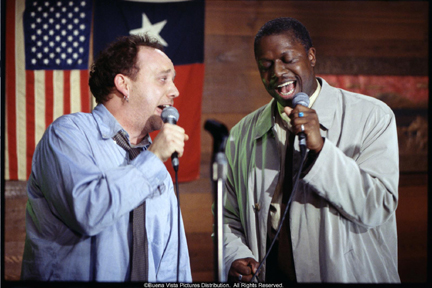
Escaping from his empty life, traveling salesman Todd Woods (Paul Giamatti –L) discovers the joys of karaoke singing and a new friend in ex-con and soulful singer Reggie Kane (Andre Braugher –R) ©2000 “Duets” Hollywood Pictures

I like movies with heart. “Duets” is a movie with a big heart that nobody went to see.  Well, almost nobody.  Despite an intelligent, one-of-a-kind script and a star-studded cast, “Duets” tallied a mere 4.73 million dollars in domestic box office sales.* In terms of Hollywood studio economics this paltry sum is tantamount to a financial implosion.

“Duets” is (mostly) a feel-good road movie about people following their hearts and discovering who they are. I don’t see any harm in a story like that, particularly if you can add a few new twists and keep  folks smiling.  I thought “Duets” did both, but a lot of people disagreed.

I can find only two explanations why “Duets,” a movie I liked, was so universally overlooked by the movie-going public. Explanation 1: I have very bad taste. Explanation 2: An overwhelming number of negative reviews by movie critics cut off the hand that feeds the box office.

According to Metacritic® (www.metacritic.com) a sample of 29 professional movie critics gave “Duets” an average rating of 40 % out of 100. In contrast, a sample of twelve “Users” (people) gave the movie a rating of 8.8 points out of 10. (I realize this is a small sampling of “Users,” but let’s not forget that not many people saw this movie.)

According to this compact study then, “Duets” is a predominantly people friendly movie with an allergy to movie critics.

Here are a few typical movie critic reviews:

“Miserable as it crawls for two eternal hours towards being “life affirming.” Wesley Morris, San Francisco Examiner

“Simply creaks with contrivance—particularly in its overwrought finale.” Curtis Morgan, Miami Herald

“A leaden piece of whimsy that looks for profound life lessons among a group of karaoke bar aficionados.” Steve Daly, Entertainment Weekly

To be fair, some critics praised “Duets, as evidenced by these reviews:

“A highly likable movie.” M.V. Moorhead, Dallas Observer.

“Appealing, and ultimately moving.” Bob Graham, San Francisco Chronicle.

Gwyneth Paltrow (L) stars as Liv, an innocent Las Vegas showgirl in search of a connection to a lone wolf karaoke hustler (Huey Lewis–R) ©2000 “Duets” Hollywood Pictures

Now let’s hear from a few movie-goers:

“Her name was Lola. She was a show girl…dah de dah de dah. This movie was fun interesting and catchy. What is better?” James R.

“This movie is engaging, the story unfolds around the music, and Paul Giamatti is great. Apart some predictable things typical nowadays in American movies (family values, etc.), this movie is fun.” Pablo E.

“I loved it. Movie critics suck.” Stephanie R.

“The karaoke scenes were great…the film got me.” John O.

“Bette Davis Eyes…I like this song! Especially when Gwyneth Paltrow sang it.” Jiae K.  (I agree with you, Jiae. Paltrow sings the song like a sultry angel in her own voice–no dubbing.)

It’s interesting to note the difference between the critical reviews and the “User” reviews.  Critics, for the most part, write about the movie from a purely intellectual and artistic point of view. Believe it or not, I feel strongly this point of view does the movie-going public a disservice. For a more detailed explanation of what I mean by this, please read my earlier post, “Do Movie Critics Have a Heart?”

The people who commented on “Duets” experienced the movie in a completely different way than the critics. They connected with the movie emotionally.  They had a good time. People primarily go to the movies to be entertained. I believe this is a fact most movie critics tend to forget.

Here is my own somewhat extended review of the movie.

The script weaves the stories of three sets of people into a road movie unified by the common thread of karaoke. I give the screenwriter, John Byrum, credit for coming up with this unique concept. Before watching the movie, I never knew karaoke bars existed, and people competed in karaoke competitions for cash prizes. I discovered an entire karaoke subculture and its attendant technology. One of the things a good movie will do is open a door to a world you’ve never experienced before. For me, Duets succeeded admirably in this regard.

Down on his luck cabbie Billy Hannon(Scott Speedman–L) comes to the rescue of wannabe singing star Suzi Loomis (Maria Bello–R) ©2000 “Duets” Hollywood Pictures

Good music of any kind never fails to stir the human soul. This comes through in the “User review” excerpts. I found the music and the surprising singing talent of the “A” list actors showcased in “Duets” both refreshing and moving. I am astonished that movie critics, in large part, failed to respond to the musical dimension of “Duets.”

“Hard to take stone-cold sober,” writes critic Jack Matthews of the New York Daily Times.

Instead of asking, “Do movie critics have are heart,” I wonder if it might be more appropriate to ask, “Do movie critics have a heart beat?”

What about the acting? Well, Huey Lewis is definitely a better singer than actor. But I thought he basically got the job done in his role as a karaoke hustler and recalcitrant father. I have some questions about the choices Gwyneth Paltrow made in playing her role as Lewis’ long-lost daughter. I think she was going for innocent, but I didn’t feel it worked.  I’d say this was the one major flaw in the film. I thought the other stars, Giamatti, Braugher, andMaria Bello all brought “A list” luster and ingenuity to their roles.

I found the three stories in the movie appealing, and yes, even insightful, some more than others. I enjoy movies that have the unmitigated gall (according to critics) to explore questions like “What the hell am I doing here?” or “What does it take to be a good person?”

I believe the emotional center of the movie revolves around the disillusioned-with-the American-Dream character of Paul Giamatti playing opposite Andre Braugher, an ex-con. Braugher (Life on the Street) brings his customary moral compass and dignity to the role, plus a singing voice you would not believe he commands if you had not heard it yourself. This can also be said for Gwyneth Paltrow, and to a slightly lesser degree, Paul Giamatti and Maria Bello.

I connected with “Duets” emotionally. Like John O said, “…this movie got me.”

I’ll close by saying it’s very hard to make a compelling, engaging movie that switches back and forth between three different stories.Yet here I am, twelve years later, still thinking about “Duets.” Am I smart or senile to like this movie? Why did it fail at the box office?” Did “Duets” make a comeback in movie rental receipts?

If you have the answers to any of these questions, I’d love to hear from you.

*September 17th to October 29, 2000. Source: Wolfram Alpha Computational Knowledge engine (www.wolframalpha.com)

Categories
Essays humor inspiration life Making Changes memories motivation reflections Uncategorized

The Not-So-Hidden-Truth About Starbucks


I am trying to write my second novel.  It is not easy, to say the least.  I am confident, however, that this is a universal truth among authors attempting to write their first or seventy-first long piece of fiction or non-fiction.  The reasons for this difficulty may vary from author to author.  My main roadblock seems to be the increasing disenchantment of sitting in a room all by myself for long periods of time.  Again, I suspect I am not alone in this predicament.  The problem apparently extends far beyond the relatively small segment of the population on planet earth attempting to write novels.  I know this because I have recently taken my laptop to a local Starbucks to resolve my isolation problem.

The Starbucks I now regularly inhabit is not your everyday Starbucks. Management recently retrofitted the place with long tables, benches actually, with stools and a strip of electrical outlets underneath to plug in battery cables.  Droves of people come here, not just to chat and caffeinate, but to do WORK! This includes college-students doing real, actual homework, not wasting time on Facebook.  Freelance, self- employed, and independent contractor types also hang out here.  These people, like myself, are hard at work, despite the distractions of noisy conversation and often-times idiotic, piped-in music.  I find this phenomenal and wonder,”Why do we come here?”  Many, if not all of us, are surely not homeless.

I can only speak for myself.  I come here to overcome loneliness—to make some sort of connection.  And I’m happy to report that my new strategy is paying off.  I’m writing my novel on a regular basis, slowly but surely.

Now that we may have some insight into the reason for the overwhelming success of the Starbucks chain, I would like to come to the point of this piece.  Many years ago, I began listening to Prem Rawat speak about an inner experience of peace and contentment.  At the time, I did not have to go to Starbucks to be around people.  I had a full time, good-paying job, a girlfriend, my parents and cousins to surround me.  Yet, something was missing.

Mr. Rawat’s message of peace captivated me in a way nothing had previously.  I followed up on his promise to reveal a source of peace and contentment within myself.  I practiced the techniques of what he calls Knowledge, and, to make a long story short, I have not been in the least bit disappointed.  Well, perhaps that statement is not entirely true.  I had the idea shortly after receiving the techniques of Knowledge that I would not need anything else, including people.  To make another long story short, that idea turned out to be foolish and a bit funny, now that I look back on it.

But there is a point here, somewhere.  Oh yes, here it is:  I need outer connections—with colleagues in my chosen profession, with friends and family, even Facebook connections. Thanks to the experience of Knowledge, I’ve learned that I need something else.  I need a connection with myself for my life to be complete.  I’m not going to put a name to what I’ll call “myself,” because I’ve learned that names are insufficient to describe it.  I will just say this:  I was looking for a missing piece of the puzzle of my life.  Prem Rawat helped me to find it.  Now, I feel my life is complete.  It is full, not stuffed with things on the outside, but from within.  And my connections on the outside are more fulfilling, because I am a more full and complete person, with more to offer to others.

Categories
reflections

Miss Crisson


The name Miss Crisson fit her. Words come to mind, like “crisp,” “sharp,” “cross,” and “criticism.” I remember a six-foot tall, middle-aged woman with regular, Germanic features and wide, hazel eyes peering from behind big-rimmed glasses supported by a clunky plastic frame.

She wore an expression of perennial disappointment punctuated by frequent, angry outbursts. I thought then her mood was the direct result of our consistently delinquent behavior — the student body of Miss Crisson’s fifth grade class. Now I think there may have been other factors involved.

Miss Crisson did not carry her statuesque figure gracefully. Instead, she stood in an ungainly posture in front of the class, arms crossed, daring anyone to misbehave. She never seemed to feel comfortable inside her own skin, or perhaps the small print, cotton dresses she wore like uniforms were all a half size too small.

Looking back, I imagine men might have considered her sexy if she had dressed in a more colorful, modern style. Regular trips to the beauty parlor would have helped too. But she had no use for fashionable clothes or fixing herself up. Her thinning hair drooped in unenthusiastic curls. The humidity in the spring and early summer made the hair from the buns she wore march in a column down her neck like AWOL soldiers.

I recall her first name with great difficulty: It was, or is Doris. Is she still alive as we speak? She took great pains to keep us at a distance, in our place. Miss Crisson the teacher, the person in charge, we the students, there to obey.

It was not so much the things she did that I remember. It was rather the things she didn’t do. She never, for instance, sat on a chair in front of the class with her legs crossed, or in a more casual moment, on the side of her desk. She always stood, implacably, a permanent fixture in front of the class. She sat at her desk only during study periods, often holding her head while reading from her lesson plan or papers that looked to be terribly important. We spent six hours a day, Monday through Friday, with Miss Crisson, surely enough time to get to know someone well, at least enough time for her guard to fall occasionally. Yet, I can’t recall any informal moments with Miss Crisson, never the spontaneous joke or appreciative laugh from the student audience.

She never spoke of children or relatives. I never learned a thing about her personal life after spending a year in her classroom. Did she spend her childhood years in a middle class tract home at the mercy of bible-toting, God-fearing parents? Did her classmates taunt her for being too tall? As a teenager, did she have many boyfriends? Did she ever have a boyfriend? Did she eat dinner at home alone every night in a terry cloth bathrobe and slippers, her hair liberated from the customary bun, hanging in loopy strands? Did she sometimes wake up to an alarm buzzing from the bedroom, slumped on a sofa in front of the television?

She came to class every day, in the full bloom of womanhood, apparently without suitors or romantic prospects of any kind, already resigned to premature spinsterhood. Perhaps Miss Crisson was a lesbian, stuck in the unenlightened nineteen fifties, a prisoner of her strict upbringing, afraid to explore her sexuality, without compassion for herself or anyone else. Her sharp rebukes for the slightest infringement of class decorum were, I realize now, a sign of frustration, the invisible weights Miss Crisson carried on her broad shoulders. We didn’t see those weights because children see only with their hearts. They respond to kindness, humor, patience and love. They don’t understand why an adult would possibly want to act any other way.


Categories
humor Uncategorized

The Offending Cashier


Why do the cashiers at supermarkets insist on putting your groceries in as many bags as possible?

Do I look like I have five hands and three arms?

Do they think the load will be lighter if I carry fewer items in more bags?

Do they do it out of spite because they have crummy, low paying jobs?

The gross profit of supermarkets would go up at least 400 percent on average if they used fewer bags.

The other day I bought five items for eighteen dollars and thirty-seven cents. The bagger put each item in its own bag.

A pack of gum gets its own bag?

The plastic bags must have cost fifty cents. The same bags will cost a dollar next week with the way oil prices are going.

Why do baggers and cashiers do this? Here’s one theory.

Imagine a Store Manager giving these instructions to his cashiers before their shift:

“Remember not to overload those grocery bags. We just lost a lawsuit that cost us forty-two million dollars because a woman dropped a banana out of her overloaded bag, slipped, and dislocated her pelvis. The jury awarded punitive damages because the poor woman is unable to have sexual intercourse without shooting pains going down her legs.

“As you all know, every cashier is responsible for supervising their bagger. It is your job to insure all groceries are properly bagged, which is to say, not over-loaded.

“The forty two million is coming out of the offending cashier’s paycheck. So be careful. This could happen to you.”