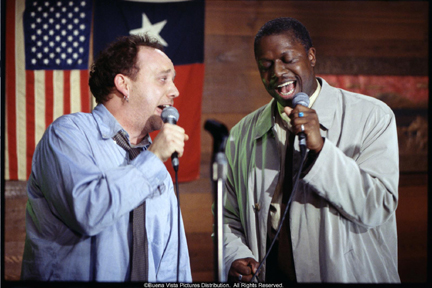
I like movies with heart. “Duets” is a movie with a big heart that nobody went to see. Well, almost nobody. Despite an intelligent, one-of-a-kind script and a star-studded cast, “Duets” tallied a mere 4.73 million dollars in domestic box office sales.* In terms of Hollywood studio economics this paltry sum is tantamount to a financial implosion.
“Duets” is (mostly) a feel-good road movie about people following their hearts and discovering who they are. I don’t see any harm in a story like that, particularly if you can add a few new twists and keep folks smiling. I thought “Duets” did both, but a lot of people disagreed.
I can find only two explanations why “Duets,” a movie I liked, was so universally overlooked by the movie-going public. Explanation 1: I have very bad taste. Explanation 2: An overwhelming number of negative reviews by movie critics cut off the hand that feeds the box office.
According to Metacritic® (www.metacritic.com) a sample of 29 professional movie critics gave “Duets” an average rating of 40 % out of 100. In contrast, a sample of twelve “Users” (people) gave the movie a rating of 8.8 points out of 10. (I realize this is a small sampling of “Users,” but let’s not forget that not many people saw this movie.)
According to this compact study then, “Duets” is a predominantly people friendly movie with an allergy to movie critics.
Here are a few typical movie critic reviews:
“Miserable as it crawls for two eternal hours towards being “life affirming.” Wesley Morris, San Francisco Examiner
“Simply creaks with contrivance—particularly in its overwrought finale.” Curtis Morgan, Miami Herald
“A leaden piece of whimsy that looks for profound life lessons among a group of karaoke bar aficionados.” Steve Daly, Entertainment Weekly
To be fair, some critics praised “Duets, as evidenced by these reviews:
“A highly likable movie.” M.V. Moorhead, Dallas Observer.
“Appealing, and ultimately moving.” Bob Graham, San Francisco Chronicle.

Now let’s hear from a few movie-goers:
“Her name was Lola. She was a show girl…dah de dah de dah. This movie was fun interesting and catchy. What is better?” James R.
“This movie is engaging, the story unfolds around the music, and Paul Giamatti is great. Apart some predictable things typical nowadays in American movies (family values, etc.), this movie is fun.” Pablo E.
“I loved it. Movie critics suck.” Stephanie R.
“The karaoke scenes were great…the film got me.” John O.
“Bette Davis Eyes…I like this song! Especially when Gwyneth Paltrow sang it.” Jiae K. (I agree with you, Jiae. Paltrow sings the song like a sultry angel in her own voice–no dubbing.)
It’s interesting to note the difference between the critical reviews and the “User” reviews. Critics, for the most part, write about the movie from a purely intellectual and artistic point of view. Believe it or not, I feel strongly this point of view does the movie-going public a disservice. For a more detailed explanation of what I mean by this, please read my earlier post, “Do Movie Critics Have a Heart?”
The people who commented on “Duets” experienced the movie in a completely different way than the critics. They connected with the movie emotionally. They had a good time. People primarily go to the movies to be entertained. I believe this is a fact most movie critics tend to forget.
Here is my own somewhat extended review of the movie.
The script weaves the stories of three sets of people into a road movie unified by the common thread of karaoke. I give the screenwriter, John Byrum, credit for coming up with this unique concept. Before watching the movie, I never knew karaoke bars existed, and people competed in karaoke competitions for cash prizes. I discovered an entire karaoke subculture and its attendant technology. One of the things a good movie will do is open a door to a world you’ve never experienced before. For me, Duets succeeded admirably in this regard.

Good music of any kind never fails to stir the human soul. This comes through in the “User review” excerpts. I found the music and the surprising singing talent of the “A” list actors showcased in “Duets” both refreshing and moving. I am astonished that movie critics, in large part, failed to respond to the musical dimension of “Duets.”
“Hard to take stone-cold sober,” writes critic Jack Matthews of the New York Daily Times.
Instead of asking, “Do movie critics have are heart,” I wonder if it might be more appropriate to ask, “Do movie critics have a heart beat?”
What about the acting? Well, Huey Lewis is definitely a better singer than actor. But I thought he basically got the job done in his role as a karaoke hustler and recalcitrant father. I have some questions about the choices Gwyneth Paltrow made in playing her role as Lewis’ long-lost daughter. I think she was going for innocent, but I didn’t feel it worked. I’d say this was the one major flaw in the film. I thought the other stars, Giamatti, Braugher, andMaria Bello all brought “A list” luster and ingenuity to their roles.
I found the three stories in the movie appealing, and yes, even insightful, some more than others. I enjoy movies that have the unmitigated gall (according to critics) to explore questions like “What the hell am I doing here?” or “What does it take to be a good person?”
I believe the emotional center of the movie revolves around the disillusioned-with-the American-Dream character of Paul Giamatti playing opposite Andre Braugher, an ex-con. Braugher (Life on the Street) brings his customary moral compass and dignity to the role, plus a singing voice you would not believe he commands if you had not heard it yourself. This can also be said for Gwyneth Paltrow, and to a slightly lesser degree, Paul Giamatti and Maria Bello.
I connected with “Duets” emotionally. Like John O said, “…this movie got me.”
I’ll close by saying it’s very hard to make a compelling, engaging movie that switches back and forth between three different stories.Yet here I am, twelve years later, still thinking about “Duets.” Am I smart or senile to like this movie? Why did it fail at the box office?” Did “Duets” make a comeback in movie rental receipts?
If you have the answers to any of these questions, I’d love to hear from you.
*September 17th to October 29, 2000. Source: Wolfram Alpha Computational Knowledge engine (www.wolframalpha.com)
 Heart Banter by David Gittlin