I started eating natural foods at the age of 21. Considering that was 42 years ago, I am somewhat of a pioneer or at the very least an early adopter.
The increasing popularity of natural foods is proof positive that human consciousness is continuing to expand. However, I am at a loss to explain how the average natural food enthusiast can afford the cost of gas and natural foods.
Wait a minute. Maybe if you eat one-and-a-half meals a day instead of three you can afford both.
Hold on. I think I’ve finallyfigured it out. Yes, this has to be the answer:
People who buy their groceries at natural food stores and continue to drive their cars no longer go to the movies.
This means that the decline in movie box office sales is NOT due to the quality of the movies coming out of Hollywood nowadays. It is due to a redistribution of disposable income into the natural food sector.
Let’s move on to a few important facts of interest that will affect your life, whether you eat natural foods or not, and whether you like it or not (the facts, I mean.)
Tofu is the natural food equivalent of Hamburger Helper.
People who eat natural foods are 37% less likely to be involved in road rage incidents when compared to a statistically relevant sample of processed food consumers.
Children brought up on natural food are 26% more likely to realize GOD at some point beyond the age of 40.
In ten years, there will be 2,719 WHOLE FOODS stores in China.
If natural food consumption continues to grow at its present rate, financial analysts predict BURGER KING and McDONALDS corporations will merge within the next seven years and the new company will attempt to buy the WHOLE FOODS chain.
Nikki and Darren (Actors Justin Nichols and Sophia Bush)
Seagulls falling out of the sky raised a line of puffs on the barren beach as they smacked into the sand.
Darren glanced upward shielding his eyes from the blazing sun. Nikki, lying on the pink towel next to him, rose on both elbows. She screamed.
More birds pelted the beach. A few hundred yards to the south, it was raining seagulls. “It’s coming this way,” he told the hazel-eyed beauty.
“Head for the water. It’s the only safe place,” he shouted.
They raced towards the incoming tide, extending their long, lean bodies over the surf. The couple pummeled the aqua water with furious crawl strokes, side by side. When they were far enough from shore, Darren pulled up, treading water. Nikki’s head broke water just as a wave rolled over her. She came up coughing and spitting water. Darren reached out. She flattened her curvaceous body against his hard torso, encircling his neck with long, slender arms.
Thunder rumbled. The waves grew higher. Darren watched in disbelief as the storm of falling seagulls engulfed the Canyon Ranch Spa and Hotel.
“The ‘Millennium Predictions’ are coming true,” Nikki gasped.
The seagull storm swallowed up the hotel. The bird-cloud mushroomed towards the sleek concrete and steel skyscraper to the north. The sky darkened. A squall rippled towards them from the macabre scene unfolding on the shore.
Darren held her tightly. “I’ll always love you, even if the world ends.”
Nikki pushed away from him with a wild-eyed expression.
“Cut,” the Director yelled from the filming platform six feet behind them.
The computer-generated effects Darren had spent hours studying the night before dissolved on the screen of his imagination. The newly built Canyon Ranch Hotel gleamed in the South Florida sun, perfectly safe as a dreamer waking from a nightmare in a comfortable bed.
He had been lost in the moment. He had made it all real. Instinct and a script two revisions old had taken over.
Darren smacked his head with an open hand. “Sorry.”
“You’re supposed to say, ‘I thought we could change the future,” the pot-bellied, bearded Director said. He pulled off his black sunglasses and glared at Darren. A gust of wind rustled his mane of graying hair. “Let’s take it from Nikki’s last line, then we’ll break for lunch.”
“Soften your expression,” Nikki told him. “You look too serious.”
One of the benefits of working with your real-life girlfriend was honest feedback.
They sat at a table for two in the crowded Spa restaurant, next to a picture window overlooking the beach. Darren munched on an under-sized grain burger with sprouts and raw carrots on the side—no dressing. Nikki played with a small bowl of whole-wheat spaghetti topped with a hint of marinara sauce—hold the parmesan cheese.
Darren reveled in the few moments of leisurely time they shared before the long night of shooting ahead of them. Two days of bad weather had thrown production behind schedule. The production crew had to squeeze six days of shooting into three. The Director expected actors and crew to stay fresh and energetic, despite the hectic schedule.
Nikki had piled her long red hair in a bun atop her head. She wore no makeup, only a thin layer of moisture cream for protection. Darren had met countless beautiful women in his acting career. Nikki was different from all of them. She wasn’t self-absorbed, and she wasn’t petty, as most of the women he knew tended to be. She read voluminously between acting roles, and was a fine painter. She could be intellectual and sophisticated or simple and playful as a happy child, depending on her mood.
She had stolen his heart shortly after they met at a wedding party eight months ago. There was only one problem. It haunted Darren day and night.
“There’s something we have to talk about, Darren darling. It’s been on my mind for the past few weeks.”
He felt an ache in his heart. He knew the issue had to come up eventually.
“Not now, Princess.”
“It makes me feel like your daughter when you call me that.”
“I can’t help it. I believe you’ve come to me from some enchanted land, or sprung up whole from a ponderous book of fairy tales.”
She stopped smiling.
“What’s wrong?” he said.
She appeared to grapple with what to say next.
“Let’s agree to hold off all serious discussions until the film wraps,” he said. “Until then, we should only try to amuse one another in the few private moments the stingy Director allows us. Now, stop nibbling at your food. Eat up. You need your strength.”
“You eat your grain burger.
“It has no taste.”
“Use your imagination,” she said.
Darren took a bite. “Mmmm. He picked up the remaining piece of grain burger and admired it as if it were the Hope Diamond. “Remind me to ask the chef how they make it taste like dried corn-stalk compost.”
He watched her turn and gaze out the window. The surf was up, reaching with long fingers, almost up to the concrete foundation of the hotel. The sun had disappeared behind late afternoon clouds. He noticed her mood remained somber.
“If you insist on being serious, you might as well tell me what’s on your mind.” He felt the ache in his chest again.
She sighed deeply. “These past eight months have been much more than I ever expected, my love.”
“There’s no reason to believe the next eight months won’t be even better,” he said in his best imitation of a well-known motivational speaker.
He had imagined this painful moment too many times. “I’m concerned about the age difference,” she would say. “What will happen when we get older?” No matter what he said in response, her words would mark the beginning-of-the-end their relationship.
“I fell in love with your humor before I fell in love with you,” she said, instead of the dreaded words he had anticipated hearing.
“And you’ve been dying to confess this to me but you didn’t know how,” he improvised.
“Don’t make this into another game.” Nikki kept staring at him with a horribly solemn expression.
“I’m not from this world,” she said.
“I’m sorry. I didn’t hear you correctly. The acoustics in here are awful.”
“Please try to believe what I’m about to tell you.”
“It’s perfect, sweetheart. Who offered you the role?”
“I’m not trying out a character, Darren.”
“Can’t we just be ourselves with the little time—“
“—I am being myself. Listen to me.”
He stared into the depths of her searching eyes. Nikki lowered her voice. “There are about a million travelers like me scattered in every country of your world.”
Chills ran through his body. “What are you talking about?”
“I’m talking about the events depicted in ‘The Millennium Predictions.’ I’m talking about a decision you have to make.”
“You’re telling me they changed the script again and didn’t tell me. They’ve cut down my role. That bastard who calls himself a Director doesn’t like me. That’s it. Isn’t it?
She stared back at him, perfectly still. “I’m not talking about the movie.”
“You can’t be an alien. I’ve kissed every inch of your body. Every part of you is perfectly, beautifully human.”
“Calm down. We’re attracting attention.” She placed a hand over his. “We have the same origin. Our ancestors seeded the galaxy with our kind millions of years ago. It was a grand experiment to study how civilizations develop in different environments. The project is also intended to ensure the survival of our genome.”
He sat there in stunned silence.
“We thought we could blend in and help your civilization grow in a more constructive direction—until recently. We’ve determined your problems are too severe. It’s too late for our help. Your civilization is a failed experiment. Our work here is finished.”
“But—“
“—Hear me out, Darren. Some of us, like me, have formed strong relationships while we’ve been here. We’re allowed to take one person back with us.” She held his hand tighter. “I want you to come with me when I leave.”
“Nikki, please, this isn’t funny. You must stop it now.”
“I’m not joking. I understand how overwhelming this must be for you. I’m asking you to be strong.”
“You’re asking me to give up everything and pop off into space with you somewhere. Why can’t you stay here with me?”
“Your civilization will most likely destroy itself,” Nikki said.
“How can you make a statement like that and sound so sure of yourself?”
“To put it in simple terms, we can chart the future of a civilizations based on socio-economic, environmental, birth rates, art, scientific measurements and other factors. Our predictive model comes from thousands of civilizations we have studied.”
Darren strained to wrap his mind around what she was telling him.
“What if you get tired of me?” The words were out of his mouth before he could stop them. His composure was melting like a sandcastle at high tide.
“Don’t be insecure,” she said.
“I’m twenty years older than you.”
“It never occurred to me. The average life span of my people is two hundred years. A twenty-five year difference in couples is quite common.”
“But I’m not going to live that long.”
“You will once you begin taking the bio-agents we’ve developed to stay young. You’re at the height of your powers, Darren. I’m offering you the chance to stay that way for at least another five decades.”
“It sounds too good to be true. For all I know, you’ll put me in a cage five minutes after boarding your ship.”
“Darling,” she said with a gleam in her eye, “we’re vegetarians, not meat eaters.”
He smiled, despite the feeling of utter uncertainty. “Do you think we can last a hundred a fifty years together?”
“Wouldn’t you love to try,” she said, deftly lowering one eyelid.
He leaned close to her. “Do they need actors on your planet?”
“Yes, my darling. You’ll have time for at least five different careers in the dramatic arts if you get bored.”
“Look at me, sitting here thinking only of myself while you’re telling me the end of the world is at hand.”
“There’s nothing you can do about it.”
“Can’t your people warn us in some way?”
“The warning signs are everywhere. Only a handful of people heed them.”
“There has to be a solution.”
“There is, darling Darren. Come with me.”
“You make it sound so simple.”
It’s not that complicated, my love. You have no children. Your parents are gone. And you’re an only child.”
“I’ve taken a lot of chances in my life. But this…I need time to think.”
“I understand completely,” she said. “We’ll talk again after the film wraps. In the meantime, don’t say a word about this to anyone. It could jeopardize my safety.”
“That’s the last thing I’d ever do.”
She looked at him with an intensity he had never seen before. “We can do this, darling. I know we can if you give it a chance. You’re the perfect man for me.”
He squeezed her hand, kissed her, and walked out of the restaurant on unsteady legs.
The woman known to Darren as Nikki turned to watch the sunset through the picture window. The orange sun plunged into the ocean surrounded by a bevy of pastel pink clouds.
Darren was perfect, she thought—bright, handsome, hardy, talented and most importantly, virile. His sperm count ran off the charts. She had tested it herself with a kit hidden in her dressing trailer. It was a miracle the man hadn’t accumulated a brood of children inside or outside of marriage. She guessed it was due to his exemplary character. He didn’t believe in having children if he wasn’t going to be there for them as a proper parent.
It was ironic that Darren was destined to father thousands of children though he didn’t know it yet. He was going to be on the star ship with her one way or another. Preferably, Darren would decide he couldn’t live without her and leave voluntarily. That way, she could break the news to him gradually during the journey to his new home. He would have time to adjust to the idea of becoming an alpha breeding male for her dying race.
She regretted lying about the nature of her mission and the prospect of her lover living another hundred and fifty years. Even with the bio-agents, the strain of steady breeding would shorten Darren’s life span considerably. But there were much worse fates in the universe than sleeping with gorgeous women like herself who possessed brilliant minds and a multitude of fascinating professional abilities.
The new job came with an array of attractive benefits. Aside from his conjugal duties, Darren’s schedule would include a healthy chunk of time in a classroom to avoid his becoming a conversational bore. Good conversation before mating improved the conception rate dramatically.
To avoid psychological problems, Darren would continue his career in the dramatic arts on her planet as she had promised, under careful supervision of course. She might even be his “girlfriend” for a while to make the transition smoother. Yes, Darren would adjust and eventually thrive in his new role. His qualities of optimism and flexibility almost guaranteed it.
The more she thought about it, the more good ideas came to her for selling the new role to Darren. When you sat back and added it all up, she believed he was a lucky man. This was especially true, considering his slim chances of survival on the sordid, troubled world he would soon be leaving behind.
The Adventure Project set an ambitious goal. Blog writers and their readers worldwide responded with enthusiasm, compassion and generosity.
The idea came to Becky Straw and Jody Landers, Co-Founders of the Adventure Project, from members of their organization, known affectionately as “The Tribe.” One week before World Water Day (March 22nd) blog writers proposed a challenge to raise $10,000 in one day by promoting The Adventure Project’s latest initiative: repairing broken water pump handles in northern India. The anticipated results of the initiative are twofold. By bringing wells that have fallen into disrepair back into use, 300 more people per month (3,600 per year) will have access to clean water. In addition, the initiative will provide training and jobs to enable unemployed people to lift themselves out of poverty.
A Pump Mechanic Rides to Her Next Job
Becky thought the tribe members might be able to recruit 50 bloggers to promote the fundraising effort. Jody, an eternal optimist, suggested 100 bloggers. One week later, 137 bloggers had signed up to participate. As the final seconds of World Water Day elapsed, the amount raised reached $11,390. Donations are still rolling in, by the way. All funds collected go to WaterAid, a charity that takes a unique approach to providing the poorest communities with potable water.
“It all came together like magic,” Becky reports. She asked her friend and colleague, Nicole Skibola, to find a company that might be willing to provide matching funds to the promotion. In her role as a “Social Innovation Strategist” with Apricot Consulting in New York City, Nicole works with corporations to create and execute effective programs for social change. A former attorney, Nicole also serves as a “Social Enterprise Advisor,” for the Adventure Project.
Nicole e-mailed a list of her friends and business contacts in an effort to locate a matching funds sponsor. Kathya Bustamante’s name happened to be on the list from a position she previously held with UBS. Kathya, among other interests, now volunteers for TPRF as Manager of the Fundraising Team. Kathya recognized a common thread between both organizations: “Clean Water” and “Dignity.” She forwarded Nicole’s request to decision makers at TPRF. Within twenty-four hours, TPRF committed to providing up to $10,000 in matching funds. “Awesome,” Nicole commented in an e-mail to Becky and Kathya, “the fastest foundation response in history.”
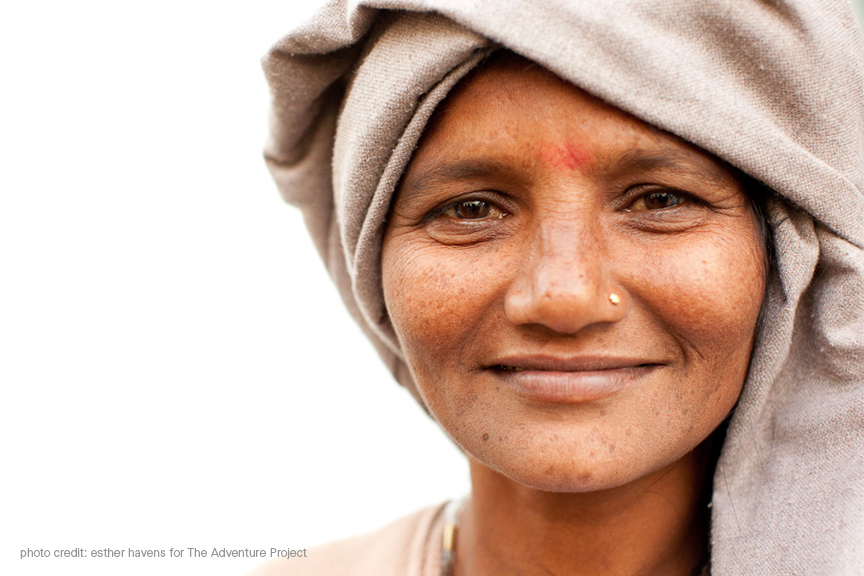
Northern Indian Woman
One final footnote—Although TPRF agreed to provide up to $10,000 in matching funds, we surprised the girls by cutting a check for the full amount of the funds raised on World Water Day: $11,390.
“Your response was so amazing and so responsible,” Becky said about TPRF’s participation.
*Photos courtesy of Esther Havens for The Adventure Project
The words resounded against the dripping walls. “Shut up. Shut up. Shut up.”
Blood trickled from the corners of Trevor Hartigan’s mouth. His awareness flickered from the pain coursing through his broken fingertips to the oppressive heat in the room, to the crooked expression on the interrogator’s ugly face.
“If you lie to me again, you’ll beg me to kill you after what I do next,” the Confessor snarled, baring his nicotine-stained teeth.
Trevor’s spine ached from about a half-hour of confinement lashed to a straight-backed wooden chair. The duct tape wrapped tightly around his upper body dug into his back and chafed the skin on his abdomen. It seemed he had been sitting in this tiny dungeon for hours. He cursed himself for whatever carelessness had landed him in this predicament. He suspected it was the girl. He had let down his guard in a moment of weakness. Blanca had to be one of their spies. He worshiped her, had asked for her hand in marriage, and she had betrayed him.
He focused on the gap between his tormentor’s chipped front teeth. The gap reminded him of a missing board in a white picket fence. He imagined crawling through the hole in the fence to freedom.
“Save your energy and kill me now,” Trevor said in a low voice.
The pain in his body only served to sharpen his mind and resolve. He carefully hid this fact with every word out of his mouth, every subtle gesture. He had to convince the Confessor he was telling the truth.
“I’m a professional, Hartigan. I’ve seen every trick in the book.” The Confessor picked up a scalpel from a row of surgical knives glinting on a steel tray next to Trevor. “You’ll tell me what I need to know or I’ll cut out your eye. I want the names of your confederates.”
Beads of sweat ran from Trevor’s forehead. He blinked reflexively to keep the moisture from stinging his eyes.
“I’m a loyal citizen of the Conglomerate, Brother Confessor. I’ve been falsely accused by inferior minds jealous of my position.”
“You are a traitor and a fool, Hartigan. You enjoyed wealth and privilege as the Conglomerate’s Master Architect. You had the opportunity to design buildings that would have lasted for centuries. Your fame would have spread around the world. You threw it all away when the girl convinced you to join the resistance.”
The Confessor ripped off his cowl. His head began to transform into the head of a Praying Mantis. Long, spindly legs sprouted underneath the Confessor’s navy blue robe. The garment burst apart as the insect grew taller. The roof of the room suddenly blasted skyward, as if it were the second stage of a rocket.
Trevor was so terrified his heart nearly stopped beating. Blanca had told him the resistance knew very little about the aliens due to the group’s limited resources. Trevor imagined no amount of training or preliminary briefing could have prepared him for what was happening before his bleary eyes.
The Confessor-turned-insect continued to grow past the height of the former ceiling. Trevor stared upwards just as the giant creature’s claw reached down to pluck him out of the cell, chair and all. He turned away, unable to look at the monster’s bulging eyes and chewing mandibles. He felt certain the Mantis was preparing to eat him alive.
Looking down from the twenty-foot high vantage point in the giant insect’s grasp, Trevor saw a honeycomb of cells on the ground similar to the one he had occupied seconds ago. On either side, a straight rock face soared hundreds of feet from a makeshift pine wood floor. It was hard to make out more details in the bluish-gray light emanating from a source somewhere above them.
Trevor figured the interrogation installation had been carved out of a massive cavern somewhere underneath the city. A huge construction crane positioned in the middle of the complex plucked the triangle-shaped roof off another interrogation cell with its multi-story steel arm. Another poor soul was about to be scared further out of his or her wits, it appeared.
Trevor thought of Blanca again. It was impossible to keep her out of his mind for more than a few minutes since the time he had met her. How could she have done this to him?
“The girl isn’t a double-agent, as you suspect,” the giant Mantis said. She will be arrested soon after she leads us to more members of the resistance.
How could the creature know he was thinking of Blanca?
“To answer your question, I can read a human mind when I get in the same room as one. Your thoughts during our session have revealed most of the useful information you have to offer. This final stage of the interrogation process makes any remaining secrets as easy to suck up as fresh meat off a dry bone.”
All of the nerve-endings in Trevor’s body went numb. “I’m glad Blanca showed me I was working for a race of alien monsters instead of what I thought was a multi-national energy corporation.”
“You are the monster,” the Mantis said. “The Conglomerate will soon be well established in every country of this world as more of us arrive. In ten years, it will no longer be necessary for us to transform into human form. The human race will cease to exist.”
Trevor heard his bones cracking as the creature’s claw closed around him.
He screamed.
“Shut up.” The harsh voice came from far away.
Trevor’s eyes opened. The first thing he saw was the gray ceiling of his solitary jail cell. He rolled off the bunk bed and sank to his knees on the cold concrete floor. The smell of disinfectant and urine filled his nostrils. He moaned.
“Shut up, goddammit.” The guard appeared on the other side of the bars dressed in a gray shirt and olive pants. His right hand rested on the .38 revolver strapped to his waist.
All of the colors in this hellhole are drab, Trevor thought. It seemed like a lifetime had passed since he had taken to wearing bright colors shortly after meeting Blanca. After a year of dating, they had decided to marry. He had never been happier in his entire life.
“Quiet down and go back to sleep,” the guard said. “You make any more noise an’ I’ll call the shrink back in here to shoot you up with sedatives. You’re gonna’ learn to settle down and do your time quietly, if it takes a fist in the teeth to teach you how. You got that?”
“Yeah,” Trevor croaked.
The guard stepped away. His boots made a hollow echo down the concrete and steel corridor.
They had placed him on suicide watch. He had tried to hang himself with a belt. They stripped his cell of anything he might use to end his life. Padding protected the walls of his eight by ten foot cell. He had no such protection against the recurring nightmares and the memory of the accident. That night replayed in his mind like an endlessly looping horror film.
They had gone out with some friends to celebrate the latest job offer. He remembered Blanca pushing back her silky red hair and laughing gaily all night long. They drank and ate at the South Beach bar and restaurant until two o’clock in the morning. The hours swept by and the drinks went down without Trevor taking much notice. When the time to leave arrived, Trevor was too embarrassed to admit he was higher than a kite.
At first, Trevor thought an animal crossing the road had hit the front tire when he heard the thunk on Blanca’s side of the car. Blanca turned to him, wild-eyed. He had never seen the pedestrian jaywalking across the deserted street. Trevor had been speeding through the residential neighborhood to make it home in time to get a few hours of sleep before his nine A.M. job interview. He never made it to the interview.
The victim was a man in his early thirties, the father of three children. His wife was waiting for him across the street at the front door of their home when the accident occurred. She told the police exactly what happened. The man died from a brain hemorrhage on the way to the hospital.
He had dreamed about a career in architecture from boyhood. After completing Architecture School with honors, he had received job offers from the top firms in Miami. He looked forward to bringing beautiful buildings and bright, creative children into the world with the passion he felt for his work and his soul mate, Blanca.
Now, all he had to look forward to was a fifteen-year prison sentence. After the accident, Blanca wanted no part of him. His future as an Architect looked dim at best. What firm worth its salt would hire an inexperienced, middle-aged man with a felony record?
One careless act. One night of celebration. A single, poor decision. The lives of six people tragically altered forever. If he had the chance, Trevor would gladly change places with the man he had accidentally killed. But now, it was too late for remorse.
David Gittlin has written three feature length screenplays, produced two short films, and published three novels. Before quitting his day job, he spent more than thirty years as a marketing director building expertise in advertising, copy writing, corporate communications, collateral sales materials, website content/design and online marketing.
The earth is one big ecosystem. Think of it as a human body. Every cell, every organ, every system of organs is interdependent. Think of the water in the earth’s rivers as blood in the body’s circulatory system. What happens to the body when infection invades the blood stream? What happens when the body cannot produce enough cells to maintain a sufficient, systemic blood level? The answer, of course, is illness.
Industrialization, urbanization, and global warming have adversely affected the rivers of the world. Pollution and insufficient water levels pose a serious health threat to all life in the surrounding regions. The problem is common to big cities as well as rural areas. The best way to illustrate this point is to cite specific examples.
From approximately 1947 to 1977, the General Electric Company poured an estimated 1.3 million pounds of polychlorinated biphenyls (PCBs) into the Hudson River from manufacturing plants at Hudson Falls and Fort Edward.
The health of area residents is at risk due to the accumulation of PCBs in the human body caused by eating the river’s contaminated fish. Since 1976, high levels of PCBs in fish have led New York State to close various recreational and commercial fisheries and to issue advisories restricting the consumption of fish caught in the Hudson River. PCBs contain carcinogenic substances known to stimulate the growth of cancer cells in humans. Additional adverse health effects include low birth weight, thyroid disease, nervous and immune system disorders. PCBs in the river sediment also affect fish and wildlife.
Runoff in urban and rural areas can easily affect a river’s health, putting local wildlife and human life at risk. Nitrates from fertilizers and pesticides collect in rainwater draining from surrounding land into rivers. These chemicals stimulate the growth of algae, throwing delicate, ecologic relationships out of whack. The result is a clogged, dysfunctional river system.
Runoff from acid rain and rain falling through polluted air is another source of contamination. A recent report states that pollution from urban runoff has become the Potomac River region’s fastest-growing water quality problem, threatening the quality of drinking water for 86 percent of local residents.
Several Abandoned mines located in England and Wales have caused significant pollution in nearby rivers. Dangerous metals such as iron, aluminum, tin, lead, mercury and cadmium from old mine workings contaminate drinking water extracted from regional rivers fed by polluted tributaries.
Phosphorous from detergents in sewage flushed into rivers is another dangerous pollutant. The chemical stays in the system for a long time, threatening plant life by taking up oxygen and poisoning the drinking water of animals and humans alike. The impact of a slow buildup of river pollution in a wide area can be devastating. In the 1950’s, the otter population in England was nearly wiped out by the accumulation of toxic wastes in major rivers throughout the country.
Rising weather temperatures caused by global warming have had a dramatic effect on fresh water levels in rivers around the world. Persistent drought conditions in Australia’s major farming region, the Murray-Darling river basin, threaten the nation’s food supply. The Murray-Darling crosses most of southeastern Australia and is one of the region’s most important river systems. It provides water for growing 40 percent of the nation’s vegetables, fruits, and grains.
Corey Watts, of the Australian Conservation Foundation in Melbourne, told reporters that drought conditions were becoming the norm in the area instead of occurring once every 20 to 25 years.
“We’ve had a string of official reports over the last fortnight painting a pretty grim picture for the climate and the future of our economy and our environment,” Watts said. “So now we’re looking at a future in the next few decades where drought will occur once every two years.”
The 2,000 year-old Yamuna is a river that “fell from heaven,” according to Hindu mythology. The residents of New Delhi worship the river and depend on it for life. Residents tossing coins and sweets into the river, or scattering the ashes of dead relatives from bridges jutting across the waters are a common sight. Unfortunately, the actions of the citizenry and the New Delhi governmental water board do not coincide with this feeling of reverence.
As the Yamuna enters the capital city, its waters are still relatively clean after a 246-mile descent from atop the Himalayas. New Delhi’s public water authority, the Jal Board, extracts 229 million gallons from the river daily for drinking water. As the river leaves the city, residents pour an average 950 gallons of sewage into the Yamuna every day.
As it winds through India’s capital city, the Yamuna transforms into a filthy band of black ink with clumps of raw sewage floating on the surface. Methane gas bubbles to the surface. The river is hardly safe for fish, let alone bathing or drinking water.
A recent government audit condemned the Jal Board for spending 200 million dollars on the construction of sewage treatment plants with minimal results. One of the city’s Pollution Control Board Directors said the situation “has not improved at all because the quantity of sewage is always increasing.” The regular occurrence of power failures adds to the problem.
The above examples are only a tiny representation of the problem. The health of the world’s rivers and their effects on plant, animal, and human life is a complex problem difficult to summarize in one short article. Governmental water management boards worldwide are struggling to deal with the problem now to avoid catastrophic water shortages in the next twenty years. Bold, new initiatives are under consideration along with traditional methods. One point is clear, however. Change in the way we treat the environment, collectively and individually, is essential.
The new movie, “The Day the Earth Stood Still,” explores this theme. The story posits the theory that painful and necessary change can occur when it becomes obvious that doing things the same old way will lead to certain destruction. Certainly, we have reached this point with respect to the environment. Two questions remain. Will we change? Can we change in time to prevent a complete breakdown of the earth’s life sustaining ecosystem?
Sources: Gertner, Jon, “The Future Is Drying Up,” Time Magazine, October 21, 2007; Government of Australia — Waters and Rivers Commission, “Water Facts,” July 1997; Sengupta, Somini, “In Teeming India, Water Crisis Means Dry Pipes and Foul Sludge,” The New York Times, September 26, 2006.
Modern India is much like a newly minted land mass; cooling on the surface while bubbling with volcanic activity underneath. Red-hot economic growth masks the nation’s underlying socio-political problems.
The utter economic desperation of Indian pastoralists has provided verdant soil for Marxist Leninist ideas to flourish in rural hamlets. Maoist guerillas recruit these tribal villagers in their crusade to replace the Indian Democratic Republic with a socialist state by means of armed insurrection. The urban-centered Indian press has chosen to downplay this story, preferring instead to focus on the country’s recent industrial boom. Manmohan Singh, India’s Prime Minister, stands apart from the Indian Establishment in his assessment of the matter. He calls the Maoist guerilla activity “the biggest internal security threat” the country faces.
The Maoist activists, known as “Naxolites,” have found a receptive audience in the Indian pastorals, known as “Tribals,” for two major reasons. The Tribal population of eighty million is the most disadvantaged segment of Indian society. Twenty-three percent of them are illiterate. Another fifty percent lives below the poverty line. In addition, the Indian Government, acting solely in its own interests, has expropriated Tribal land rich in minerals and other natural resources. The politically powerless Tribal people have nowhere to turn, except to the Naxolites, who press them into bands of roving militias, hunted and killed by government forces.
The Tribal people are not alone in their economic and political plight. A relatively thin veneer of privileged middle and upper class citizens covers a population of more than eight hundred and fifty million people who exist on two dollars a day or less. India’s corrupt and overly bureaucratic government cannot begin to cope with the nation’s staggering poverty. The outdated Indian caste system makes it more difficult for the poor to improve their lives. The predicament of India’s massive underclass is a persistent disease that constantly threatens the future well-being of the country’s entire society.
Another flashpoint of tension within India’s borders is the struggle with Pakistan for control of the Kasmir territory. After India won its independence from British rule, the country’s princely states enjoyed the freedom of choice to join either India or Pakistan. The Maharaja of Kashmir chose to join India because he was a Hindu. This decision was a bitter pill to swallow for the majority of the Kashmiri people who are Muslims. The agreement to annex Kashmir included a provision for a plebiscite to confirm the Maharaja’s decision. India never allowed the plebiscite to occur.
These seeds of conflict have erupted into three wars between India and Pakistan over control of this beautiful, northeastern territory. Tension has escalated even higher with the acquisition of nuclear weapons by both countries. In addition, militant Islamists in the territory are waging a bloody struggle for an independent state of Kashmir. With the separatist militants folded into the mix, the situation is as unstable as homemade nitroglycerin.
The conflict in Kashmir is indicative of a deeper, more serious problem; an innate hatred and distrust between Indian Hindus and their Muslim counterparts. This centuries old antagonism is rooted in religious intolerance. The rift began when Islamic fundamentalists invaded India in the sixth century. A noted scholar deemed this war as “probably the bloodiest in history.”
There is a basic incompatibility between the aggressive, xenophobic tenants of Islam, which proclaims Allah as the only God, and the polytheistic nature of Hinduism. Throughout the history of India’s independence movement, a series of political clashes between Muslims and Hindus echoed the animosity between the two groups. Even a great leader like Mahatma Gandhi failed to generate lasting cooperation between these factions. Splitting off Pakistan from India as a separate Muslim state has similarly failed to provide a solution. The hatred and distrust doggedly endures.
Undoubtedly, India faces major challenges in its quest for a peaceful and prosperous future. Surely, a more streamlined and efficient government would provide part of the answer. However, it is the people of India themselves who must learn to cooperate and share with one another to move forward into a brighter future.
Smart, observant children can learn from the mistakes of their parents. In the case of Iraq, it is the child ignoring the wisdom of the parent.
One can imagine George Herbert Bush’s military advisors telling him not to go after Saddam Hussein in the Gulf War. Overthrowing Hussein, the advisors explain to the erstwhile president, will create a power vacuum and a country splintered by bloody civil war. In addition, the advisors remind the president that the United Nations has not issued a mandate allowing military forces on the ground to topple the Hussein government. George Herbert Bush decided to listen to his advisors and obey the will of the international community. It was not a popular decision at the time.
In retrospect, it is obvious to even a casual observer that our incumbent president was itching to finish what his father started. George W. Bush figured he could secure his place in history by exporting democracy to Iraq with an iron fist. The results have been catastrophic for the Iraqi people and the citizens of the United States.
Here are the simple facts. Despite opposition from international and domestic leaders, President Bush convinced enough people in government to green light the invasion of Iraq. The military intelligence used as a pretext for the invasion turned out to be bogus. Five years later, the war rages on. Thousands of U.S. Military personnel have died or have received serious, life-changing injuries. Thousands of innocent Iraqi citizens have needlessly lost their lives or suffered serious wounds. More than five million Iraqi refugees have lost their homes, jobs, and entire way of life.
No one in the United States government wants to take responsibility for this destruction. It is now the responsibility of the people in this country to do the right thing.
Nothing speaks more eloquently about the suffering the war in Iraq has caused than the stories of the refugees themselves. Kareem, a history professor, suffered disfiguring wounds to his face when American airplanes bombed the University where he teaches. Forty-five students and teachers died when the second floor of the building collapsed into the first floor. More than a hundred people reported injuries from the attack.
“The Americans are a peaceful and honest people,” Kareem says. “That’s what I’ve seen through the television. They refused the war and this war has been destructive to both countries…For the last four years, it has gone from bad to worse.”
Ahmad worked as a loyal employee of the US Coalition Forces in Iraq. He bonded with the Marines he worked with as a translator and cultural liaison. He felt as if the Marines had become his family. After a Shiite militia murdered his fellow translator and friend, Ahmad fled the country in fear for his own life.
This story is all too familiar to seven thousand other young Iraqis who worked faithfully in official capacities for U.S. troops in Iraq, mostly as translators and cultural advisors. Insurgent factions have marked these young Iraqis for death. The United States Government refuses to grant visas or political asylum to these former employees.
Hiba is a young woman who fled Iraq with her family a few months after the war began. Jordan’s government denied asylum to this family of seven. They spent four years living in a tent in Ruwayshed, a refugee camp on the border of Iraq and Jordan.
Unfortunately, Hiba’s story is similar to the experience of a majority of Iraqi refugees. Syria, Lebanon and Jordan routinely deny access or status to homeless families and refugees fleeing from religious or political persecution from within their own country. There is no government infrastructure or private sector relief programs established in bordering countries to deal with the refugee crisis. The situation is analogous to the Jewish refugee crisis after World War II when more than four million people lost their homes and way of life in the Holocaust.
These are but a handful of the refugees stories. There are thousands of stories, many too horrible and brutal to imagine. We are the only source of help the Iraqi refugees can call on at this time. “The List,” an independent citizen action group, helps Iraqis living under the threat of death to find safe haven outside of the country. UNHCR, the U.N. refugee agency, urgently needs funding. This agency relies on private contributions for over 95% of its budget. To find out how you can support organizations like these, please visit http://www.iraqirefugeestories.org/
“It’s not going to happen.” This will be the short and tragic answer to the question if governing bodies throughout the world continue to side-step the troubling reality of our planet’s shrinking fresh water supply. The challenges of global warming, pollution from industrial waste and sewage disposal, and the deterioration of water delivery systems must be faced now in order to avoid a worldwide water crisis within the next ten to fifteen years.
As the world population grows, more fresh water is needed for drinking water and sanitation. As a result, the water available for agriculture and industrial uses is plunging below demand levels. The effects of global warming are causing water shortages and droughts in Africa, Asia and the Middle East. Water mismanagement by government agencies adds to the shortages. Dumping treated and untreated human waste into bodies of water is a suicidal policy that is reducing the worldwide fresh water supply on a daily basis. Poisonous industrial waste products continue to find their way into lakes, rivers, streams and aquifers.
The world’s supply of fresh water hasn’t increased since biblical times. We’re destroying an irreplaceable commodity essential to life while increasing demand at an uncontrolled, alarming rate.
While 75 percent of the earth’s surface is covered by water, only 2.5 percent of it is fresh water. O.3 percent of the fresh water is found on the surface. The balance is buried deep underground.
The burgeoning water crisis is not confined to third world countries or the desert nations of the Middle-East. In Atlanta, Georgia for example, there are days the tap water is so murky residents are afraid to bathe in it much less drink it, even though city officials claim the water is safe. The discoloration of the water is a result of under-serviced mains and pipes, many more than a century old, reaching the end of their useful life spans. When pipes in a water delivery system crack or break, dirt, bacteria, and other pathogens are sucked into the complex underground arteries of a system like Atlanta’s. The problem is usually handled by flushing out the contaminated pipes and upping chlorine levels in each, isolated instance. Few Officials see this as a viable solution for the future. Atlanta’s water problems exemplify similar situations in major cities across America. The Country’s water delivery systems are failing due to old age. A massive infusion of capital (100 to 150 billion dollars per city) is needed to install new systems.
Most of us are too consumed with our daily struggle for existence to worry about global problems like the water crisis. This has to change. Citizens of every country in the world have to take steps to force their governments to enact social programs and legislation to address the water crisis right away in order to avert a catastrophic decline in the quality of life we have become used to.
The situation is bad enough already. One person out of six people alive today doesn’t have easy access to a safe, fresh water supply. Two out of six people in the world (approximately 2.4 billion individuals) do not have access to adequate sanitation facilities. This increases the instance of water-borne diseases astronomically. One child in the world dies every fifteen seconds due to a water-related illness. Studies have estimated 443 million school days are lost each year due to water-related diseases. Half of the world’s hospital beds are occupied by patients suffering from water-related health problems. 1.8 million Children die each year from diarrhea. Millions of women and children in under developed countries are forced to trek long distances every day to collect water from sources that are often polluted.
It will take unprecedented cooperation between world governments to solve the world-wide water crisis. But the effort has to begin with individual citizens. Governments will not move quickly enough unless there is a loud outcry from the people most affected — you and me.
Let’s take the issue of carbon dioxide emissions for example. The U.S. Government has been too slow in lowering emissions standards. We would all be driving cars running on hybrid and even non-gasoline based fuels today if the original schedule for emissions reductions had been adhered to. We face the imminent threat of crop failures, coastline flooding, extensive droughts, and other serious problems resulting from global warming because this issue has not been managed properly by our government. It is not a problem of adequate technology. It is a problem of mandating change.
Another issue world governments are avoiding is the disposal of raw sewage. We need an environmentally friendly method of treating and disposing of human waste. The necessary funds can be raised and the technology implemented quickly if people force their governments to mandate change.
We need more projects like the “One Water” documentary film sponsored by the University of Miami to raise public awareness of the growing world water crisis. In addition, governments and people around the world must cooperate in developing educational programs, incentive programs, and the distribution of birth control devices to slow population growth to a responsible rate.
Cooperation, innovative ideas, comprehensive solutions, and immediate action are required. We must not put off until tomorrow what desperately needs to be done today.
David Gittlin has written three feature length screenplays, produced two short films, and published three novels. Before quitting his day job, he spent more than thirty years as a marketing director building expertise in advertising, copy writing, corporate communications, collateral sales materials, website content/design and online marketing





 Heart Banter by David Gittlin